Taliban Publicly Flogs Woman & Man In Takhar
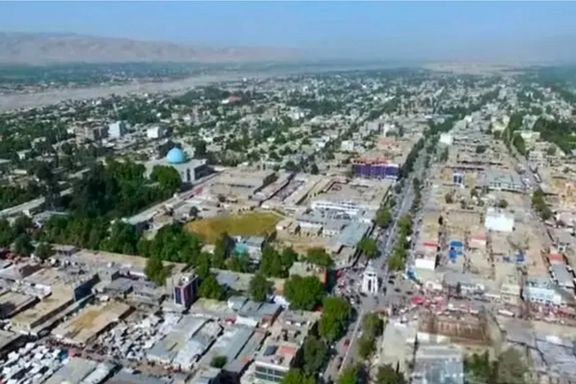
The Taliban's Supreme Court announced the execution of 39 lashes on a woman and a man in Farkhar district of Takhar province.
The Taliban's Supreme Court announced the execution of 39 lashes on a woman and a man in Farkhar district of Takhar province.
The court said in a statement Monday that the individuals had been convicted of extramarital sex.
In a statement issued on Monday, November 4, the court said that a woman and a man were flogged in the courtyard of the municipality of Farkhar district of Takhar province.
On Monday morning, the Taliban's Supreme Court also announced the execution of another woman in the Kuz Kunar district of Nangarhar province on charges of "running away from home”.
A recent UNAMA report shows that the group has flogged 95 men and 16 women across Afghanistan on various charges in the past three months.
Corporal punishment carried out by the Taliban in Afghanistan is not limited to flogging.
Recently, the Taliban's Supreme Court announced that since August 2021, five people have been executed in the country, and 30 more death sentences are awaiting final approval by the group's leader.

The Taliban's Supreme Court announced in a statement on Monday, November 4, that the group had flogged a woman in Nangarhar province.
According to the Taliban's court ruling in Kuz Kunar district of Nangarhar province, the woman was flogged 39 times in public for "running away from home”.
The Taliban's Supreme Court said that the woman was flogged in the presence of a number of Taliban officials, mullahs, and the public.
The Taliban's court statement said that the group's mullahs spoke about the "value of hudud and punishment" after the woman was flogged.
The United Nations political mission announced in its quarterly report last week that the Taliban have handed out corporal punishment to 111 people, including 16 women, across Afghanistan in the past three months. UNAMA said that the Taliban flogged these individuals individually and sometimes in groups on various charges.
Abdul Mateen Qani, the spokesman for the Taliban's Interior Ministry, announced the formation of a mobile motorcycle patrol group in Badakhshan.
In a note on social media platform X, Abdul Mateen Qani wrote that this group of 100 people have been equipped with "advanced military equipment”.
The Taliban official wrote on Sunday, November 3, that this mobile motorcycle group will operate round the clock.
Qani stated that the purpose of forming this mobile group is to prevent criminal activities.
According to details provided by the Taliban's Interior Ministry spokesman, the 100-member mobile group is operating in the security districts of Faizabad city and other districts of Badakhshan province.
Since the Taliban's return to power in August 2021, Afghanistan has received a total of about $6.7 billion in aid, the UN Office for the Coordination of Humanitarian Affairs (OCHA) reported.
OCHA warned that aid cuts could jeopardise gains and increase food insecurity and poverty in the country.
In a report published on Sunday, OCHA explained that most of the aid came in 2022, with resources peaking at nearly $3.3 billion.
The aid comes amid an unprecedented increase in poverty, economic crisis, political collapse and the risk of health system collapse.
The organisation spoke of the positive effects of international aid on poverty reduction and the humanitarian crisis, adding that "Afghanistan remains extremely vulnerable to natural disasters, climate change and geopolitical developments”.
Referring to the Taliban's Law on the Promotion of Virtue and Prevention of Vice, OCHA expressed concern over the increasing restrictions on Afghan women and girls, calling it a sign of the human rights crisis and protection risks in the country.
The organisation stressed that international efforts have prevented famine and the number of vulnerable people has decreased. The absence of active fighting in the country has also facilitated better access and identification of needs in remote areas, OCHA said.
The organisation has warned that if the budget level is reduced, humanitarian gains will be quickly lost, and the vulnerable people of Afghanistan will once again face more suffering and damage.
Some observers have said that the Taliban members are misusing international humanitarian aid and interfering in its distribution.
Following the meeting between the Maldivian ambassador Mohamed Thoha and a Taliban diplomat in Pakistan, the Maldivian Foreign Ministry announced that the meeting took place without their permission and approval.
The ministry said that it was acting in accordance with the procedure of the UN Assembly and recognised Afghanistan's representative to the United Nations as the representative of the legitimate government of Afghanistan.
The Taliban's embassy in Islamabad on Saturday had announced a meeting between the chargé d'affaires of the embassy, Sardar Ahmad Shakeeb, and the ambassador of the Republic of Maldives to Pakistan, Mohamed Thoha.
After the meeting, the Maldives Foreign Ministry said in a statement on Sunday that in international relations, it acts in accordance with the procedure of the United Nations General Assembly regarding the person representing a state. The ministry stressed that in accordance with this procedure, the Maldives recognises Afghanistan's representative to the United Nations as the representative of the legitimate government of Afghanistan.
The Maldives Foreign Ministry stressed that "the recent meeting between the Maldivian ambassador to Pakistan and the Taliban representative in Islamabad took place without the approval of the Maldivian government”.
According to the statement, after the meeting, "appropriate measures have been taken by the Maldivian government," however, the Maldives Foreign Ministry did not elaborate on the measures.
On Saturday, the Taliban's embassy in Islamabad quoted the Maldivian ambassador as saying that the country "as a brotherly Muslim country, wants strong and close relations with Afghanistan”.
The Taliban's embassy quoted the Maldivian ambassador in Islamabad as saying that he expressed hope that they would be able to establish transit and trade relations with Central Asian countries through Afghanistan.
The Taliban diplomat said that the group wants constructive relations with all countries and is trying to turn Afghanistan into a regional connection point with economic-oriented policies.
The Maldives is an island country in the Indian Ocean, consisting of 1,192 islands, and is known as a tourist destination famous for its beautiful beaches and crystal clear waters.
So far, no country has recognised the Taliban, and the United Nations General Assembly has refused to accept the Taliban's representative. Nasir Ahmad Faiq, Afghanistan's Acting Representative to the United Nations, is present.
The international community has conditioned the legitimacy of the Taliban on the observance of human rights, the formation of an inclusive national government, the observance of women's rights, especially the right to education and work, and the fight against terrorism.
The Iran Human Rights organisation has reported a significant rise in the executions of Afghans in Iran since the Taliban regained power, with 90 Afghans executed in the country since 2022.
The organisation noted that, in the past month alone, 13 Afghans were executed in Iran on various charges.
Statistics from the organisation indicate that 49 Afghan citizens have been executed in Iranian prisons this year.
The Taliban has yet to respond to the reported executions of Afghan citizens in Iran.
On Saturday, Iran Human Rights released its monthly report, warning of a surge in executions by the Islamic Republic amid escalating tensions with Israel.
The organisation disclosed that in October alone, the Islamic Republic executed 166 individuals, including 13 Afghans, across various charges. This represents the highest monthly execution count since 2007.
The report stated, “Following the presidential election and the onset of new tensions between Iran and Israel, the pace of executions has intensified.”
According to the report, since President Masoud Pezeshkian’s term began, at least 353 people have been executed in Iranian prisons over August, September, and October.
In October alone, executions included 13 Afghans, six women, 11 Baloch, nine Kurds, and one Iranian-German citizen.
The report detailed that, during this period, 80 individuals were executed for “premeditated murder,” 64 for drug offences, 12 for “enmity against God” or armed rebellion, and 10 for rape.
The report further highlighted an increase in executions of Afghan citizens in Iran following the Taliban’s rise to power. It recorded 16 Afghan executions in 2022, 25 in 2023, and at least 49 this year.
The organisation also reported that one prisoner with mental health issues, who had a history of hospitalisation, was executed in October, with two other individuals executed publicly.
Mahmood Amiry-Moghaddam, Director of Iran Human Rights, urged, “The international community and countries with diplomatic ties to Iran must take this warning seriously and respond firmly to prevent larger-scale atrocities by the Islamic Republic.”
The organisation noted that, of the 166 executions carried out last month, only 20 were reported by Iranian media.