Taliban Publicly Flogs Woman & Man In Parwan
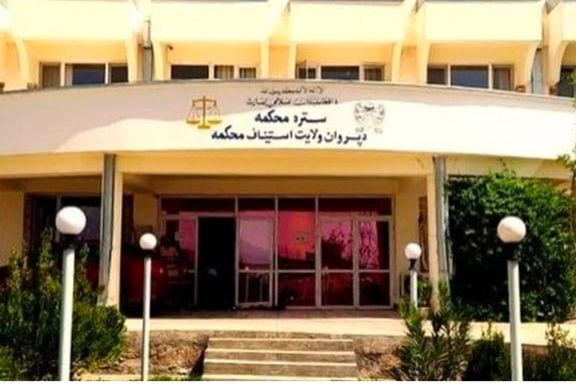
The Taliban's Supreme Court announced that the group's primary court in Bagram district of Parwan province had flogged a woman and a man on charges of having extramarital affairs.
The Taliban's Supreme Court announced that the group's primary court in Bagram district of Parwan province had flogged a woman and a man on charges of having extramarital affairs.
The court said that the defendants were sentenced to three years in prison and sentenced to 39 lashes.
The Taliban's Supreme Court announced in a statement on Wednesday, November 6, that the two defendants were sentenced to flogging in the presence of local officials, court clients, and the general public.
On Tuesday, November 5, the Taliban's Supreme Court announced the flogging of at least 27 people in Kabul, Maidan Wardak, Paktika, and Jawzjan provinces.
According to reports from the Taliban's Supreme Court, the group has publicly flogged more than 40 people in various provinces of Afghanistan in the past week.
This comes as international human rights organisations have repeatedly called on the Taliban to stop corporal punishment and torture of defendants. The Taliban, however, has continued to publicly punish the accused.
The Taliban consider the implementation of the public flogging sentence to be one of the orders of "Islamic Sharia".

After Donald Trump declared his victory in the US presidential election, the presidents of the European Commission and the Council of Europe and a number of European leaders congratulated him on his victory.
These officials and leaders have expressed their readiness to work with Trump.
In his congratulatory message to Trump, European Council President Charles Michel said that the EU and the United States have an enduring alliance and a historic bond, and as allies and friends, the EU is eager to continue constructive cooperation with Washington.
European Commission President Ursula von der Leyen congratulated Donald Trump on his victory, saying that the EU and the US are more than just ordinary allies. "We are bound by a true partnership between our people that unites 800 million citizens. Let's work together for a strong transatlantic agenda that benefits them all."
In a message, New Zealand Prime Minister Christopher Luxon called the United States one of the country's most important partners and stressed on his eagerness to strengthen ties with the new Trump administration.
Romanian Prime Minister Marcel Ciolacu called Donald Trump's victory in the US presidential election "historic" and said that the country is ready to strengthen strategic cooperation with the United States. "We hope that under your new leadership, peace and prosperity will be provided to all of our citizens," he added.
In his congratulatory message on Trump's victory on social media platform X, Dutch Prime Minister Dick Schoof wrote, "I look forward to working closely together on common interests between the United States and the Netherlands."
Italian Prime Minister Giorgia Meloni said that Rome and Washington are linked by an unwavering alliance, shared values and historical friendship. She added that with Trump's "good work," this strategic bond will be further strengthened.
However, the final results of the US elections have not yet been announced, and Donald Trump has declared himself the winner of the election in the last moments of the vote counting.
In a meeting with Afghan journalists and activists in Ottawa, senior Canadian officials said that they are working to hold the Taliban accountable for widespread violations of women's rights.
Canada's ambassador to the United Nations, Bob Rae, said that gender apartheid in Afghanistan is a reality and that the "systematic discrimination" against Afghan women is unprecedented.
They expressed their concern about the growing restrictions on the media and women in Afghanistan on Tuesday in a meeting organised by the Dashty Foundation and the Free Speech Hub and hosted by the Canadian Parliament.
Referring to the situation of women in Afghanistan under the control of the Taliban, Bob Rae, Canada's representative to the United Nations, said that there is no such systematic, brutal and complete discrimination against women anywhere in the world.
He said that what exists is "gender apartheid" quite clearly.
Jacqueline O'Neill, Canada's ambassador for women, peace and security, said that they will do everything in their power to hold the Taliban accountable for their actions. Referring to the joint decision of Canada, Germany, Australia and the Netherlands to take the Taliban to the International Court of Justice, O’Neill said that there is no immediate change in the situation.
Canada and other Western countries are critical of the Taliban which has not yet criminalised gender apartheid. Britain's ambassador and interim head of the Security Council said this week that the gender apartheid debate could divert attention from helping Afghan women.
The Canadian government has not yet officially announced whether it supports the criminalisation of gender apartheid and its recognition in Afghanistan or not.
In this meeting, Ali Ehsassi, a member of the Canadian Parliament, and Lotfullah Najafizada, the head of Amu TV, spoke about the sharp decline in media freedom in Afghanistan and said that Afghanistan has fallen from 121st to 178th in the global press freedom index over the past three years.
In this meeting, the release of imprisoned Afghan journalists was emphasised.
In the last three years, more than 300 journalists have been arrested, persecuted and tortured.
The participants asked Canada and other countries that support press freedom to support Afghan journalists by providing safety training for working in the current conditions of Afghanistan, supporting exiled media and journalists, pressuring the Taliban to release imprisoned journalists, and lifting restrictions on electronic media.
They also emphasised on the need to support Afghan journalists in Türkiye, Iran and Pakistan who are facing the threat of deportation.
Afghan journalists asked the representatives of these countries to stick to their principled position towards Afghanistan.
Karen Decker, the charge d'affaires of the US Embassy in Afghanistan, said on Tuesday that Afghan journalists need to continue their work without fear of punishment and intimidation.
Decker asked for support for the media and journalists in Afghanistan.
The Chargé d'Affaires of the American Embassy in Afghanistan wrote on her Facebook page, “Access to information is a universal human right and is necessary for making informed decisions in all aspects of life."
Decker added, "Afghan journalists inform Afghan citizens all over the world. Journalists and media workers must be protected and able to work safely without fear of reprisals or intimidation."
Earlier, the US Embassy in Afghanistan said on the occasion of the International Day to End Impunity for Crimes Against Journalists that Afghan journalists are facing threats, violence and intimidation.
This embassy demanded security and protection of journalists against these violence.
The Afghan Journalists Centre had announced that the Taliban has arrested at least 220 journalists in the last three years.
The centre added that during this period, it recorded 447 incidents of violation of the rights of journalists and media workers.
On Tuesday, the Taliban announced that at least 27 people had been flogged in four provinces.
Abdul Ghani Saeed, head of the Taliban’s appeals court in Jawzjan, said that 22 people, including four women, were punished in public at the stadium in this province.
The Taliban court has publicly flogged five other people in Paktika, Kabul and Maidan Wardak provinces.
The head of the Taliban’s appeals court in Jawzjan province said on Tuesday, November 5, that these people were publicly flogged on charges of extramarital sex, buying, selling, producing and smuggling drugs and alcohol.
This local Taliban official has not explained details about the identity of these people and the process of their trial to justice.
A few hours ago, the Taliban’s Supreme Court announced in separate newsletters that two men were flogged on charges of sexual relations in Khoshamand district of Paktika province and the punishment of another man in Syed Abad district of Maidan Wardak province. In the third newsletter, this court also announced the punishment of a woman and a man for having extramarital relations in Kabul.
According to this court, the accused were flogged in public and in the presence of local authorities.
The Taliban’s Supreme Court wrote that it punished two men in Paktika Province with 36 lashes and one man in Wardak with 39 lashes. Taliban has punished a woman and a man in Kabul with 39 lashes.
According to the Supreme Court reports of this group, the Taliban has publicly whipped more than 40 people in different provinces in the past week.
Meanwhile, international human rights organisations have repeatedly asked the Taliban to stop corporal punishment and torture of the accused. However, the Taliban has continued to publicly punish the accused.
The Taliban consider the execution of whipping in public as one of the orders of "Islamic Sharia".
The Taliban's police command in Takhar has appointed a committee to investigate the killing of Gul Bibi, a 55-year-old woman who was recently severely beaten to death by the group's police chief in Darqad District.
Mubin Safi, a spokesman for the Taliban's police command in Takhar, said that the results of the committee’s findings would be presented in the future.
According to sources, Gul Bibi, a 55-year-old woman, was taken to a hospital after a clash with Taliban members over the ownership of a plot of land in Darqad, Takhar province, and died four days later in the hospital.
Local sources said that Omar Farooq, the Taliban's police commander in Darqad, had beaten the woman and a number of other women.
Gul Bibi's relatives have sent documents saying that these lands have belonged to the woman's family for more than 60 years and even their ownership of these lands has been approved by a high-ranking Taliban delegation.
Sources also report that the Taliban police chief also beat up Gul Bibi's husband.
Sources confirmed that Gul Bibi's family filed an official complaint against the Taliban's police commander in Darqad, demanding that the incident be investigated.
According to sources, although the Taliban's district governor has issued an order to investigate the incident, the Taliban's police chief in Darqad Takhar has torn up the request.
According to information received by Afghanistan International, the Taliban police chief also told the investigation team that Gul Bibi died due to a blood pressure disease and not as a result of physical assault.