Taliban Delegation Attends UN Climate Change Conference in Azerbaijan
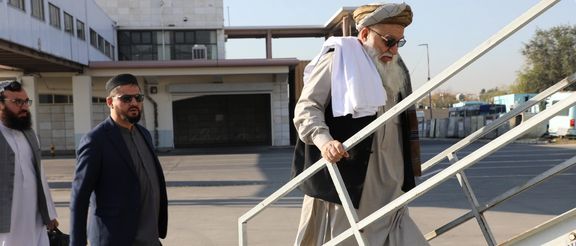
Matiul Haq Khalis, head of the Taliban’s Environmental Protection Agency, has led a delegation to participate in the United Nations climate change conference in Baku.

Matiul Haq Khalis, head of the Taliban’s Environmental Protection Agency, has led a delegation to participate in the United Nations climate change conference in Baku.
This marks the first time the Taliban have been invited to attend a climate-focused event on the international stage. The conference is scheduled to run from 11 to 22 November.
The Taliban’s Environmental Protection Agency has described this conference as a significant opportunity for Afghanistan. According to a statement released by the agency on Sunday, the Taliban delegation plans to discuss avenues for cooperation with the international community on environmental conservation and addressing climate change.
The annual UN climate change conference is regarded as one of the organisation’s most critical events of the year.
Since assuming power in 2021, the Taliban regime remains unrecognised by any country. Despite this, the Taliban have sought to engage in international climate change discussions over the past three years. Taliban officials have stressed that “political issues” should not obstruct their participation in these global forums.
Afghanistan ranks among the world’s most climate-vulnerable nations. Before the Taliban’s rise to power, Afghanistan was a signatory to the 2015 Paris Agreement, committing to reduce greenhouse gas emissions and curb global climate change.
Matiul Haq Khalis, head of the Taliban’s Environmental Protection Agency, emphasised that “climate change should be regarded as a humanitarian issue, unaffected by political considerations.”


Fazl Mohammad Haqqani, the Taliban representative in Tehran, attended the “Nasrallah School” conference on Saturday, held in Tehran to mark the 40th day since the death of Hassan Nasrallah, the former Secretary-General of Hezbollah in Lebanon.
According to a report by ISNA, the conference took place at the Islamic Countries Summit Hall in Tehran, organised collaboratively by Iran’s Ministry of Culture and Islamic Guidance and the Islamic Culture and Relations Organisation.
Iranian media reported that the conference examined “various intellectual and ideological aspects of Hassan Nasrallah’s work, with the aim of providing a model and defining the role of future resistance leaders.”
Hassan Nasrallah was killed in an Israeli airstrike in southern Beirut last month. Senior Taliban officials have since refrained from commenting on the death of Hassan Nasrallah, maintaining public silence on the matter.

Mullah Hibatullah Akhundzada, the leader of the Taliban, has issued a directive instructing the group’s intelligence agency to identify and halt foreign funding sources for “Ahl-e-Hadith” seminaries in Afghanistan’s Kunar province.
Additionally, the Taliban leader has called for the exclusion of “Ahl-e-Hadith” affiliates from government employment, advocating for their dismissal from official roles.
A copy of this directive, obtained by Afghanistan International, reveals that Akhundzada has tasked Taliban intelligence operatives with preventing foreign financial support for Ahl-e-Hadith educational institutions. The order further stresses the need to curb the influence of “non-followers” within government departments.
This directive, issued 20 days ago, followed a report submitted to the Taliban leader by the group’s intelligence service concerning the situation in Kunar.
In the directive, Akhundzada instructs the Taliban’s military courts to investigate and adjudicate claims of murder within their jurisdiction. Furthermore, the order requests the Ministry of Guidance, Hajj, and Endowments to appoint “followers” in institutions associated with Kunar province, replacing Ahl-e-Hadith personnel.
The directive also urges that the General Directorate of Intelligence appoint a “strong and follower” candidate as the head of intelligence in Kunar. Additionally, the Ministry of Education has been asked to establish officially sanctioned seminaries in Kunar, conduct inquiries into non-follower seminaries and their funding sources, and obstruct any foreign financial backing for these organisations.
In a related instruction, the Ministry of Interior has been tasked with reviewing and finalising its organisational structure in Kunar. The directive underscores that Ahl-e-Hadith members should be excluded from Ministry of Interior roles and, if identified, should be removed from their positions.
Local Taliban sources in Kunar informed Afghanistan International that the terms “follower” and “non-follower” are widely used in the region. The Taliban accuse “Ahl-e-Hadith” and Salafi groups of affiliations with ISIS.
According to local sources, these groups have criticised the Taliban for perceived lapses in fully enforcing the Quran and Hadith, accusing the group of blind adherence. The sources further indicated that, in an effort to limit ISIS’s influence, the Taliban have imposed restrictions on the activities of Ahl-e-Hadith seminaries in Kunar.
Kunar remains one of Afghanistan’s provinces with significant Salafi influence. Observers have also accused the Taliban of assassinating prominent Salafi figures in Kabul and eastern Afghanistan in recent years.

A court in Germany has fined Detlef Gürth, a former member of parliament in the state of Saxony-Anhalt and a member of the Christian Democratic Party, 18,000 euros for insulting Afghans.
The sentence was issued after Gürth wrote derogatory words against Afghans on the social network X.
In late June this year, an Afghan citizen stabbed to death a compatriot in Berlin and then attacked spectators in eastern Germany during the opening match of Euro 2024, injuring three people. The attacker was shot dead by the police.
After the attack, which drew widespread reactions, Gürth called for the expulsion of Afghans in harsh and abusive language on the social media platform X.
The court in the city of Halle (Saale) ruled that the politician must pay a fine of 200 euros per day for the next 90 days. However, Gürth says he has appealed against the court's ruling.
According to German media reports, after the stabbing incident by an Afghan asylum seeker during a soccer match, Gürth wrote on his X page: "This soil must be cleared of Afghans."
He also defended the police shooting at Afghans, stating that "this filth should be cleaned up from Germany." Many condemned Gürth’s reaction, calling the use of the word "dirty" an insult to all Afghans and that the term was a form of hate speech and contradicted the principles of the German constitution, which protects human dignity and equal rights.
Incitement to hatred usually carries a penalty of three months in prison, but in certain cases, a German court can convert the sentence to a fine.

Pakistani health authorities on Friday (November 8) announced the identification of two new cases of polio in Sindh and Khyber Pakhtunkhwa provinces. With the identification of these two new cases, the total number of polio cases in Pakistan this year has reached 48.
The Regional Reference Laboratory for Polio Eradication at the National Institute of Health of Pakistan on Friday announced that it has identified two new cases of the polio virus.
The first case of polio was reported in Sindh's Ghotki district, with Sukar, Rahim Yar Khan and Shikarpur districts being areas where cases of the virus had previously been recorded, the organisation said.
The second case was also detected on Friday in the Dera Ismail Khan area of southern Khyber Pakhtunkhwa province, the report added. Earlier, three more cases of polio have been recorded in this district this year, the organisation said.
The agency said that genetic sequencing of samples collected from both children is currently under review. Pakistani health officials also stressed on the importance of the polio vaccine to protect children from virus-related disabilities.
Pakistani health officials urged parents across the country to ensure that all children under the age of five have received a dose of oral polio vaccine.
Pakistan's health authorities have reported 48 cases of polio in the country this year, while Pakistan and Afghanistan are currently the only countries where the virus has so far claimed victims.

Nasir Ahmad Faiq, Afghanistan's acting representative to the United Nations, said that the condition of Afghan refugees in Iran and Pakistan is "dire”.
Speaking at a meeting of the United Nations General Assembly’s Third Committee on Thursday, Faiq said that many Afghan refugee children in neighbouring countries have been deprived of education and health services.
Faiq said that the Afghan refugee population has reached an alarming figure and that more than five million Afghan refugees have taken refuge in Iran and Pakistan. He added that the high volume of immigrants has put the countries under a lot of pressure.
"Since the Taliban's military takeover of Afghanistan in 2021, more than 1.6 million more Afghans have fled violence, economic collapse and systematic human rights violations and sought refuge in neighbouring countries," Faiq said.
He called on UN member states to increase their financial commitments to support Afghan refugees. Member states should increase resettlement quotas and support Afghan refugees through safe routes, such as family reunification and humanitarian visas, he said. According to him, this will reduce the pressure on the host countries.
Pakistan and Iran have intensified the deportation of Afghan refugees. Iran is currently aggressively implementing the deportation of migrants, and thousands of Afghan migrants are being arrested and deported every day. In recent months, there have been numerous reports of Iranian police officials mistreating migrants and attacking Afghans in parts of Iran.
Among the undocumented immigrants, the Islamic Republic also deports Afghans with legal documents. Faiq described the conditions of Afghan refugees in these countries as dire, adding that refugees in Iran face challenges in accessing banking and other services due to problems related to documents, and some of them are even deported from the country despite having documents.
The Acting Representative of Afghanistan to the United Nations also emphasised that there should be no forced deportation of Afghans, adding that the voluntary return of Afghan refugees should be carried out in safe conditions and with respect for their human dignity.
Referring to a recent report by the United Nations High Commissioner for Refugees (UNHCR), Faiq said that the population of Afghan refugees and migrants has reached 5.53 million and since September last year, more than 733,000 Afghans, including women and children, have returned to the country from Pakistan.