Taliban Imprisons 150 Foreign Nationals, Including 10 Iranians

Sources from the Taliban's Prisons Regulatory Authority confirmed to Afghanistan International that 150 foreign nationals are currently being held in the group's prisons in Afghanistan.

Sources from the Taliban's Prisons Regulatory Authority confirmed to Afghanistan International that 150 foreign nationals are currently being held in the group's prisons in Afghanistan.
According to these sources, at least 10 of these prisoners are Iranian.
Sources from the Taliban's Prisons Regulatory Authority confirmed on Thursday, November 21, that about 8,000 Afghan prisoners are being held in Iranian prisons.
According to statistics provided by the agency, a total of nearly 12,000 prisoners are held in Taliban-controlled prisons in Afghanistan.
The Taliban has not yet provided details about the identities and reasons for not releasing these foreign prisoners in Afghanistan.
Earlier, US officials had confirmed that three US citizens had been imprisoned by the Taliban. Last week, the Taliban had arrested a Canadian veteran.
On November 14, the Taliban announced that a delegation from Iran's Ministry of Justice had travelled to Kabul to discuss the transfer of Afghan prisoners. According to the Taliban, these talks were held in order to transfer Afghan prisoners from Iran to Afghanistan to serve their sentences.
On November 18, Esmail Baghaei, a spokesman for the Iranian Foreign Ministry, also announced that the number of Afghan prisoners in Iran is significant, and that this has cost the Islamic Republic a lot of money. He also said that Iran has redoubled its efforts to transfer these prisoners.
Iran's Deputy Minister for International Affairs and Human Rights has emphasised that the agreement for the transfer of Afghan convicts was signed in 2006 and that the Taliban is committed to this agreement.
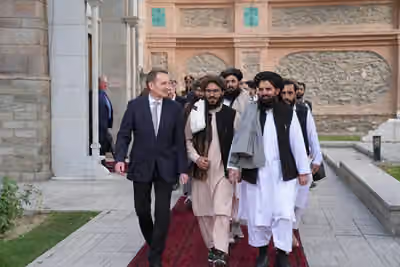

Jabbar Ali Zakeri, Deputy Minister for Roads and Urban Development of Iran, Chair of Board and President of Railways of Islamic Republic, given the proximity of Iran, Afghanistan, and China, called for connecting the railways of the three countries.
Zakeri said that since this proximity reduces the cost of transit and shortens the route, Iran is proposing a trilateral meeting.
In a meeting with Mohammad Ishaq Sahibzada, Deputy Minister of Public Works and head of the Taliban's Railway Authority, Zakeri referred to the determination of the Islamic Republic of Iran Railways to help Afghanistan's railways, saying, "The existence of the railway in the northwest of Afghanistan and its proximity to the common border with Iran is a great opportunity for transit between the two countries."
Emphasising on the importance of completing the Herat rail axis based on a specific timeline, Zakeri said, "This line can shorten the transit route and reduce its cost."
Regarding the transportation of goods through the railway between Iran and Afghanistan, he said that many of the problems faced by the Iran-Afghanistan railway consortium have now been solved and currently three trains are running on the designated route per week.
The Taliban's deputy minister of public works also said that according to assessments, there is a good load capacity on the China-Afghanistan-Iran route and Afghanistan is fully prepared to take the necessary steps along with Iran in this direction.
Training of Afghan Railway Staff
Referring to the training courses held for Afghan railway employees in the past years, Iran's Deputy Minister of Roads and Urban Development said that due to the Taliban's request, a third training course for railway employees will be held in person soon.
The head of the Taliban's Railway Authority also thanked the training programmes for 96 Afghan railway employees and called for a third round of training for Afghan railway employees.
According to IRNA, the Taliban official also announced engineering studies for the construction of the Zaranj-Kandahar railway route, which will open a new chapter of cooperation and trade exchanges between the two countries by connecting this railway line to Zabul.

Local sources told Afghanistan International on Wednesday that the Taliban in Kunar Province has banned the broadcast of images of living creatures.
In a meeting with local officials, the governor of Kunar stressed that from now on, no interviews will be conducted with the visual media.
In addition to national television, there is a private channel called Zala in Kunar, which has also been ordered to refrain from publishing images of living creatures.
Previously, the Taliban had banned the publication of images in Nangarhar, Kandahar, Takhar, Badghis and Helmand provinces.
The Taliban's media restrictions over the past three years have led to the closure of dozens of media outlets and the loss of hundreds of journalists. Concerns have also been raised that these restrictions will be extended to Kabul and other provinces.
Visual media officials travelled to Kandahar earlier this month to resolve the issue and shared their concerns with Taliban leaders.
However, these meetings ended inconclusively.
The Taliban has announced that these actions are carried out in accordance with Article 17 of the Law on the Promotion of Virtue and in accordance with Islamic Sharia. This article prohibits the photography of living beings.

In response to Pakistan's security concerns from Afghan soil, the US State Department spokesperson, Mathew Miller said that Washington is cooperating with Islamabad in strengthening its capabilities to counter the threats of terrorist groups.
Miller said that the United States has an important bilateral partnership in the field of counterterrorism with the government of Pakistan.
In a press briefing on Tuesday, November 19, the US State Department spokesperson condemned the recent militant attacks near the Pakistan-Afghanistan border that killed seven Pakistani soldiers.
"The people of Pakistan have suffered immensely at the hands of terrorists and violent extremists, and our hearts go out to the families and loved ones of those who have been killed or injured in recent attacks, including the November 9 suicide attack in Quetta," Miller said.
Miller also said that the US is committed to working with Pakistani government leaders and civil society organisations to identify opportunities to strengthen capabilities to identify, prevent and respond to threats posed by "extremist terrorist groups”.
Asked why the United States is not taking any action against terrorist groups based in Afghanistan, the State Department spokesperson said, "We have an important bilateral partnership with Pakistan in the fight against terrorism, which includes regular dialogues and working consultations to strengthen capabilities in identifying and countering threats."
Earlier, the US State Department accused the Taliban of violating the provisions of the Doha Agreement, saying that the group has provided shelter to some terrorist groups, including al-Qaeda leaders.
Matthew Miller said that Washington holds the Taliban accountable for the increase in the activity of terrorist groups in Afghanistan.
The Taliban has repeatedly denied harbouring terrorist groups, including the Tehreek-e-Taliban Pakistan (TTP), and threats emanating from Afghan soil against other countries, especially Pakistan.

The Embassy of the Islamic Republic of Iran in Kabul said that former President Hamid Karzai in a meeting with Iran's special representative for Afghanistan called for a regional initiative to solve the problems of the Afghan people.
According to the embassy, Karzai called for more attention from the countries of the region, especially Iran, to the issue of Afghanistan.
The Embassy of the Islamic Republic of Iran in Kabul on Wednesday, November 20, announced the meeting between Hamid Karzai and Kazemi Qomi.
Karzai has not commented on the meeting and the regional initiative to resolve the Afghan issue.
According to information provided by the Embassy of the Islamic Republic, Kazemi Qomi had a separate meeting with Abdul Kabir, the Taliban's deputy prime minister, and Amir Khan Muttaqi, the group's foreign minister.
Without providing details, the embassy wrote that during the meeting of Hassan Kazemi Qomi with these Taliban officials, the current developments in Afghanistan were discussed.
Regarding the meeting, the Taliban said that Iran wants to expand political cooperation with the group. These meetings took place after a delegation of the Islamic Republic visited Kabul and held talks with Taliban officials.
During the visit of a delegation from the Islamic Republic to Kabul in recent days, it was agreed that 1,000 Afghan prisoners in Iran will be handed over to the Taliban.
Karzai is a supporter of intra-Afghan dialogue and has consistently spoken of a "national dialogue" to resolve the Afghan issue over the past three years. The former president of Afghanistan has been critical of the closure of girls' schools and has repeatedly called on the Taliban to reopen girls' schools.
Iran has close ties with the Taliban and has consistently called for the formation of an inclusive government in Afghanistan. However, the Taliban has rejected the idea of the formation of an inclusive government, which is also the demand of the international community.

Several UN agencies are trying to make Afghanistan's blocked climate funds available, which have been frozen since the Taliban seized power in the country.
If this effort is successful, the Food and Agriculture Organisation of the United Nations (FAO) and the United Nations Development Programme (UNDP) will allocate $19 million for climate programmes.
Afghanistan is one of the most vulnerable countries affected by climate change. The country, which is experiencing deadly droughts and floods, has not been able to receive climate funding from international institutions since the Taliban's recapture in 2021.
The two UN agencies plan to submit proposals for nearly $19 million to the UN's Global Environment Programme next year.
The Food and Agriculture Organisation (FAO) is seeking a $10 million budget to improve natural resource management in four Afghan provinces.
Meanwhile, the United Nations Development Programme (UNDP) plans to provide $8.9 million to rehabilitate rural communities as livestock in villages have been severely affected by drought.
According to Reuters, the UN development programme also plans to provide an additional $20 million in funding.
In its proposal, the agency emphasises that the climate budget should be presented to the people without directly transferring it to the Taliban.
"We are in talks with major climate financial institutions, including the United Nations Environment Programme, to bring funds back into Afghanistan, without them being available to the Taliban," said Stephen Rodriguez, a representative of the United Nations Development Programme.
Dick Trenchard, FAO Country Director in Afghanistan, said, "There is no doubt about the effects of climate change in Afghanistan. You can see the effects everywhere."
Since the Taliban's takeover in 2021, no new funds have been allocated to Afghanistan. If the UN's efforts in this regard bear fruit, it will be the first time in three years that a new international climate budget has been allocated to Afghanistan.
The two organisations must receive initial approval from the secretariat of the United Nations World Environment Programme (GEF) in order to be able to submit their proposals for donations.
Flash floods in Afghanistan have claimed hundreds of lives this year, and the country is facing a food security crisis after a severe drought.
The Taliban has not yet been recognised by any country, however, the group's officials also attended the annual United Nations Climate Change Summit (COP29) in Baku for the first time this year.