Russia Deports Multiple Undocumented Migrants, Including Afghan Nationals
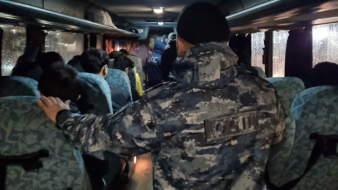
Russian authorities have reportedly arrested and deported 15 undocumented migrants from the city of Pskov, according to local media.
Russian authorities have reportedly arrested and deported 15 undocumented migrants from the city of Pskov, according to local media.
The deported individuals were identified as citizens of Afghanistan, Kenya, Sri Lanka, and Kazakhstan, who were allegedly attempting to cross the border into Europe illegally.
Under Russian immigration laws, the deported individuals are banned from re-entering the country for the next five years.
Government statistics reveal that since the start of this year, security forces in Pskov have deported 520 foreign nationals, a figure nearly three times higher than during the same periods in 2022 and 2023.
Over the past three years, an increasing number of citizens from Central Asia and Afghanistan have used Russia as a transit point to reach Europe. Many of these individuals have been apprehended and subsequently returned to their home countries by Russian authorities.

The Taliban Embassy in Islamabad has categorically denied claims that Afghan refugees participated in recent anti-government protests in Pakistan.
In an official statement, the embassy expressed concern that such allegations, made by the Pakistani Interior Minister and other officials, could serve as justification for the harassment and mistreatment of Afghan refugees in the country.
Earlier, Pakistan’s Interior Ministry accused Afghan refugees of taking part in protests against the government, stating that at least 37 Afghan nationals were arrested during the demonstrations. The country’s Minister of Information and Culture also alleged that Afghan citizens had been involved in protests organised by the Pakistan Tehreek-e-Insaf (PTI) party. Meanwhile, the Punjab government announced its intention to disclose the identities of Afghan participants in the demonstrations.
Pakistan’s Interior Minister, Mohsin Naqvi, declared on Wednesday that Afghan citizens without proper documentation would not be permitted to reside in Islamabad after 31 December.
In a statement issued on Saturday, the Taliban Embassy dismissed these accusations as unfounded and voiced concerns that such rhetoric could lead to unjust treatment and harassment of Afghan refugees by Pakistani law enforcement agencies.
The embassy stated: “Afghan refugees in Pakistan have never engaged in political activities or criminal acts. They have consistently lived peacefully and made positive contributions to Pakistan’s economy.”
The Taliban Embassy called on the Pakistani government to avoid creating an atmosphere of distrust towards Afghan refugees, warning that such an environment could exacerbate incidents of harassment, damage reputations, and result in forced deportations.
The statement also cautioned that continuing these policies would be detrimental to Pakistan’s interests and could further strain relations between the two neighbouring nations.
The allegations surfaced following protests led by supporters of the Pakistan Tehreek-e-Insaf (PTI) party, demanding the release of Imran Khan from prison. Thousands of PTI supporters responded to Khan’s call for action last Monday, marching towards Islamabad and clashing with police upon entering the capital.
The protests were subsequently quelled, with Pakistani police arresting dozens of demonstrators. Reports indicated that several individuals were killed during the clashes.
Local sources from Kapisa province reported that the Taliban members arrested a 35-year-old woman, Niloufar, who is a gangrape victim, and imprisoned her.
According to sources, the woman has been in Taliban custody for the past eight days in the centre of Kapisa province.
Sources from Kapisa province told Afghanistan International that a group of men gang-raped Niloufar at her home in the village of Aruki in Kapisa province on Friday, November 22.
Sources claimed that the five perpetrators of the gangrape are members of Niloufar's husband's family. According to them, one of the perpetrators has been identified as "Mayel Agha" and is a member of the Taliban in Kapisa.
Local sources said that after Niloufar was sexually assaulted in her home, she started making noise, and locals heard her voice and informed the Taliban. The Taliban were able to arrest one person on charges of involvement in the rape, and four others fled the scene.
The Taliban has not yet commented on the reason for Niloufar's arrest.
‘Victims of Domestic Violence Imprisoned’
Women's rights activists said that after the Taliban’s takeover, the safe houses that sheltered women victims of domestic violence were abolished and the Taliban kept these women in prisons.
Before August 2021, the shelters operated under the umbrella of the Ministry of Women's Affairs.
Upon entering Kabul, the Taliban abolished the Ministry of Women's Affairs and replaced it with the Ministry for the Promotion of Virtue and the Prevention of Vice.
Earlier, the United Nations Assistance Mission in Afghanistan (UNAMA) in a report in December quoted some Taliban officials as saying they were imprisoning "women without a mahram" who were victims of violence.
UNAMA has said that the imprisonment of women "in order to protect them" deprives these victims of their freedom.
Yuri Chikhanchin, the chairman of the Eurasian Group on Combating Money Laundering and Financing of Terrorism (EAG) said that the group is seeking joint measures to counter the threat of terrorism in Afghanistan.
Chikhanchin said about 600 people have been identified who are linked to international networks involved in terror financing this year.
The EAG consists of nine members: China, Russia, India, Tajikistan, Uzbekistan, Kazakhstan, Kyrgyzstan, Turkmenistan and Belarus.
The regional group held its 41st plenary meeting in India on November 25. The five-day meeting concluded on Friday with a statement on the growing threat of terrorism.
The member states of this group have expressed concern about the financing of terrorism, saying that the risks related to terrorism are not limited to any country.
The chairman of the regional group, Chikhanchin, warned that "the threat of terrorism throughout the region is the most prevalent and worrisome threat".
"Afghanistan is a country where the threat of terrorism is still present. We are considering joint measures to counter this threat emanating from Afghanistan. In one of our meetings, we discussed how to strengthen relations with Afghanistan and minimise risks in that country," he said.
Previously, the countries of the region have repeatedly expressed concern about the increasing spread of "terrorism" from Afghanistan.
Earlier, the head of the Russian Security Service (FSB) considered the presence of international terrorist groups in Afghanistan as the biggest threat to Central Asian countries.
The Collective Security Treaty Organisation (CSTO) has also warned that the risk of terrorism spreading in Central Asia from Afghanistan remains.
Eskandar Momeni, Iran's interior minister, said that the wall construction at the borders continues rapidly.
Momeni added, “regulating migrants, includes the management of borders and an agenda for their housing and employment, which is being implemented."
On Saturday, November 30, at the inauguration ceremony of the governor of Mazandaran, the Islamic Republic's Interior Minister claimed that there are currently about six million "foreign nationals" living in Iran.
Momeni added, "Iran is not really able to provide so many job opportunities to immigrants."
Iran's Interior Minister emphasised that closing the border with Afghanistan is one of the parts of the plan to organise refugees, which includes physical, electronic, and optical blockages. He added that the process of closing the border and preventing the employment of migrants without residency documents has made good progress with the cooperation of the public and employers.
This comes even as the authorities of this country have intensified the process of deporting Afghan immigrants without residency documents and have made living conditions extremely difficult for these immigrants. According to the Islamic Republic media, 4,000 Afghan refugees are deported daily from the Dogharoun border alone.
The Taliban's Ministry of Promotion of Virtue and Prevention of Vice announced that the ministry's ombudsmen arrested 23 people in six provinces of Afghanistan last week.
Fifteen people were arrested in Kabul, Nimroz and Sar-e-Pul and eight others were arrested in Balkh, Zabul and Daikundi on charges of violating the Law on the Promotion of Virtue.
The Taliban has accused these individuals of "moral corruption" and "witchcraft”.
The Taliban leader has authorised the Ministry for the Promotion of Virtue and Prevention of Vice to detain individuals on charges of violating the controversial Law on the Promotion of Virtue, which was signed in September.
The Ministry of Promotion of Virtue and Prevention of Vice said that the 23 arrested individuals had been handed over to judicial institutions after preliminary investigations.
The ombudsman of the Taliban's Ministry inspects people in all provinces through mobile patrols and monitors people's behavior and actions.
These ombudsmen claim that they are reforming society in accordance with the "Islamic Sharia”.
In September, Taliban leader Hibatullah Akhundzada signed the controversial law on the promotion of virtue. This law specifies the affairs related to the promotion of virtue and the prevention of vice, as well as the scope of the activities of the Ministry's ombudsmen.
According to this law, women's lives outside the home are severely restricted, and women's voices and faces are prohibited too.
These laws, which are implemented under the auspices of the Taliban's Ministry for the Promotion of Virtue and Prevention of Vice, have affected many aspects of the daily lives of the Afghan people, especially women's rights and individual freedoms.