Taliban Accuse ISIS of Assassinating Minister Khalil-ur-Rahman Haqqani

The Taliban has accused ISIS of carrying out the assassination of Khalil-ur-Rahman Haqqani, the group’s Minister for Refugees, in what they described as a “brutal attack”.

The Taliban has accused ISIS of carrying out the assassination of Khalil-ur-Rahman Haqqani, the group’s Minister for Refugees, in what they described as a “brutal attack”.
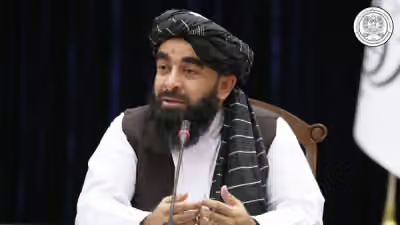
In a statement, Taliban spokesperson Zabihullah Mujahid mourned Haqqani’s death, calling it a “great loss” for the group.
Pakistan’s Foreign Minister, Ishaq Dar, expressed shock over the killing, condemning it as a “terrorist attack”. He reaffirmed Pakistan’s strong stance against terrorism in all its forms and manifestations.
Haqqani, who was killed in an explosion at the Ministry of Refugees in Kabul on Wednesday, had been urging Afghan refugees to return to Afghanistan in recent months, asserting that “security has been restored” in the country.
According to sources, the explosion occurred while Haqqani was hosting a public meeting at the ministry. Reports indicate that the attack was likely a suicide bombing.

The United Nations Security Council will hold a meeting on Afghanistan on Thursday, December 12. The UN Secretary-General's Special Representative Roza Otunbayeva is scheduled to speak at the meeting on the situation in Afghanistan.
The United Nations Assistance Mission in Afghanistan (UNAMA) said in a statement on Wednesday, December 11, that the meeting will be held at 7:30pm Afghan time.
The meeting is expected to review the human rights situation and the situation of women in Afghanistan.
Earlier in September, the UN Security Council held a meeting on Afghanistan to discuss the situation in the country.

Sources have confirmed to Afghanistan International that Khalil-ur-Rahman Haqqani, the Taliban’s Minister for Refugees, has been killed in an explosion.
Earlier, local sources had reported an explosion at the Taliban’s Ministry of Refugees in Kabul.
Taliban officials are yet to comment on the incident.
Daud Naji, the political head of the Afghanistan Freedom Front (AFF), denied involvement in the assassination of Khalil Haqqani.
Naji told Afghanistan International that the AFF does not carry out assassinations and that the explosion was caused due to internal disputes within the Taliban.
This story is developing.

Rina Amiri, the US envoy for Afghan women, said on Tuesday that the Taliban's discriminatory policies have added to the suffering of the people, especially Afghan women.
She stressed that these policies destroy the prospects for peace and stability in the country.
In a message on the occasion of International Human Rights Day on Tuesday, Amiri stressed on the importance of human rights in addressing the crisis in Afghanistan.
"Millions of Afghans have suffered human rights violations in more than four decades of war," she said.
"The Taliban's gender-based harassment of women and girls, as well as the Taliban's violation of the rights of ethnic and religious groups, journalists and human rights defenders, has deepened the suffering of the Afghan people," the US special envoy added.
The Taliban have deprived women of all their fundamental freedoms and rights, including the right to work, education, and movement. Following the increase in repressive measures, some countries and human rights organisations are seeking to hold the Taliban accountable by referring Afghanistan's case to the Hague Court.
The Taliban leader recently said that he will not be burdened by any power to implement Islamic law. He has said that Islamic law is more important than interaction with the world.

On International Human Rights Day (December 10), a Taliban spokesman Zabihullah Mujahid said that the group accepts human rights principles within the "framework of Sharia law and Afghan culture”.
Mujahid rejected the harsh criticism of the human rights situation in Afghanistan by countries and international institutions, saying that the Taliban has not violated human rights.
These countries "should not see Afghanistan from their own point of view, but from the perspective of Islam, Afghan culture and values", he told the Radio Television Afghanistan (RTA) controlled by the group.
His criticisms are focused on the statements of international human rights officials and organisations that have painted a critical and bleak picture of the human rights situation in Afghanistan in the past three years with their reports.
Yesterday, the UN special rapporteurs said that the Taliban has resorted to "femicide" by removing women from the public sphere and banning them from working in all fields.
However, from the Taliban's point of view, banning women's work and education is not a violation of human rights, and keeping women at home is to support them.
The Taliban spokesman said that international demands for human rights in Afghanistan are contrary to Islamic values and Afghan culture, saying, "The same rights that are common in the West, demanding them from the people of Afghanistan are not principled. We define the issue of human rights based on Afghan values and culture and beliefs.”
Western countries have called on the Taliban to allow women to study like other Islamic countries, but the group considers education for girls above the sixth grade to be against Sharia.
Claiming that "human rights and the rights of all citizens in Afghanistan are protected", Mujahid added that with the arrival of this group, "deaths and human casualties have been prevented".
Human casualties have decreased since the fall of the previous government in Afghanistan. In the past 20 years, many civilians had been killed and injured during the Taliban's conflict with the Republican government, as well as the group's suicide attacks in cities.
The United Nations mission in Afghanistan warned on Tuesday that the human rights situation, especially the situation of women, in Afghanistan is deteriorating. On International Human Rights Day, UNAMA said that the legitimacy of the Taliban depends on respect for human rights.

Taliban members set fire to a man in Khyber District, Faryab province, on charges of being a member of the National Resistance Front (NRF) of Afghanistan. In a video provided to Afghanistan International, Taliban gunmen can be seen gathering around the man's body.
Sources confirmed to Afghanistan International that Taliban fighters set fire to a man in the village of Jawdana in the newly-established Khyber district of Faryab province on Saturday night.
In a video obtained by Afghanistan International, Taliban gunmen can be seen gathering around the man's burnt body and cursing him. The video also shows Taliban fighters lighting a fire near the body and warming themselves.
In the video, one of the Taliban fighters says, "This is a member of the Resistance Front. Alhamdulillah, the Mujahideen killed him. Here is his body. "The mujahideen have gathered around him." The Taliban fighter can be heard asking, "How did you injure and martyr the Mujahideen?"
Sources told Afghanistan International that the man was identified as "Abdullah". According to information, the Taliban have clashed with 13 opponents of the group in this area.
Local sources claimed that the man was accused of being a member of the National Resistance Front and took refuge in a house in the Jawdana area, and after resisting, Taliban fighters set him on fire in the same house.
The National Resistance Front of Afghanistan has not yet commented on the individual's membership in its ranks.
After coming to power in Afghanistan, the Taliban has repeatedly arrested people on charges of being members of the National Resistance Front, and there have been reports of harassment and ill-treatment of them.