Taliban To Set Up Special Courts To Review Salaries For Retirees
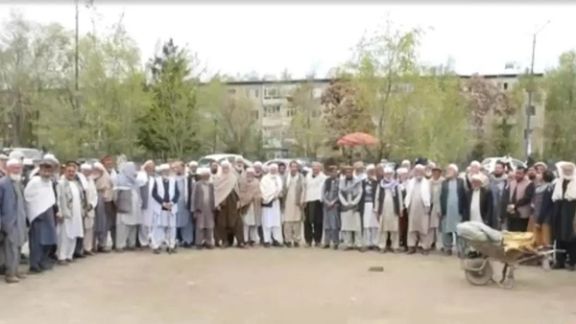
Bakhtar News Agency, a Taliban-controlled media outlet, reported that the group's leader, Hibatullah Akhundzada, has ordered the establishment of special courts to review pensions.

Bakhtar News Agency, a Taliban-controlled media outlet, reported that the group's leader, Hibatullah Akhundzada, has ordered the establishment of special courts to review pensions.
The report states that these courts must enforce the rights of retirees based on "Sharia and the law”.
Bakhtar News Agency reported on Saturday, December 21, that Hibatullah Akhundzada has issued a decree obliging the Ministry of Finance to regulate and implement the salaries of retirees.
Earlier, the Taliban leader had issued a decree canceling the pension system in Afghanistan. The Taliban has not paid pension to retirees in their more than three years of control over Afghanistan.
Over the past three years, retirees have repeatedly protested in front of the Retirement Treasury Department, the Ministry of Finance, and UNAMA to pursue their rights to withdraw salaries.

Pakistan's Special Representative for Afghanistan Mohammad Sadiq announced a meeting with Philippa Candler, the representative of the United Nations High Commissioner for Refugees (UNHCR) in Islamabad.
He wrote on social media platform X that issues related to Afghan refugees in Pakistan were discussed during the meeting.
Pakistan's special envoy for Afghanistan wrote on Friday, December 20, that the meeting was held at the request of Philippa Candler.
He did not elaborate on the details of the talks, but the meeting took place as the deportation of Afghan refugees from Pakistan continues, and concerns have increased due to the cold season in winter.
Last year, the United Nations High Commissioner for Refugees (UNHCR) called on Pakistan to stop deporting undocumented Afghan refugees during the winter season. The organisation had warned that deporting migrants during the winter would endanger their lives.

In response to the recent statements of the US Secretary of State, Hamdullah Fitrat, the Taliban's deputy spokesman, said that the Taliban is not isolated and that the group currently has diplomatic, political, and economic relations with many countries.
The Taliban official called on countries not to interfere in Afghanistan's internal affairs.
In an audio tape on Friday, December 20, the Taliban's deputy spokesman stressed that the group's commitments in the Doha Agreement are clear and they have adhered to it.
US Secretary of State Antony Blinken had said on Thursday (December 19) that the Tahrir al-Sham (HTS), which rules Damascus, must follow through on its promises to form an inclusive government and learn from the Taliban's isolation. He stressed that the rebels ruling Syria must take concrete steps to advance the country's affairs.
During the peace talks in Doha, Taliban officials spoke of changes in their views and promised to respect the rights of Afghan citizens, including women. After taking control of Afghanistan, the group reneged on calls for the formation of an inclusive government and respect for women's rights, and returned to the harsh policies of the 1990s.
"The Taliban portrayed a more moderate face when they took over Afghanistan, or at least tried to portray them as such, but their true nature was later revealed," the secretary of state told the Council on Foreign Relations in New York.
However, Hamdullah Fitrat, the Taliban's deputy spokesman, said that the recent changes that have taken place in Afghanistan are based on "Islamic law" and that other countries should not interfere in Afghanistan's internal affairs.
He noted that the group's commitments in the Doha talks did not stipulate that other countries should interfere in Afghanistan's internal affairs.
Ahmed al-Sharaa, the leader of the Islamist group Tahrir al-Sham who recently took power in Damascus, says he does not want to establish a Taliban-style government in Syria. Ahmed al-Sharaa has said that unlike the Taliban leaders, he will not stop the education of women and girls.

Sources told Afghanistan International that the Taliban released Rahmdel Hanafi, one of Ashraf Ghani's former bodyguards’ wife from prison five days after he committed suicide.
Rahmdel Hanafi committed suicide in Kabul on Sunday, December 15, due to the arrest of his wife by the Taliban.
Earlier, sources told Afghanistan International that Rahmdel Hanafi has 10 children, and after the Taliban took away his wife, he approached the group's institutions but did not receive a response. He committed suicide in Kabul after unsuccessful attempts to find his wife.
Sources said that Rahmdel Hanafi committed suicide three days after his wife was arrested by the Taliban. According to Taliban sources, his wife was released from a prison in Kabul on Thursday, December 19.
Rahmdel Hanafi had migrated to Iran after the Taliban takeover of Afghanistan in August 2021, but had returned to Afghanistan with the guarantee of Nooruddin Azizi, the Taliban's minister of commerce, and Qudratullah Amini, the former governor of Panjshir.
The Taliban has not yet commented on the incident, but the group has arbitrarily detained a number of former Afghan military personnel and officials and their family members in the past.

The United Nations High Commissioner for Refugees (UNHCR) has confirmed that the Islamic Republic has deported many Afghan refugees with valid residency documents in the past year.
The organisation said that Iran has sharply increased the forced return and deportation of migrants in 2024.
The United Nations High Commissioner for Refugees (UNHCR) said in a video release on Friday (December 20) that the Islamic Republic of Iran has repatriated thousands of Afghan refugees to Afghanistan every week from its borders in 2024.
The organisation added that among them are immigrants who have valid residency documents.
Recently, the International Organisation for Migration (IOM) announced that Iran has deported more than one million Afghan refugees in the past year.
UNHCR added that following the intensification of the deportation process of migrants from Iran, it has increased the provision of services to returnees at the Afghanistan-Iran border and provided immediate cash and social assistance to vulnerable returnees.
Meanwhile, Bakhtar News Agency, a Taliban-controlled media outlet, reported on Friday that at least 135 families had been deported from Iran and Pakistan in a single day and returned to Afghanistan. The Taliban media outlet wrote that 32 families from Pakistan and 103 families from Iran have returned to Afghanistan.
The International Organisation for Migration (IOM) had announced on Wednesday, December 18, that more than 1.2 million Afghan refugees had returned to Afghanistan from Pakistan and Iran in 2024. According to the organisation, more than 1.1 million people have entered the country from Iran's borders, 80,500 from Pakistan, and 100,000 through the airport.

The emergency hospital in Kabul reported that since August 2021, the total number of road accidents in Afghanistan has increased fivefold.
According to statistics recorded between March 2022 and March 2024, there has been a 78.5% increase in road accidents in Afghanistan.
The report, published on Thursday, December 20, states that the number of accidents has increased from 2,662 to 5,520 during this period.
With the official end of hostilities, many roads have been reopened, however, most remain in war-like conditions and need to be rebuilt, the hospital said.
In addition to poor road conditions and high speeds, many accidents are also caused by landslides on the road and non-compliance with traffic regulations.
The report states that in Afghanistan, passengers often do not have suitable vehicles, and widespread poverty means that large numbers of people gather in one vehicle to travel long distances.
The report follows two traffic accidents on the Kabul-Kandahar highway, which according to the Taliban, left 52 people dead.
Emergency is an international humanitarian organisation that provides free medical treatment to victims of war, poverty, and landmines. The organisation was founded in 1994.
Since its establishment, the organisation has treated more than nine million patients. Most of its activities are in Afghanistan, the Central African Republic, Iraq, Italy, Sudan and Uganda.
