Senior Army Officer, 13 TTP Members Killed In Khyber Pakhtunkhwa, Says Pakistan
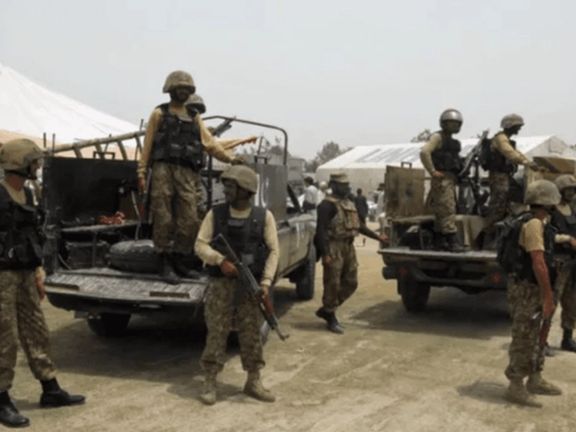
Pakistan's military said that a senior army officer and 13 TTP members were killed in separate clashes between its security forces and insurgents in Khyber Pakhtunkhwa.

Pakistan's military said that a senior army officer and 13 TTP members were killed in separate clashes between its security forces and insurgents in Khyber Pakhtunkhwa.
Recently, clashes between Pakistani security forces and the Tehreek-e-Taliban Pakistan (TTP) have escalated in the province.
The Pakistani army has announced the name of the slain senior army officer as Colonel Muhammad Owais.
Also on Wednesday, the Pakistani army announced that it had killed 13 insurgents in the South Waziristan region.
Earlier, the Tehreek-e-Taliban Pakistan (TTP) killed 16 Pakistani security forces in an attack at a checkpoint in South Waziristan.
Pakistani officials have always said that TTP members have safe havens in Afghanistan. The Afghan Taliban, however, have rejected the claims of Pakistani officials.
Meanwhile, Pakistani army warplanes bombed several locations in Barmal district of Paktika province on Tuesday evening.
A Pakistani official told Reuters that Pakistani warplanes targeted a camp of the Tehreek-e-Taliban Pakistan (TTP) militant group. However, Taliban spokesman Zabihullah Mujahid said that at least 46 people were killed in the attacks, most of them women and children.

The Taliban's Ministry of Public Works announced on December 27 that China's first rail transit shipment arrived in Herat via Iran's rail network.
Mohammad Ashraf Haqshenas, a spokesman for the ministry, said that the shipment included 1,000 iron coils from Bandar Abbas to Herat's Roznak station.
A spokesman for the Taliban's Ministry of Public Works wrote on Friday, December 27, "The shipment, which had started its departure from Chinese territory, arrived in Afghanistan via the Islamic Republic of Iran's rail network."
Haqshenas called the transfer of this cargo through the Bandar Abbas-Herat transit route "an important step in the development of Afghanistan's transit communications and connecting the country to open waters".
He also said that with the completion of the Khaf-Herat railway, new capacities will be created for the Afghan economy and will be the ground for the expansion of trade and transit in the region.
The project to connect Afghanistan to international waters through Iran's railway system began a few years ago. The work of this major project has been implemented in several phases since Ashraf Ghani's government.
Previously, Afghan traders had access to international waters only through Pakistan and the port of Karachi.
Pakistan's strictures have caused Afghan businessmen to transfer their trade through Karachi to Iran’s Chabahar port.

The Taliban's foreign minister called the Pakistani airstrike on Paktika a great injustice and said that Afghans do not forget anyone's good or evil deeds.
"We will not forget Pakistan's benevolence during the time of jihad, but we will not forget Pakistan's aggression on Afghan soil today," said Amir Khan Muttaqi.
Amir Khan Muttaqi said on Thursday, December 26, at a meeting marking the 45th anniversary of the Soviet invasion of Afghanistan, that Pakistan had killed Waziristani refugees, including children, women and elders, in the attack on Paktika.
Muttaqi stressed that Waziristani refugees had taken refuge in Afghanistan ten years ago after the destruction of their homes by the Pakistani government and were now living in difficult conditions.
He called on Pakistan to not look down on Afghanistan. Muttaqi added that Pakistan "should know that Afghanistan is an honourable neighbour and has respectable people and politicians".
He warned the Pakistani government to look at the fate of the former Soviet Union and Britain in Afghanistan and learn from it.
The Taliban's foreign minister said that on the one hand, Pakistan sent its political delegation to Kabul for talks and on the other hand, the country attacked Paktika at the same time. He called Pakistan's move disrespectful to the Pakistani delegation.
On Tuesday, Mohammad Sadiq, Pakistan's special representative for Afghanistan affairs, had traveled to Kabul and met with a number of Taliban officials. On Tuesday evening, Pakistani warplanes attacked Barmal district of Paktika.

Alireza Bekdeli, the charge d'affaires of the Iranian embassy in Kabul, during a meeting with Abbas Araghchi and Iskandar Momeni, the country's foreign and interior ministers, emphasised on the strengthening of Iran's relations with the Taliban.
During the meeting with Abbas Araghchi, Bekdeli outlined plans to develop relations with the Taliban.
The Embassy of the Islamic Republic of Iran wrote on social media platform X that Alireza Bekdeli, in a meeting with Abbas Araghchi, "presented a report on the scope of his mission and outlined the upcoming plans in the field of pursuing the development of relations and cooperation between the two neighbouring countries".
In a meeting between the Charge d'Affaires of the Iranian Embassy in Kabul and Interior Minister Iskandar Momeni, the importance of strengthening cooperation between the Interior Ministries of the Islamic Republic of Iran and the Taliban was also emphasised.
Details of plans for developing relations with the Taliban have not been announced.
Although the Islamic Republic does not recognise the Taliban like other countries, it has close diplomatic and economic relations with the group.
Alireza Bekdeli arrived in Kabul on Saturday, November 30, for the official start of his mission. Upon his arrival in Kabul, he was welcomed by the Taliban's Foreign Ministry officials.
Alireza Bekdeli has replaced Hassan Kazemi Qomi by decree of the Minister of Foreign Affairs of the Islamic Republic of Iran. Qomi was the special representative of the Iranian president for Afghanistan affairs and introduced himself as the head of Iran's diplomatic mission in Kabul.

The Taliban's Supreme Court announced that the group flogged two people on Wednesday in the Warmi district of Paktika province on charges of having extramarital affairs.
The Taliban said that one of the defendants was sentenced to 39 lashes and the other was given 29 lashes.
According to a statement by the Taliban's Supreme Court, the group sentenced the first defendant to five years in prison and the second defendant to two months in prison.
The Taliban has not commented on the identities of the suspects.
Despite international condemnation, the Taliban government announces the implementation of corporal punishment sentences against defendants almost daily.
Human rights organisations have repeatedly called on the Taliban to end corporal punishment of defendants.

In response to Pakistan's airstrikes on Paktika, Taliban’s intelligence agency spokesman Jawad Sargar said that Punjab has been separated from other parts of Pakistan and now the possibility of Pakistan's disintegration is stronger than ever.
Sargar said that the Pakistani army has no incentive to fight and that the Taliban should seize the opportunities.
"The tribes have risen up, the soldiers of Islam are fighting there, the people are suspicious of the government, and the army has no incentive to fight," Sargar wrote in a note on social media platform X.
In the note, which appears to be in response to recent attacks by Pakistani warplanes on TTP centres in Barmal district of Paktika province, the Taliban’s intelligence agency spokesman wrote, "Now is not the time for promises or expressions of feelings, strategic alliance is needed, power is needed, unity is needed."
According to the Taliban spokesman, Punjab province has been separated from other parts of Pakistan and there is a "high probability of disintegration" of Pakistan.
He described the history of the Pakistani army as full of "shame and disgrace", which he said the "Ummah of Islam" considers the Pakistani government to be the second "Zionist regime".
In his note, the Taliban's intelligence agency spokesman stressed that "we must therefore seize the opportunities”. The Taliban spokesman did not specify who he meant by "soldiers of Islam”.
However, he appears to be referring to the Tehreek-e-Taliban Pakistan (TTP) militants who have intensified their attacks against Pakistani security forces in recent years, especially after the Taliban took power in Afghanistan.
Islamabad expected that with the Taliban's rise to power in Afghanistan, the intensity of attacks by its allies, including the Tehreek-e-Taliban Pakistan (TTP) in Pakistan, would decrease, but on the contrary, the group increased the intensity of its attacks in the country.
Senior Pakistani officials have accused the Afghan Taliban of harbouring and training TTP fighters. Earlier, Pakistan's defence minister had threatened that Islamabad might launch an attack against TTP bases on Afghan soil.
On Tuesday evening, as Pakistan's special envoy Mohammad Sadiq visited Kabul and met with senior Taliban officials, Pakistani warplanes attacked TTP headquarters in Barmal district of Paktika in eastern Afghanistan. The Taliban said that 46 civilians, including women and children, were killed in the attack.
Earlier on Wednesday, TTP spokesman Mohammad Khurasani said at least 50 people, including 27 women and children, had been killed in Pakistani airstrikes. The victims are displaced persons who fled to Afghanistan due to the Pakistani army's invasion in Khyber Pakhtunkhwa, he said.
