AFF Claims Responsibility for Attack on Taliban Convoy in Baghlan

The Afghanistan Freedom Front (AFF) has claimed responsibility for an explosion in the central square of Pol-e-Khomri city, targeting a convoy of Taliban intelligence vehicles.

The Afghanistan Freedom Front (AFF) has claimed responsibility for an explosion in the central square of Pol-e-Khomri city, targeting a convoy of Taliban intelligence vehicles.
The attack occurred on the evening of Saturday, 18 January, according to a statement released by the group on Sunday.
The AFF stated, “As a result of this attack, four Taliban members were killed, and two others were injured.” The group also added that Mullah Ibrahim Mansoori, a Taliban intelligence commander, was among those targeted, but his fate remains unclear.
Residents of Baghlan province earlier reported the explosion to Afghanistan International, which occurred in Pol-e-Khomri city on Saturday afternoon.
The Afghanistan Freedom Front is an armed resistance group opposing the Taliban, formed after the fall of the previous Afghan government in 2021. The AFF identifies itself as a defender of freedom, justice, and the rights of the Afghan people.
The group has declared its mission to achieve an Afghanistan free from extremism and has embraced armed struggle as a means to achieve this goal.
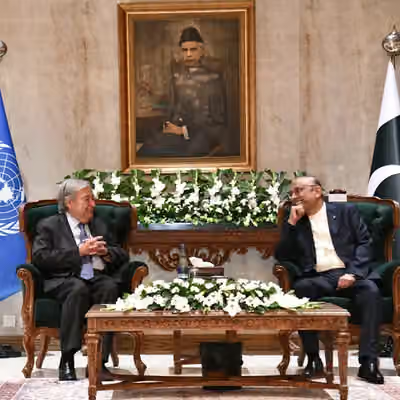

The Taliban has announced that Iran will soon transfer 1,500 Afghan prisoners to Afghanistan. The announcement, made by the Taliban’s Supreme Court, did not provide specific details regarding the timing or conditions of the transfer.
In a statement issued on Sunday, the Taliban’s Supreme Court revealed that a delegation led by Abdul Malik Haqqani, the court’s administrative deputy, met with Kazem Gharibabadi, the Deputy Chief for International Affairs of the Iranian Judiciary, during a visit to Tehran.
The statement highlighted discussions between the two sides aimed at strengthening judicial and legal cooperation. Among the key topics was the transfer of Afghan prisoners currently held in Iranian custody.
The Taliban also claimed to have raised the issue of exploring alternatives to the death penalty for Afghan prisoners facing execution in Iran. The rights of Afghan migrants were reportedly another topic of discussion during the talks.
In the past, concerns have been raised about the treatment of Afghan prisoners handed over by Iran to the Taliban. There are fears that some of these individuals may be opponents of the Taliban and could face human rights violations upon their return.
This development comes amidst broader issues in Afghan-Iranian relations, including the treatment of Afghan migrants, the execution of Afghan prisoners in Iran, and ongoing judicial interactions between the two countries. These remain significant and contentious matters in their bilateral relationship.

Jan Egeland, Secretary General of the Norwegian Refugee Council (NRC), described the denial of girls’ education in Afghanistan as “heartbreaking” and “intolerable” during a visit to a women’s carpet-weaving centre in Herat.
Egeland noted that the girls weaving carpets at the centre have been deprived of their right to education. One child labourer shared her story, saying: “I only finished Year 5, but my dream is still to become a doctor.”
On Saturday, Egeland posted on the social media platform X that he had returned to Afghanistan, where 22 million people are in need of humanitarian aid. Amid this crisis, Pakistan has deported 800,000 Afghan refugees, and Iran is planning to expel an additional two million.
During his visit to Herat, Egeland met women who have returned to Afghanistan without their husbands and now live in poverty and despair. He also visited a women’s entrepreneurship centre in Parwan province. He shared that Parwana, an entrepreneur supported by the NRC in 2021, now employs 20 female tailors, all of whom are the primary breadwinners for their families.
Egeland criticised the slow pace of financial support for humanitarian initiatives aimed at empowering Afghan women.
The Taliban has banned girls from attending school beyond Year 6 and has closed universities to women. The regime has also imposed severe restrictions on Afghan women, including prohibiting them from working, visiting parks, travelling without a male guardian, and working with international organisations.
Several human rights groups and activists have accused the Taliban of implementing a system of “gender apartheid.”

The Taliban’s Deputy Foreign Minister for Political Affairs has admitted that the group’s decision to bar girls from attending schools and universities lacks any religious justification.
Abbas Stanekzai stated that the prohibition on women’s education is solely the personal view of Hibatullah Akhundzada, the Taliban’s supreme leader.
Speaking at a graduation ceremony for religious school students in Khost Province on Saturday, Stanekzai said the Taliban’s actions are contrary to Islamic law and have deprived Afghanistan’s 20 million women of their fundamental rights.
Since taking control of Afghanistan, the Taliban has closed schools to girls beyond the sixth grade, barred women from universities, and imposed severe restrictions on their participation in public life. Women are prohibited from working in government positions, banned from non-governmental organisations, and prevented from accessing recreational facilities, including parks and sports activities. The group has also declared women’s voices as inappropriate to be heard publicly.
Stanekzai criticised these measures as un-Islamic and suggested that they reflect the personal inclinations of the Taliban leader rather than any religious doctrine. He appealed to the Taliban leadership to reopen schools and universities to girls, emphasising that no valid reason or excuse justifies these restrictions.
This is not the first instance where Stanekzai has spoken out against the Taliban’s policies towards women. He has previously criticised the ban on girls’ education and called for greater respect for women’s rights.
During his speech, Stanekzai underscored the importance of education in Islamic history, asserting: “Out of Afghanistan’s 40 million population, we are committing injustice against 20 million women. How will we answer for this on the Day of Judgement?”
He also highlighted the harsh conditions women face under Taliban rule, noting that they are often denied their rightful inheritance, forced into traditional compensatory marriages, and excluded from places of worship and learning. He questioned whether these actions align with Islamic principles.
The Taliban deputy foreign minister acknowledged that international criticism of the Taliban is largely driven by the group’s treatment of women. “The entire world confronts us over this issue. They criticise us for it. We have taken a path that is shaped by our own personal tendencies, not by Islamic law,” Stanekzai said.
His remarks come in the face of repeated instructions from Hibatullah Akhundzada, who has urged Taliban officials to refrain from publicly criticising the group’s policies. Instead, he has directed them to convey their opinions privately.
Over the past three years, numerous Islamic leaders and scholars around the world have challenged the Taliban’s stance on women, arguing that it violates the principles of Islamic teachings.

At his farewell ceremony at the Pentagon, Lloyd Austin, the US Secretary of Defence said that with the withdrawal of US troops from Afghanistan, "terrible things have happened to Afghan women's rights".
Austin, who is now retired, said that efforts to improve the situation of Afghan women should continue. Austin, 71, America's first black secretary of defence, announced the end of his tenure at the Department of Defence on Friday.
He served the US military for 41 years and is a four-star general and a Pentagon leader who has had combat experience.
Austin retired from the military in 2016, but returned to the Pentagon in 2021 by President Joe Biden and was appointed as the first black US secretary of defence.
Austin's tenure coincided with three major military crises, including the war in Ukraine, the withdrawal of US troops from Afghanistan, and the war in the Middle East.
"Over the past four years, we've stood up to our competitors, weakened our enemies, strengthened our friends, and invested in the future," Austin said at a ceremony marking the end of his tenure at Myer-Henderson Air Force Base.
However, his tenure coincided with the disastrous withdrawal of US troops from Afghanistan and the rise of the Taliban to power, which critics say is a historic defeat for the United States.
According to the Associated Press, the shocking fall of the Afghan government to the Taliban has affected Austin's tenure forever.
The withdrawal of US troops from Afghanistan has still created a deep sense of betrayal among some veterans of the loss of Afghanistan, and is one of the issues that President-elect Donald Trump's team has repeatedly criticised.
Biden's decision to continue withdrawing troops from Afghanistan led to two weeks of turmoil in August 2021, when the Air Force evacuated more than 124,000 people from Afghanistan within 17 days.
After the Taliban's return to power, all the hard-won gains for women and democracy were wiped out.
"There were a lot of predictions that if we got out of Afghanistan, we would be attacked every day," Austin said. This has not happened."
"However, some terrible things have happened with women's rights. We must continue to try to improve these issues," he added.
The Biden administration had not yet recovered from the shock of withdrawing from Afghanistan when Russian President Vladimir Putin began amassing hundreds of thousands of troops to invade Ukraine.
In response to the invasion, Austin formed the Ukraine Defence Contact Group, a coalition of more than 50 countries that have sent more than $126 billion in weapons and training to Kyiv over the past three years.
Then, the Hamas-Israel war began on October 7, 2023, and since then, the United States has helped continue this war by providing strategic and military support to Israel. Israel, an ally of the United States, has been accused of genocide in Gaza in this war.
Austin sent two aircraft carriers to the region, and since then, the conflict has spilled over into the Red Sea, disrupting trade and plunging the US Navy into the fiercest naval battle since World War II.
In his closing remarks on Friday, Austin praised his country's "achievements" in these crises.
"We have united the free world to help Ukraine fight for its freedom against the aggression of the Putin empire," he said.
“We have led the NATO alliance, which is stronger, bigger and more united than ever. We have prevented a full-scale war in the Middle East, weakened Iran's proxies across the region, and worked tirelessly to rescue Palestinian civilians in Gaza," he added.

Zia Siraj, the former head of Afghanistan's National Directorate of Security (NDS), has alleged that al-Qaeda has managed the disputes among Taliban leaders and prevented the group's collapse.
Siraj said that the son of former al-Qaeda leader Osama bin Laden was likely to be in Kandahar or Panjshir.
In an interview with a number of reporters, Siraj said that at the level of the Taliban leadership, ethnic and religious differences have increased more than ever, but the al-Qaeda network has played a prominent role in managing this situation.
Siraj also said that there are massive differences over power-sharing among Taliban leaders.
According to Zia Siraj, the message of the al-Qaeda network to the Taliban is that now is a good opportunity to expand their activities and they should use it properly to achieve their goals.
He stated that al-Qaeda currently sees Afghanistan as its centre of command and administration and does not want to lose this strategic position.
The former Afghan security official added that the West and the United States are now aware of the activities of the al-Qaeda network in Afghanistan and have sufficient evidence in this regard, but as long as these activities do not pose a direct threat to them, they prefer to manage them remotely.
Previously, there were concerns that the Taliban had provided sanctuary to members and senior leaders of the al-Qaeda network in Afghanistan.
These concerns made headlines when Ayman al-Zawahiri, the leader of the al-Qaeda network, was killed in a US airstrike in Kabul.
The US State Department released its annual report on terrorism on December 14 this year, announcing that the Taliban continue to host and shelter al-Qaeda in Afghanistan.
In September, the UN Security Council also reported on the visits of some al-Qaeda commanders to Afghanistan. The report said that al-Qaeda has continued to secretly organise attacks and train forces in Afghanistan.
The first round of Taliban rule led by Mullah Omar in the 1990s was also overthrown by the US-led coalition with the cooperation of the Northern Alliance forces due to its support for Osama bin Laden and the Al-Qaeda network.