New Polio Vaccination Campaign To Launch Across 16 Afghan Provinces
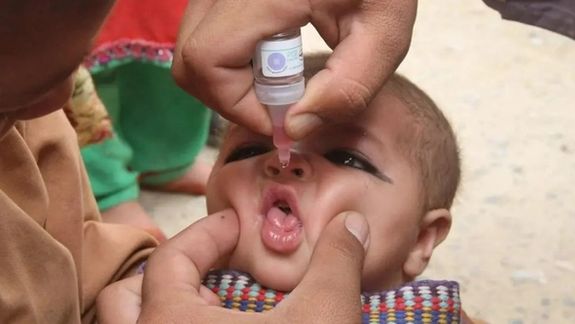
The “Polio-Free Afghanistan” organisation has announced the launch of a new polio vaccination campaign, set to begin on Monday, 27 January, across 16 provinces in Afghanistan.
The “Polio-Free Afghanistan” organisation has announced the launch of a new polio vaccination campaign, set to begin on Monday, 27 January, across 16 provinces in Afghanistan.
According to the World Health Organization (WHO), Afghanistan recorded 25 cases of polio in 2024. However, the Taliban had previously claimed that no positive cases of the disease had been reported within the country.
In a statement released on Sunday, Polio-Free Afghanistan revealed that the campaign will be conducted in the provinces of Kandahar, Helmand, Uruzgan, Zabul, Paktia, Paktika, Khost, Ghazni, Nangarhar, Laghman, Kunar, Nuristan, Kabul, Baghlan, Herat, and Badghis.
The organisation, however, did not specify the duration of the campaign or the number of children expected to be vaccinated.
The WHO continues to stress the importance of vaccination campaigns in eradicating polio, particularly in regions like Afghanistan, where the disease remains a significant health concern.

Mullah Hassan Akhund, the Taliban Prime Minister has assured Iran that the group has no intention of causing harm over water-related issues, according to a statement released by the Taliban on Sunday, 26 January.
During a meeting with Abbas Araghchi, the Iranian Foreign Minister, the Taliban Prime Minister expressed commitment to addressing water disputes amicably. Hamdullah Fitrat, the Taliban’s Deputy Spokesperson, stated that Araghchi emphasised the full implementation of the Helmand Water Treaty as a means to resolve ongoing water-related concerns.
Fitrat quoted the Iranian Foreign Minister as saying, “Iran has no intention of interfering in Afghanistan’s internal affairs and calls for the full implementation of the Helmand Water Treaty.” Araghchi further noted, “Iran’s security and stability are closely tied to Afghanistan’s security and stability.”
The meeting also focused on expanding cooperation between Tehran and the Taliban, with both sides expressing a desire for stronger bilateral ties. The statement highlighted Iran’s continued efforts to repatriate undocumented Afghan refugees as a point of discussion.
Another key topic raised was the treatment of Afghan prisoners in Iranian custody. The Taliban Prime Minister urged Iranian officials to show leniency towards Afghan prisoners, noting, “Sometimes, the execution of Afghans stirs public sentiment. Therefore, they should be treated kindly based on principles of good neighbourliness.”
He also requested that Iran avoid the immediate deportation of Afghan refugees, calling for their repatriation to be carried out “gradually” to allow Afghanistan to manage the process effectively.
The Taliban’s Ministry of Information and Culture has announced that media outlets operating in Afghanistan must comply with the group’s policies, Islamic rulings, and Afghan cultural values.
Habib Ghafran, spokesperson for the ministry, issued a warning on Sunday, 26 January, stating that any media organisations failing to meet these three principles would face suspension. Speaking to Radio Television Afghanistan (RTA), now under Taliban control, Ghafran emphasised that non-compliant media outlets would not be allowed to continue operations.
The Taliban has also reinstated the Commission for Media Complaints and Violations, a body widely seen by exiled Afghan journalists as a mechanism for enforcing control over the press.
Since the Taliban’s return to power in August 2021, the environment for journalists and media outlets in Afghanistan has grown increasingly restrictive. Over the past three years, hundreds of media organisations have ceased operations, with many journalists facing imprisonment under Taliban-imposed restrictions.
A recent report by the Afghanistan Journalists Center highlighted the scale of the crackdown. In 2024, the organisation documented 181 cases of violations against journalists and media rights. These included 130 incidents of threats and 51 arrests of journalists.
The Taliban’s policies have drawn widespread criticism from media freedom advocates, who warn that such restrictions severely undermine independent journalism and free expression in Afghanistan.
Marco Rubio, the newly appointed U.S. Secretary of State, has stated that the Taliban have taken more American citizens hostage than previously reported.
Rubio remarked, “If this is true, we will have to immediately place a very substantial bounty on their top leaders, possibly even larger than the one we placed on bin Laden.”
On Saturday, 25 January, Rubio took to the social media platform X to reveal reports suggesting the Taliban were holding more American citizens captive than had been disclosed.
On the final day of Joe Biden’s presidency, the Taliban released two American prisoners in exchange for one of their own members. Ryan Corbett and William McEntee were freed in early January and returned to the United States. According to the Taliban, Khan Mohammad, a member of their group, was released from prison following “lengthy and constructive negotiations” with the U.S.
Previously, the State Department had confirmed the detention of three American citizens by the Taliban—George Golzman, Mahmoud Habibi, and Ryan Corbett. However, the Taliban insisted they were holding only two of these individuals, denying that Habibi, an Afghan-American citizen, was in their custody. Despite this, Habibi’s family and U.S. officials maintain that he is being held by the Taliban.
Habibi, formerly the head of Afghanistan’s Civil Aviation Authority, was detained on 10 August 2022 along with 29 other employees of ARX Communication. His arrest came a day after the assassination of Ayman al-Zawahiri, the former leader of al-Qaeda, in Kabul. The Taliban accused ARX Communication of being involved in the operation targeting al-Zawahiri.
Ryan Corbett was detained in July 2022 while travelling in Afghanistan, and George Golzman was arrested by the Taliban on 5 December 2022.
The Secretary of State has not revealed how many Americans remain in Taliban custody.
The FBI had previously offered a $5 million reward for information leading to the capture of Sirajuddin Haqqani, the Taliban’s Minister of Interior. However, after the U.S. withdrawal and the Taliban’s takeover of Kabul, this reward was doubled.
Osama bin Laden, the former leader of al-Qaeda, was killed in 2011 during a U.S. operation in Abbottabad, Pakistan. The United States had placed a bounty of approximately $27 million on him.
Marco Rubio has long been one of the fiercest critics of the Taliban in U.S. politics. Following the collapse of the Islamic Republic of Afghanistan in August 2021, Rubio adopted a firm stance against the Taliban and their supporters.
His dissatisfaction with his country’s conciliatory approach toward the Taliban has spanned more than a decade. In 2014, he criticised the exchange of one American prisoner for five Taliban detainees. His opposition intensified after the Taliban’s takeover of Kabul in 2021.
Rubio is also a vocal advocate for halting U.S. financial aid to Afghanistan. He has introduced legislation calling for the suspension of all humanitarian aid to Afghanistan until assurances are made that such assistance does not reach the Taliban.
Since assuming office, Rubio has suspended U.S. foreign aid to Afghanistan. This decision has ensured that American aid to Taliban-controlled Afghanistan will be withheld for at least three more months.
Amir Khan Muttaqi, the Taliban’s Foreign Minister, met with Abbas Araghchi, the Iranian Foreign Minister, to discuss bilateral cooperation.
During the meeting, Muttaqi expressed hope that Araghchi’s visit to Kabul would serve as a catalyst for deepening ties between the Taliban and the Islamic Republic of Iran.
Muttaqi remarked, “Iran and Afghanistan are two neighbouring Muslim nations that have shared in each other’s joys and sorrows.”
Araghchi arrived in Kabul on Sunday morning, leading a political and economic delegation. During his discussion with Muttaqi, he stated, “Iran and Afghanistan have always enjoyed friendly relations, and we aspire to see these ties grow further, particularly in economic and cultural domains.”
The Iranian minister also expressed satisfaction with the current state of relations between Tehran and the Taliban, noting, “Iran-Afghanistan economic and trade relations are currently at a favourable level. This visit provides an opportunity to further advance relations in the interests of both nations.”
Esmail Baghaei, spokesperson for Iran’s Foreign Ministry, described Araghchi’s trip to Kabul as part of Tehran’s broader efforts to safeguard its national interests. In a post on X (formerly Twitter), he wrote, “This visit aligns with our neighbourhood policy and reflects the Foreign Ministry’s inherent mission to pursue national interests through engagement and the resolution of shared concerns.”
The issue of water rights remains a key topic in discussions between officials from the Islamic Republic and the Taliban.
Mohammad Ashraf Haqshenas, spokesman for the Taliban Ministry of Public Works, announced that the rail transport contract with China, Uzbekistan, and Kyrgyzstan has been extended for 2025.
Haqshenas added that the contract was signed by the Taliban's deputy railway director in Uzbekistan.
Mohammad Ashraf Haqshenas, spokesman for the Taliban Ministry of Public Works, announced on Saturday, January 25, that 4,200 containers had been transported through this rail corridor last year. He explained that the rail corridor passes through China, Kyrgyzstan, and Uzbekistan and connects to the Hairatan crossing in Balkh province.
Haqshenas added that it is expected that with the extension of this contract, the amount of rail transportation on this route will increase significantly.
The contract to transport commercial goods through this rail corridor was first signed in 2022 between the Taliban and these three countries.