Pakistan Detains & Deports Over 140 Afghan Migrants from Islamabad
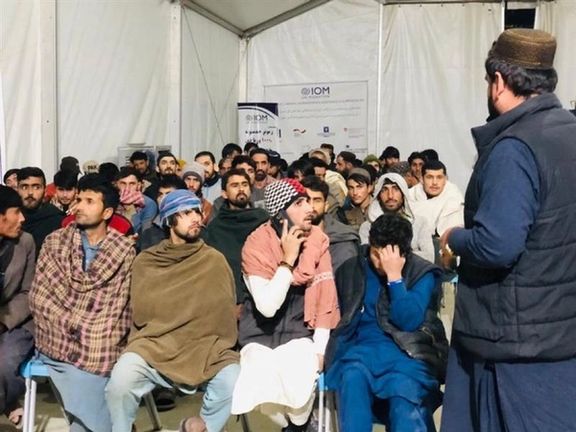
On Sunday, the Taliban’s Ministry of Refugees and Repatriation announced that 141 Afghan migrants, including women and children, were recently returned from Pakistan to Afghanistan.
On Sunday, the Taliban’s Ministry of Refugees and Repatriation announced that 141 Afghan migrants, including women and children, were recently returned from Pakistan to Afghanistan.
According to the ministry, these migrants had been detained in Islamabad for two to five days.
A statement from the ministry, citing information from the Torkham Border Authority in Nangarhar province, indicated that these individuals were arrested in Islamabad due to a lack of legal documents. They were held for two to five days in Haji Camp prison before being deported to Afghanistan.
The Pakistani government, led by Shehbaz Sharif, is preparing to implement a new wave of mass deportations of Afghan refugees and migrants.
According to a document obtained by Afghanistan International, Pakistan’s cabinet, in a meeting chaired by Shehbaz Sharif on Wednesday, approved this plan.
In recent months, Pakistan has not only expelled undocumented Afghan migrants but has also arrested a significant number of them.
The actions of Pakistani authorities against Afghan migrants have raised concerns among refugee advocacy organisations.

Sediqeh Torabi, Deputy Head of Iran’s Environmental Protection Organisation, has announced that the organisation has proposed joint environmental projects to the Taliban administration.
She stated that one of the main objectives of this proposal is to mitigate the effects of dust storms and revive the Hamoun Wetland.
According to a report by the Islamic Republic News Agency (IRNA) published on Saturday, Torabi mentioned that their assessments indicate the Taliban administration lacks an environmental department. Therefore, Iran has put forward specific proposals.
She emphasised the need to discuss water resource management for the Hamoun Wetland and noted that the Taliban has expressed willingness to cooperate on this matter.
The Hamoun Wetland is located in northern Sistan and Baluchestan Province, in Zabol County, along the Iran-Afghanistan border.
Regarding the timeline and likelihood of the Taliban fulfilling Iran’s water rights for Hamoun, Torabi stated: “The construction of the Kamal Khan diversion dam has altered the flow of water resources, particularly floodwaters.”
Previously, IRNA reported that the Kamal Khan Dam had effectively drained the life out of Hamoun.
Torabi also mentioned that during his recent visit to Kabul, Iran’s Foreign Minister, Abbas Araghchi, stressed the importance of restoring the Hamoun Wetland in his discussions with Taliban officials.
Earlier, the Jomhouri-e Eslami newspaper strongly criticised Araghchi’s trip to Kabul, warning: “Undoubtedly, the Taliban’s water policies will lead to severe drought in eastern Iran.”
Iran’s Interior Minister, Eskandar Momeni, has announced that since the beginning of this year, approximately 1.1 million Afghan migrants have been deported to Afghanistan.
He added that estimates indicate 50 percent of these individuals have since returned to Iran.
On Saturday, Momeni stated in an interview with Iran’s state television that the country no longer has the capacity to host Afghan migrants and is implementing various measures, including border closures, to prevent the entry of unauthorised migrants.
He reported that at least six million foreign nationals reside in Iran, with at least two million of them being undocumented. Stressing the necessity of deporting undocumented migrants, he asserted that there is no alternative to their expulsion.
Iran’s Interior Minister further highlighted that foreign aid for refugee support has significantly decreased and claimed that many job opportunities for Iranians have been taken by migrants.
In addition to accelerating the deportation of Afghan migrants, the Islamic Republic has banned their presence in several Iranian cities and has criminalised the employment of undocumented migrants.
Several leaders of the National Resistance Council for the Salvation of Afghanistan met with a delegation from the Global Peace Foundation US in Ankara on Saturday.
Senior members of the council, including Abdul Rashid Dostum, Mohammad Mohaqiq, Almas Zahid, and Basir Anwar, attended the meeting.
One of the participants told Afghanistan International that researchers from the foundation discussed the resumption of Afghanistan's peace process with the leaders of the National Resistance Council. He added that the council leaders presented their positions regarding peace talks and national reconciliation in the country.
Mohammad Mohaqiq, one of the attendees, stated that they provided the American delegation with explanations about the objectives behind forming the National Resistance Council for the Salvation of Afghanistan. According to him, the council was established to pave the way for intra-Afghan peace negotiations under the supervision of the United Nations, with the participation of all relevant countries.
Mohaqiq, quoting the American delegation, wrote that “for the past three years, the issue of Afghanistan had been forgotten in President Biden’s administration, and discussing it was against the prevailing policies of the time.”
According to Mohaqiq, the American delegation mentioned that Donald Trump’s administration had included Afghanistan’s peace process in its agenda and had a deep understanding of the suffering and challenges faced by the Afghan people.
The American delegation stated that the new administration is determined to stand by the Afghan people and work towards achieving real peace and forming an inclusive government.
Some key leaders of the National Resistance Council for the Salvation of Afghanistan, such as Yunus Qanooni, Abdul Rab Rasul Sayyaf, and Atta Mohammad Noor, were absent from the meeting.
Previously, sources told Afghanistan International that some leaders of the National Resistance Council were set to meet with a delegation from Pakistan’s intelligence agency in Türkiye. However, Khalid Pashtun, a spokesperson for the council, denied that the meeting took place.
The Pakistani government, led by Shehbaz Sharif, has approved a new phase of mass deportations targeting Afghan refugees and migrants.
According to a document obtained by Afghanistan International, a meeting chaired by Sharif on Wednesday, 31 January, finalised the decision to expel Afghan refugees from the country.
As per the document, Pakistan's Ministry of Interior is responsible for the initial phase, during which Afghan citizens without official residence documents, along with holders of the Afghan Citizen Card (ACC), will be deported from Islamabad and Rawalpindi to Afghanistan. The exact number of undocumented migrants and ACC cardholders remains unknown.
The ACC is issued to Afghans recognised as legal migrants in Pakistan, serving as proof of their lawful status in the country.
Second Phase and PoR Cardholders' Status
The document outlines that in the second phase, the status of holders of the Proof of Registration (PoR) card will be reviewed. The Pakistani federal cabinet has granted PoR cardholders permission to stay in Pakistan until 30 June 2025. However, despite this allowance, they too will be expelled from Islamabad and Rawalpindi.
Around seven months ago, Sharif’s office reported that approximately 1.45 million Afghans with PoR cards were residing in Pakistan.
The PoR card is granted to Afghans who participated in Pakistan’s refugee registration programme and have official refugee status. PoR cardholders are recognised as registered refugees and, in some cases, have access to specific services and facilities in Pakistan.
Fate of Afghans Awaiting Resettlement in Western Countries
Afghan citizens awaiting resettlement in third countries will be deported from Islamabad and Rawalpindi by 31 March 2025.
Following the Taliban’s takeover of Afghanistan, thousands fled to neighbouring countries, seeking resettlement in a third country. Many remain in limbo as they await the completion of this process.
Shehbaz Sharif has directed the Ministry of Foreign Affairs to liaise with Western consulates in Islamabad to facilitate the transfer of these migrants. If no arrangements are made, they will also be deported to Afghanistan.
During the meeting, it was decided that Pakistani authorities must ensure that deported refugees and migrants do not return to Pakistan.
Additionally, the document states that Pakistani intelligence agencies must closely monitor the implementation of the deportation plan and regularly report to the Prime Minister’s office.
Response from the UN Refugee Agency
Meanwhile, the United Nations Refugee Agency (UNHCR) has acknowledged the Pakistani government’s directive requiring all Afghans holding ACC cards to leave Islamabad and Rawalpindi and return to Afghanistan immediately.
The agency has also confirmed its awareness of the planned deportation of PoR cardholders.
Expressing concern over these developments, the UNHCR has warned that non-compliance with these directives could result in the arrest and deportation of refugees to Afghanistan.
The UNHCR stated that it is seeking further clarification on Pakistan’s deportation programme and reaffirmed its commitment to ongoing discussions to support Afghan refugees and migrants.
Last year, the Pakistani government deported approximately half a million Afghan citizens.
The Special Inspector General for Afghanistan Reconstruction (SIGAR) has asserted that the Taliban has no legal right to access billions of dollars allocated for Afghanistan, as the group is not recognised as the legitimate government and remains subject to sanctions.
In its latest report, released on Friday, SIGAR noted that former U.S. President Donald Trump and Congress may place approximately $4 billion of Afghanistan’s allocated budget under the “custody and control” of the United States.
In 2022, the U.S. government transferred $3.5 billion of Afghanistan’s central bank assets into a Swiss escrow account. According to SIGAR, the balance of this account has since grown to around $4 billion.
Although no payments have been made from the fund to directly benefit the Afghan people, the account was established to safeguard and stabilise Afghanistan’s economy.
The Taliban has repeatedly demanded that the United States return the funds to Afghanistan’s central bank. However, SIGAR maintains that the group has no legal claim to these reserves, as the U.S. does not recognise it as the legitimate government.
Additionally, SIGAR highlighted that the Taliban remains designated as a Specially Designated Global Terrorist (SDGT) group by the U.S. and is subject to both U.S. and UN sanctions.
The SIGAR report follows the Trump administration’s recent decision to suspend foreign aid—except for assistance to Israel and Egypt—for 90 days. The U.S. State Department has stated that it is reviewing all foreign aid to ensure alignment with Trump’s foreign policy objectives.
Since its withdrawal from Afghanistan in 2021, the United States has spent nearly $3.71 billion in the country, with a significant portion directed to UN agencies. SIGAR also reported that approximately $1.2 billion remains under review and could be disbursed in the future.
While U.S. humanitarian assistance may have prevented famine following Afghanistan’s economic collapse, SIGAR states that it has failed to stop the Taliban from taking American citizens hostage, suppressing women’s and girls’ rights, censoring the media, turning Afghanistan into a “terrorist haven”, and targeting former Afghan government employees
Despite the Taliban’s severe restrictions and governance failures, the United States remains the largest foreign donor to Afghanistan. The report also alleges that the Taliban collects taxes on a significant portion of foreign aid and misuses another portion for its own benefit.