• العربية
  • پښتو
  • فارسی
Brand
  • Afghanistan
  • Sport
  • Markets
  • Afghanistan
  • Sport
  • Markets
  • Theme
  • Language
    • العربية
    • پښتو
    • فارسی
  • Afghanistan
  • Sport
  • Markets
All rights reserved for Volant Media UK Limited
volant media logo

Pakistan Claims U.S. Weapons Used In Attacks From Afghanistan, Says Taliban Ambassador

Feb 18, 2025, 15:16 GMT+0

A confidential letter from the Taliban Embassy in Pakistan, leaked by TalibLeaks, reveals that the Taliban ambassador in Islamabad has reported Pakistan’s concerns regarding the alleged use of US weapons in attacks launched from Afghan soil.

The letter, dated 5 April 2024, was sent by Sardar Ahmad Shakib to the Taliban’s Ministry of Foreign Affairs and highlights the diplomatic tensions and challenges in Pakistan-Taliban relations.

Shakib stated that Pakistan is convinced that American weapons have been used in attacks originating from Afghanistan, further straining relations between the two countries. The document also outlines ongoing diplomatic disputes, particularly Pakistan’s alleged violations of Afghan airspace and its reported facilitation of U.S. reconnaissance flights over Afghanistan.

According to the letter, Pakistan has intensified its claims regarding the presence of Tehreek-e-Taliban Pakistan (TTP) militants in Afghanistan, alleging that the Taliban administration provides moral support to the group. Pakistani officials reportedly believe that senior TTP leaders have established safe havens in Afghan territory.

The leaked document further indicates Pakistan’s growing dissatisfaction with improving Taliban-India relations, warning that direct engagement between the Taliban and New Delhi could diminish Pakistan’s influence in Afghanistan, leading to further deterioration in ties between Islamabad and the Taliban administration.

The report also sheds light on the politicisation of trade relations between Afghanistan and Pakistan. It states that trade and economic exchanges between the two countries have been disrupted due to the lack of a modern legal framework, causing financial strain on Afghan traders. The document asserts that this politicisation has led to increased costs, including higher taxes, import restrictions, and rising transportation expenses.

The letter emphasises that resolving border violations and diplomatic tensions requires sustained engagement and mutual cooperation from both sides. In his communication with the Taliban’s Ministry of Foreign Affairs, Shakib urged the Taliban leadership to engage constructively with Pakistan to address ongoing disputes and stabilise bilateral relations.

Most Viewed

Taliban Order Cut To Residential Fibre-Optic Internet In Kabul, Say Sources
1

Taliban Order Cut To Residential Fibre-Optic Internet In Kabul, Say Sources

2

Taliban Besieged TOLOnews Offices After Journalist Detentions, Say Sources

3

Taliban Leader Adviser Arrested In Kandahar Over Alleged Bribery

4

Exiled Media Watchdog Urges UN, EU To Seek Release Of Journalists Held By Taliban

5

Taliban Urges Turkmenistan To Implement 24-Hour Operations At Torghundi Port

•
•
•

More Stories

UN Envoy Calls For Stronger Engagement To Address Women’s Rights In Afghanistan

Feb 18, 2025, 13:44 GMT+0

Roza Otunbayeva, head of the United Nations Assistance Mission in Afghanistan (UNAMA), has called for greater engagement and concrete measures to lift the restrictions imposed on Afghan women and girls by the Taliban.

Otunbayeva made the remarks during a meeting with representatives of the Organisation of Islamic Cooperation (OIC) in Kabul, where she highlighted the severe consequences of ongoing restrictions on women’s education, employment, and access to healthcare.

On Tuesday, 20 February, in a post on X (formerly Twitter), Otunbayeva reiterated that the Taliban’s policies are causing long-term damage to Afghan society. She stressed that women’s and girls’ rights must be prioritised and noted that her discussions with OIC representatives were both constructive and critical in addressing these concerns.

Her remarks were made during the “Workshop on Dissemination of the Jeddah Declaration”, held at the OIC office in Kabul on 17–18 February.

The Organisation of Islamic Cooperation (OIC) also issued a statement regarding Otunbayeva’s meeting with Tariq Ali Bakhit, the OIC representative in Afghanistan.

According to the statement, the two officials discussed joint cooperation between the UN and OIC in supporting Afghanistan’s people and tackling political, humanitarian, and security challenges.

Over the past three years, the Taliban’s ban on girls’ education beyond sixth grade has left 1.4 million female students unable to continue their studies. Women have also been barred from working in NGOs and pursuing higher education.

Despite international and domestic pressure, the Taliban maintain that the "Islamic conditions" in Afghanistan are not yet suitable for girls’ education.

The UN, OIC, and other international organisations continue to call for immediate action to restore Afghan women’s fundamental rights, which remain among the most severely restricted in the world.

Vienna Conference for a Democratic Afghanistan Commences in Austria

Feb 18, 2025, 13:07 GMT+0

The fifth round of Vienna conference for a democratic Afghanistan commenced on Tuesday, 18 February, in the Austrian capital, bringing together leading Afghan anit-Taliban figures, women's rights activists, and civil society representatives.

Among the notable attendees are Ahmad Massoud, leader of the National Resistance Front (NRF), Yasin Zia, leader of the Afghanistan Freedom Front (AFF), and Rangin Dadfar Spanta, former National Security Advisor of Afghanistan.

The two-day conference aims to foster political unity among Afghanistan's political, civil, and military movements. Since the fall of the previous Afghan government, the Vienna Process has emerged as one of the most significant platforms uniting opposition groups against the Taliban.

Organisers emphasised that the fifth round of conference provides an open political space where participants will transparently discuss solutions to Afghanistan’s ongoing crisis.

Ali Maisam Nazary, head of foreign relations for the NRF, wrote on X that the conference includes representatives from diverse political, ethnic, and religious backgrounds.

The Afghanistan Freedom Front (AFF) issued a statement welcoming political initiatives aimed at strengthening political groups, military fronts, women’s movements, and civil resistance efforts. The statement underlined the need for a comprehensive struggle to overthrow the Taliban regime and eradicate terrorism, extremism, and Taliban-led violence.

According to the agenda obtained by Afghanistan International, the first day features key discussions led by Hazara leader Mohammad Mohaqiq, AFF leader Yasin Zia, NRF leader Ahmad Massoud, former Afghan National Security Advisor, Rangin Dadfar Spanta, former MP Khalid Pashtoon, Rahela Dostum duaghter of former Vice President Marshal Dostum, women rights activist Fawzia Koofi, and former Afghan governor Rahmatullah Yarmal.

Discussions will focus on Afghanistan’s current state, the challenges ahead, and topics such as “unity for a common goal” and “the inevitable collapse of the Taliban regime”.

The second day will address Afghanistan’s future, global perspectives on the crisis, and the conference’s final declaration. The event will conclude with a press conference.

World Bank Warns Of Afghanistan’s Fragile Economy Amid Financial Isolation & Inflation

Feb 18, 2025, 10:58 GMT+0

Afghanistan’s economy remains precarious due to financial isolation, political instability, and a shortage of skilled labour, the World Bank stated in its latest report.

The report highlights the depreciation of the Afghani currency, which has led to rising prices of essential goods and food items.

The report, published on Monday, acknowledges that while Afghanistan experienced economic growth in 2023-2024, widespread poverty, unemployment, and limited financial resources continue to leave millions in a vulnerable state. Weak purchasing power remains a significant barrier to economic stability.

In December 2024, the afghani depreciated for the third consecutive month, falling 12 percent between November 2024 and January 2025. The exchange rate dropped to 74.8 afghanis per US dollar in January 2025, compared to 67.1 afghanis in October 2024.

In response, Afghanistan’s central bank injected $100 million into the market, but the downward trend of the currency persisted. The depreciation was exacerbated by the suspension of U.S. aid, prompting the Taliban to tighten control over the currency market. Reports suggest that Taliban authorities deployed armed personnel in Kabul’s Sarai Shahzada exchange market to curb further instability.

Despite economic hardships, government revenue collection in 2024 increased by 11.5 percent compared to the previous year. However, declining state revenues in other sectors pose risks to financial stability.

Afghanistan’s imports surged by 40 percent in 2024, driven by increased purchases of food, chemicals, minerals, and transport equipment. Meanwhile, the trade deficit widened by 8 percent in December 2024, reaching $926 million, primarily due to declining exports.

Afghanistan’s exports fell by 19.5 percent in December 2024 to $191 million, with food exports declining by 25 percent and textile exports by 23 percent, largely due to harsh winter conditions affecting production and trade.

The World Bank identified Iran as Afghanistan’s largest trading partner in 2024, accounting for 30 percent of total imports. Other major trade partners included United Arab Emirates, Pakistanand China.

Iranian officials reported that bilateral trade between Iran and Afghanistan exceeded $4 billion, marking the highest trade volume between the two countries in the past two decades.

The World Bank warned that Afghanistan’s economy remains fragile, citing the sharp decline in foreign aid, economic isolation, and uncertain financial policies. A further reduction in international assistance could significantly weaken overall demand and increase economic pressures.

The United States has suspended its humanitarian aid to Afghanistan, raising concerns over a potential humanitarian crisis. Observers caution that if aid remains suspended or stops entirely, Afghanistan could face a severe economic and social catastrophe, with the UN estimating that 22 million Afghans require urgent humanitarian assistance.

The World Bank stressed the need for economic reforms, greater financial transparency, and sustainable policies to reduce Afghanistan’s dependence on foreign aid and imports. Without such measures, the country risks further economic deterioration and instability.
Haqqani Yet To Return To Afghanistan Amid Discontent With Taliban Leader, Sources Say

Feb 18, 2025, 09:46 GMT+0

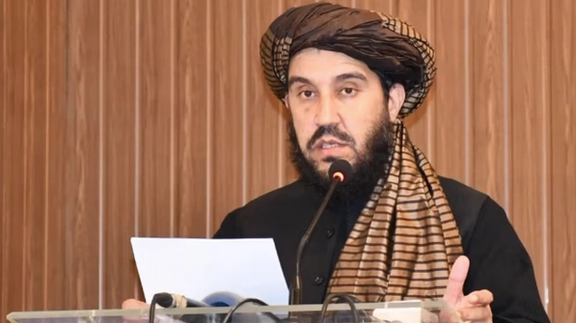
Sirajuddin Haqqani, the Taliban’s Interior Minister, has not returned to Afghanistan for nearly a month, despite earlier claims by the Taliban spokesperson that he had re-entered the country two weeks ago, sources told Afghanistan International on Monday.

According to multiple sources, Haqqani remains outside Afghanistan due to his dissatisfaction with the unilateral decisions of Taliban leader Hibatullah Akhundzada.

On January 21, the Taliban announced that Haqqani and Abdul Haq Wasiq, head of the Taliban’s intelligence agency, had travelled to the United Arab Emirates (UAE). However, Haqqani has yet to return, and the Taliban has provided no updates on his recent activities.

Sources suggest that Haqqani, a key figure within the Haqqani Network, is increasingly frustrated with Akhundzada’s leadership, particularly his hardline policies on women’s education and governance.

Additionally, Abbas Stanekzai, the Taliban’s Deputy Foreign Minister, has reportedly taken refuge in the UAE due to his criticism of Akhundzada’s restrictive policies on women’s rights.

According to reports, Haqqani is particularly concerned about Akhundzada’s efforts to consolidate power, including the transfer of elite Taliban special forces and military assets to Kandahar. 313 Badar Army Corps, previously under Haqqani Network influence, was relocated to Kandahar, Akhundzada’s stronghold. Azizuddin, Haqqani’s close ally and former Badar commander, was removed from his position. Kandahar’s security chief, a key Haqqani associate, was dismissed and replaced by Mawlawi Abdul Ahad Talib, one of Akhundzada’s trusted men.

Observers see these moves as Akhundzada’s attempt to tighten control over the Taliban’s security apparatus and reduce Haqqani’s influence within the group.

Sources indicate that Sirajuddin Haqqani is currently residing in Dubai, reportedly with his Arab mother. During his stay, he also travelled to Saudi Arabia for Umrah, despite having already performed Hajj in June 2024.

Meanwhile, Mullah Baradar, the Taliban’s Deputy Prime Minister for Economic Affairs, has travelled to Doha for a one-month medical treatment, according to a UN Security Council report on February 15.

The prolonged absence of senior Taliban officials has fuelled speculation of growing internal rifts within the group.

Earlier this year, the UN Security Council granted travel exemptions to three high-ranking Taliban officials, allowing them to travel to Saudi Arabia and the UAE for diplomatic and religious purposes.

Taliban Publicly Flog Nine Individuals, Including Three Women, in Ghazni & Takhar

Feb 17, 2025, 17:21 GMT+0

The Taliban Supreme Court announced on Monday that nine individuals, including three women, were publicly flogged in Ghazni and Takhar provinces. The group accused them of crimes ranging from theft and same-sex relations to extramarital affairs and fleeing home.

According to the statement, five individuals, including one woman, were flogged in Jaghori district of Ghazni. In addition to corporal punishment, some were sentenced to one to five years in prison.

Three men were accused of theft and same-sex relations and a man and a woman were convicted of “running away from home and kidnapping.” Two individuals were sentenced to one year and six months in prison, receiving 35 lashes. Three others were sentenced to two to five years in prison and received 30 to 39 lashes.

Residents of Jaghori shared footage with Afghanistan International, stating that the Taliban forced locals to witness the public floggings. Reports indicate that the Taliban shut down the Ghujor market to draw crowds to the punishment site. Images show a large gathering in an open field where the sentences were carried out.

In a separate statement, the Taliban Supreme Court reported the flogging of four individuals, including two women, in Farkhar district, Takhar. The group accused them of extramarital sexual relations. Three individuals received one year and six months in prison and 39 lashes. The fourth person was sentenced to five years in prison and 39 lashes.

The Taliban Supreme Court frequently announces public floggings across Afghanistan. Human rights organisations and the United Nations have repeatedly called for an end to corporal punishment, condemning it as inhumane and unlawful under international law.