• العربية
  • پښتو
  • فارسی
Brand
  • Afghanistan
  • Sport
  • Markets
  • Afghanistan
  • Sport
  • Markets
  • Theme
  • Language
    • العربية
    • پښتو
    • فارسی
  • Afghanistan
  • Sport
  • Markets
All rights reserved for Volant Media UK Limited
volant media logo

Taliban Uses Forced Gathering to Claim National Unity, Ignores Shia Rights

Feb 27, 2025, 12:09 GMT+0

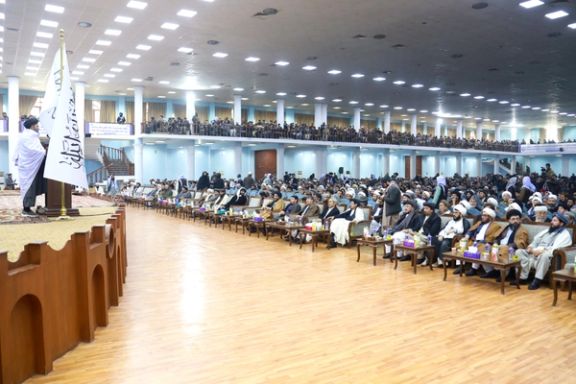
The Taliban announced that the High Shia Commission of Afghanistan organised a gathering at the Loya Jirga Hall in Kabul to express support for the group’s rule and promote national unity.

During the event, Abdul Ghani Baradar, the Taliban’s Deputy Prime Minister for Economic Affairs, claimed that Afghanistan’s ethnic and religious diversity symbolises national unity. He asserted that Afghanistan belongs to all its people and that everyone has equal rights under Taliban rule.

However, the Taliban does not recognise the Jafari school of thought (Shia jurisprudence) and has removed it from the educational system, basing its laws solely on Hanafi jurisprudence. Over the past three years, the group has imposed severe restrictions on Shia religious ceremonies.

During the gathering on Thursday, Mullah Baradar declared that “there are no differences based on minority status, ethnicity, or religion in Afghanistan,” insisting that the Taliban values diversity as a unifying factor.

For over three years, the Afghanistan Shia Scholars Council has repeatedly demanded official recognition of the Jafari sect, the inclusion of Jafari jurisprudence in schools and universities for Shia students, and meaningful representation in government. The Taliban has ignored these demands.

Despite acknowledging Afghanistan’s ethnic and religious diversity, Baradar claimed that before the Taliban’s rule, these differences were misused to divide the country. He accused political parties of undermining national unity, stating that their presence prevented Afghanistan from achieving true cohesion.

However, in practice, the Taliban has excluded not only Shias but also other ethnic and religious minorities from government positions. There are currently no Hazaras or Shias in the Taliban’s cabinet. In addition to sidelining ethnic and religious groups, the Taliban has systematically erased women from public life, leading to accusations of gender apartheid.

The Taliban’s Deputy Prime Minister’s Office confirmed that the High Shia Commission of Afghanistan organised the gathering at the Loya Jirga Hall, attended by senior Taliban officials and several Shia figures. Reports indicate that the commission was established by the Taliban itself.

Sources told Afghanistan International that the Taliban pressured the commission to bring around 5,000 people to the event to stage a show of support for the regime. A similar pro-Taliban gathering was previously organised by the same commission in Balkh province.

The commission is led by Mohammad Ali Akhlaqi, a former member of parliament.

The United States Commission on International Religious Freedom has repeatedly reported that religious minorities in Afghanistan face threats from both ISIS and the Taliban. The commission states that under Taliban rule, Shias, Hindus, and Sikhs have been subjected to severe religious persecution.

Despite these reports, Mullah Baradar insisted during the event that the Taliban’s rule is the result of sacrifices made by all Afghans. He stated that maintaining national unity is essential for the country’s political and economic progress.

Most Viewed

Taliban Order Cut To Residential Fibre-Optic Internet In Kabul, Say Sources
1

Taliban Order Cut To Residential Fibre-Optic Internet In Kabul, Say Sources

2

Taliban Leader Adviser Arrested In Kandahar Over Alleged Bribery

3

Taliban Besieged TOLOnews Offices After Journalist Detentions, Say Sources

4

Exiled Media Watchdog Urges UN, EU To Seek Release Of Journalists Held By Taliban

5

Taliban Urges Turkmenistan To Implement 24-Hour Operations At Torghundi Port

•
•
•

More Stories

Taliban Publicly Flogs Man For Theft In Samangan

Feb 27, 2025, 10:56 GMT+0

The Taliban Supreme Court has announced that a primary court in Feroz Nakhchir district, Samangan province, publicly flogged a man convicted of theft. The individual received 39 lashes and was sentenced to one year in prison.

In a statement issued on Thursday, the Taliban Supreme Court confirmed that the sentence was carried out in the presence of local officials, court attendees, and members of the public after receiving judicial approval.

On Wednesday, the Taliban Supreme Court also reported that its local courts in Bamiyan, Herat, and Laghman provinces had publicly flogged at least 13 individuals on various charges.

Over the past three days, the Taliban has subjected more than 30 people across Afghanistan to public floggings. The group claims these punishments are conducted in accordance with “Islamic Sharia law,” despite widespread international condemnation of corporal punishment.

Taliban Push For Trade Balance Amid Economic Isolation

Feb 27, 2025, 10:29 GMT+0

Despite international trade and banking sanctions and continued diplomatic isolation, the Taliban’s Ministry of Commerce has reiterated its commitment to balancing Afghanistan’s imports and exports.

In a joint meeting with the private sector, the ministry claimed that achieving economic self-sufficiency remains a key objective.

In a statement released on Wednesday, the Taliban’s Ministry of Industry and Commerce announced a meeting focused on facilitating the transportation of large commercial and transit shipments through the Herat-Khaf and Hairatan-China railway routes.

Nooruddin Azizi, the Taliban’s Minister of Industry and Commerce, stressed the need for trade balance, stating that their goal is to attain economic independence. “Trade will continue with the transfer of goods at reasonable rates. If shipment volumes increase, exports will also grow, ultimately stabilising the value of the national currency,” he said.

Ahmadullah Zahid, the Deputy Minister of Industry and Commerce, also underscored the Taliban’s efforts to achieve economic self-reliance. He highlighted the fight against administrative corruption, the reduction of bureaucracy, and urged Afghan investors abroad to invest in the country with confidence.

However, despite the Taliban’s emphasis on trade balance, Afghanistan continues to face a significant trade deficit. Currently, 90 percent of the country’s consumer goods are imported.

According to the National Statistics and Information Authority, Afghanistan’s imports reached $8.6 billion over the past nine months, while exports stood at just $1.3 billion. The country primarily produces agricultural and livestock products but relies heavily on imports for most other essential goods. Additionally, Afghan companies still lack the capacity to export agricultural goods on a larger scale.

International banking and trade sanctions have further worsened Afghanistan’s economic struggles. The Taliban’s promises to boost exports come as their government remains unrecognised by the international community.

A recent World Bank report warned that the sharp decline in foreign aid, economic isolation, and uncertainty in financial policies have left Afghanistan’s economy in a fragile state.

China To Build Housing For Afghan Refugees, Says Ambassador

Feb 27, 2025, 09:31 GMT+0

China’s ambassador to Kabul, Zhao Xing, has announced Beijing’s readiness to construct shelters and residential townships for Afghan refugees. The pledge was made during a meeting on Wednesday with the Taliban’s Minister of Refugees, Abdul Kabir.

According to a statement released by the Taliban’s Ministry of Refugees on Sunday, the Chinese ambassador highlighted the long-standing diplomatic and political relations between the two countries and reaffirmed China’s commitment to continued economic development and investment cooperation in Afghanistan.

Zhao Xing also expressed China’s willingness to provide humanitarian aid for Afghan refugees and facilitate the construction of housing for them within Afghanistan.

During the meeting, Abdul Kabir raised concerns over the forced deportation of Afghan refugees from neighbouring countries, stating that it has significantly disrupted domestic aid distribution efforts.

Both Iran and Pakistan have recently intensified their expulsion of Afghan refugees. Iranian authorities have announced plans to deport all undocumented Afghan migrants in the coming months while imposing further restrictions on their employment opportunities. Meanwhile, Pakistan has set a deadline of the end of March for Afghan refugees with temporary residency to leave the country and has also announced plans to relocate all Afghan refugees from Islamabad and Rawalpindi to other areas.

The Taliban’s Minister of Refugees reiterated the group’s plans to establish residential townships for Afghan refugees and called for cooperation from humanitarian organisations in this effort. Abdul Kabir assured the Chinese ambassador that any aid provided would be distributed transparently and fairly to those in need.

BBC’s Alleged Backing Of Taliban Administration Sparks Controversy

Feb 26, 2025, 18:06 GMT+0

The UK-based investigative news outlet UnHerd has reported that the BBC and its affiliated organisation, BBC Media Action, have been making significant payments to the Taliban.

So far, the BBC’s press office has not responded to Afghanistan International’s inquiries regarding its financial interactions with the group.

Allegations of Payments to the Taliban

According to UnHerd, the BBC has been paying the Taliban’s security agencies to protect its broadcasting infrastructure in Afghanistan. If true, these payments could potentially breach UK and US sanctions against the Taliban.

The report, authored by Ali Hamedani and David Rose, highlights that since the Taliban’s return to power in 2021, the group has resumed public executions, imposed gender apartheid, and intensified restrictions on freedom of speech. Despite the Taliban shutting down multiple independent media outlets, the BBC has continued operations in Afghanistan—raising concerns over its relationship with the group.

The investigation suggests that the BBC may have adjusted its editorial policies to avoid broadcasting reports that could upset the Taliban, allegedly exerting internal pressure on its journalists to comply.

BBC’s Relationship with the Taliban

UnHerd’s report claims that while the Taliban has banned international broadcasters such as Voice of America and Radio Free Europe/Radio Liberty—both direct competitors of the BBC—the Taliban has maintained favourable ties with the British broadcaster.

It also notes a meeting in 2022 between Jacky Martens, BBC’s South Asia bureau chief, and Sirajuddin Haqqani, the Taliban’s Interior Minister. The timing of this meeting, which occurred just two weeks before the Taliban banned Voice of America and Radio Free Europe, raises suspicions about BBC’s editorial stance and its continued operations inside Afghanistan.

Sirajuddin Haqqani, who heads the Haqqani Network, remains on international sanctions lists and is wanted for terrorism-related activities. At the time of the meeting, the Taliban’s Ministry of Interior described the BBC as an important international media organisation, with Haqqani stating that he expected “neutrality” in its reporting on Afghanistan.

Funding Taliban-Controlled Media and Security Forces

The investigation claims that the BBC has been making direct payments to Radio Television Afghanistan (RTA), the state broadcaster now under Taliban control. Despite BBC’s refusal to disclose exact figures, a spokesperson confirmed that the payments covered transmitter usage, electricity costs, and security expenses.

However, UnHerd’s findings indicate that these payments extend to security services provided by Taliban officials—notably under Haqqani’s leadership.

Further, the report alleges that BBC Media Action, the charity arm of the BBC engaged in educational projects in Afghanistan, may have transferred up to 60 percent of its UK and US government funding to the Taliban under the guise of taxes and operational fees.

Both Sirajuddin Haqqani and Qari Mohammad Yousuf Ahmadi, the Taliban-appointed head of RTA, remain on sanctions lists, making any financial transactions with them potentially illegal under UK law.

The UnHerd report states:

“Aside from his avowed extremism, Haqqani is the former head of the so-called Haqqani Network, a group responsible for kidnapping British citizens and conducting deadly suicide bombings. Since Haqqani remains on Britain’s sanctions list, it is a criminal offence under UK law to have any financial dealings with him. Qari Mohammad Yousuf Ahmadi, head of RTA, is on the sanctions list too, not least for writing articles glorifying attacks on Western troops.”

Reaction to the Report

Following the publication of UnHerd’s investigation, Richard Grenell, the former US presidential envoy and Deputy Director of National Intelligence, urged Elon Musk to address the allegations, noting that USAID funding had previously supported the BBC.

Editorial Censorship in Favour of the Taliban

UnHerd further reported that BBC’s Afghanistan service appears to suppress anti-Taliban content that is otherwise covered by other BBC sections.

According to the report, the BBC has ceased airing Western music in its programming, though the broadcaster stated that it occasionally includes Afghan music in its broadcasts.

One BBC journalist, speaking anonymously, confirmed that editorial self-censorship has increased under Taliban pressure. The journalist stated:

“People call and beg us to play more music on air, but we don’t—because if we do, our operations inside Afghanistan could be shut down.”

Additionally, UnHerd found that Taliban complaints have led to internal investigations into BBC journalists, raising concerns about the broadcaster’s independence.

BBC Media Action’s Deal with Taliban-Controlled Media

The investigation also revealed that BBC Media Action signed a memorandum of understanding with Taliban-controlled RTA, securing a $1.9 million agreement for health education projects.

BBC officials confirmed that Media Action has been paying the Taliban-imposed taxes on staff salaries and operational activities.

Despite these allegations, the BBC defended its continued presence in Afghanistan, stating that it remains proud to be the only international broadcaster still operating in the country.
Uzbekistan, Pakistan Strengthen Counterterrorism & Regional Cooperation Efforts

Feb 26, 2025, 16:20 GMT+0

The leaders of Uzbekistan and Pakistan have reaffirmed their commitment to combating terrorism, extremism, and security threats while enhancing regional cooperation.

Uzbek President Shavkat Mirziyoyev and Pakistani Prime Minister Shehbaz Sharif underscored the importance of coordinated counterterrorism measures and strategic partnerships during their meeting in Tashkent.

Ahead of the Pakistani Prime Minister’s visit, a high-ranking Taliban delegation, led by Mullah Abdul Ghani Baradar, also traveled to Uzbekistan. According to a press release from Baradar’s office, the Taliban’s Deputy Prime Minister reiterated the group’s policy of neutrality in foreign affairs. “Our foreign policy towards neighbouring and regional countries is based on neutrality and non-interference, and we expect the same from our neighbours and the international community,” he stated. Baradar also assured regional nations that Afghan territory would not pose a security threat to them.

On Tuesday, Shehbaz Sharif arrived in Uzbekistan for an official two-day visit. During their meeting, Mirziyoyev and Sharif emphasised the need for collaboration on infrastructure projects, particularly the Afghan-Trans railway initiative. Uzbekistan had previously announced that construction on the railway would commence this year.

The estimated cost of the project has been assessed at $4.6 billion by the Uzbek Transport Design and Research Institute, whereas Pakistan’s estimates suggest the cost could reach $8.2 billion.

In a statement issued on Wednesday, the Uzbek presidency noted that Mirziyoyev and Sharif discussed key regional, trade, and international matters. According to the statement, freight transport along the Uzbekistan–Afghanistan–Pakistan corridor has increased fivefold in recent years.

Following their discussions, the two leaders agreed to formulate a joint roadmap to implement the agreed-upon initiatives, further strengthening economic and security ties between the two nations.