Iranian Workers Leaving For Afghanistan In Search Of Better Wages

Mohsen Bagheri, a representative in Iran’s Supreme Labour Council, has stated that Iranian workers are leaving for Afghanistan and Iraq in search of better wages.

Mohsen Bagheri, a representative in Iran’s Supreme Labour Council, has stated that Iranian workers are leaving for Afghanistan and Iraq in search of better wages.
He said that employers in Iran are struggling due to a shortage of workers, while many Iranians are seeking jobs abroad. He noted that most of these workers are looking for simple jobs in neighbouring countries.
Bagheri attributed this trend to Iran’s weak domestic labour market, which has forced workers to seek opportunities elsewhere.
According to Entekhab news agency, he also claimed that Afghan migrants in Iran are no longer taking on physically demanding jobs, such as working in mines. Instead, he alleged that many now occupy well-paid jobs in northern Tehran, replacing Iranian workers.
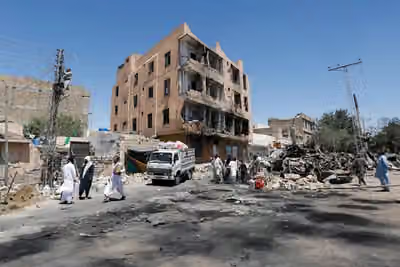

Ehsanullah Ehsan, former spokesperson of Tehreek-e-Taliban Pakistan (TTP), has claimed that Pakistan is increasingly concerned about the Taliban’s growing ties with India. He also alleged that Pakistan is using ISIS to pressure the Afghan Taliban.
On Sunday, 10 March, The Sunday Guardian, an Indian newspaper, published an article by Ehsan. He argued that Pakistan has long used ISIS as a proxy force in Afghanistan to destabilise the region and weaken the Taliban’s control.
Tensions between Pakistan and the Taliban have increased over accusations of Islamabad’s alleged support for ISIS. In response to Pakistan’s criticism of the Taliban for backing TTP militants, the Afghan Taliban accused Pakistan of harbouring ISIS members in Balochistan.
Pakistan’s Foreign Ministry strongly denied this claim. However, Ehsan wrote that Pakistan’s renewed use of militant groups in Kashmir and Afghanistan reflects its strategic failures.
India supported Afghanistan’s former government but has since strengthened its diplomatic, trade, and political ties with the Taliban. Meanwhile, the Taliban, once a Pakistani proxy, has shifted towards closer engagement with India.
According to Ehsan, Pakistan does not want Afghanistan to develop strong ties with India. He claimed that Islamabad fears New Delhi’s growing influence in the region.
Ehsan alleged that Pakistan is now attempting to destabilise Afghanistan to pressure the Taliban, using ISIS as one of its tools. He warned that the rise of ISIS in Afghanistan could further damage relations between the Taliban and Pakistan.
The claim that Pakistan supports ISIS has been repeatedly made by Afghan Taliban officials. Recently, after the arrest of one of the perpetrators of the September 2021 Kabul airport attack in Pakistan, the Taliban accused Islamabad of protecting ISIS members and giving them safe havens.
Taliban officials also alleged that ISIS-Khorasan leaders and fighters have been relocated to Khyber Pakhtunkhwa and Balochistan with help from Pakistani intelligence agencies.
Pakistan has strongly rejected these accusations, calling them baseless. It has also denied the presence of ISIS-Khorasan leaders, fighters, or training camps in its territory.
Historically, the Afghan and Pakistani Taliban have been allies, supporting each other in conflicts. TTP militants fought alongside the Afghan Taliban against Afghanistan’s previous government. Now, in return, the Afghan Taliban is accused of providing sanctuary to TTP fighters in Afghanistan.

Afghan and Pakistani tribal elders have agreed on a temporary ceasefire at the Torkham border until 11 March. The decision was made during the first round of a tribal jirga, aimed at easing border tensions.
According to sources, both sides agreed not to construct any new military installations along the border during this period.
The jirga took place on Sunday and included 35 representatives from Taliban-controlled Afghanistan and 40 from Khyber Pakhtunkhwa, Pakistan. The province shares a border with Nangarhar, Afghanistan, and Torkham remains one of the most critical crossing points between the two countries.
A reliable source stated that the jirga participants, including tribal elders and Pakistani officials, decided to form a joint assessment team on 11 March. This team will review disputed construction activities by the Taliban near the border. The next steps will be determined based on this assessment.
Local sources confirmed that once the border dispute is resolved, the Torkham crossing will reopen, restoring trade and travel between Afghanistan and Pakistan.
The Torkham border has been closed for 16 days due to rising tensions. Pakistani officials accused the Taliban of building checkpoints inside Pakistan’s territory, a claim the Taliban denied. The group insisted it was only constructing a post on Afghan soil.

Friedrich Merz, Germany’s Chancellor-in-waiting, has announced that once his government takes office, the refugee admission programme, including those for Afghans, will be suspended.
Merz also stated that, in coordination with neighbouring countries, Germany will reject asylum requests at shared borders.
On Saturday, 8 March, Merz, who won Germany’s parliamentary elections, said in a meeting with potential coalition partners that his government would take all legal measures to reduce illegal migration.
He confirmed that border controls would be tightened from the first day of the new administration. He also emphasised that migration restrictions would be included in residency laws.
Referring to refugee admission programmes, including those for Afghanistan, he said these must end.
Markus Söder, leader of Bavaria’s Christian Social Union (CSU), announced that deportation flights to Afghanistan and Syria would be organised. However, flights from Afghanistan to Germany would no longer take place.
German officials also stressed that family reunification programmes for those with subsidiary protection would be suspended.
During the meeting, officials also proposed allowing Federal Police to request temporary or pre-departure detention for asylum seekers required to leave Germany.
The Christian Democratic Union (CDU) and the Christian Social Union (CSU) also plan to examine whether individuals with dual citizenship could lose their German nationality if they are found to be extremist or antisemitic.

Iranian security forces have arrested 150 undocumented Afghan migrants in Sistan and Baluchestan province, according to Ebrahim Nouri, police commander of Hamun County.
Nouri stated that the arrests were part of the “Social Security Enhancement” initiative. He confirmed that the detained migrants have been handed over to authorities for deportation.
On Sunday, 9 March, Nouri said the operation aimed to improve social security and increase public satisfaction. He also reported that several drug addicts and small-scale drug dealers were arrested during the crackdown. He stressed that tackling illegal migration remains a top priority for security forces.
Authorities in Sistan and Baluchestan, which shares a border with Afghanistan, have recently intensified deportations of Afghan migrants. On Saturday, Hamid Noori, police chief of Zahedan province, reported that 486 Afghan migrants were arrested under the same initiative and transferred for deportation.
Earlier, Ali Akbar Habibifar, police chief of Zabol city, announced the arrest of 172 undocumented Afghan migrants.
In the past year, Iran has tightened restrictions on Afghan migrants, making work and living conditions increasingly difficult. Under new Iranian laws, employing or renting property to Afghan migrants is now a criminal offence punishable by prosecution.

Pakistan did not consult the Taliban regarding the extradition of Mohammad Sharifullah to the United States, according to Aqeel Malik, Adviser to Pakistan’s Ministry of Law and Justice.
Sharifullah, the alleged mastermind behind the deadly ISIS attack at Kabul airport, was arrested in Pakistan and later handed over to U.S. authorities.
The U.S. Department of Justice previously stated that Sharifullah was involved in multiple attacks, including the March 2024 concert hall bombing in Moscow, which killed at least 145 people.
Malik explained that Sharifullah was arrested at the Pakistan-Afghanistan border and later extradited to the U.S.. He stated that there was no need to consult Afghanistan on the matter.
He also clarified that while Pakistan does not have a formal extradition treaty with the U.S., it follows specific procedures allowing extradition if the requesting country provides the necessary legal documentation.
In an interview with RIA Novosti, Malik also claimed that U.S. weapons left in Afghanistan are being used in terrorist attacks inside Pakistan.
Pakistan’s Prime Minister, Shehbaz Sharif, confirmed that Sharifullah is an Afghan citizen.
On Tuesday, 4 March, U.S. President Donald Trump, in a speech before a joint session of Congress, announced that the mastermind behind the Kabul airport bombing—which killed 13 U.S. soldiers and over 170 Afghan civilians—had been captured with Pakistan’s cooperation.
Following Trump’s statement, Kash Patel, Director of the FBI, confirmed that Sharifullah had been transferred to the U.S. and would face “American justice”.
The attack at Kabul airport occurred on 26 August 2021, during the chaotic evacuation of U.S. and NATO forces. A suicide bombing at the Abbey Gate entrance killed 13 U.S. troops and over 170 Afghan civilians, leaving dozens more injured.