• العربية
  • پښتو
  • فارسی
Brand
  • Afghanistan
  • Sport
  • Markets
  • Afghanistan
  • Sport
  • Markets
  • Theme
  • Language
    • العربية
    • پښتو
    • فارسی
  • Afghanistan
  • Sport
  • Markets
All rights reserved for Volant Media UK Limited
volant media logo

Torkham Border Remains Closed To Travellers Due To Repairs, Says Pakistan

Mar 21, 2025, 09:06 GMT+0

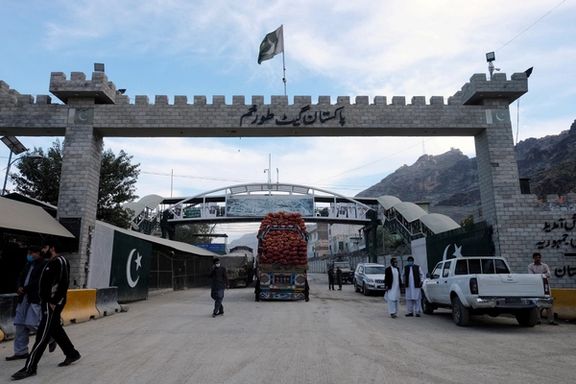
Pakistani officials at the Torkham border have announced that the crossing will remain closed to travellers and patients on Friday due to ongoing repairs at the immigration office.

In a statement, the Torkham border administration advised travellers and patients to avoid the crossing until normal operations resume. Officials did not clarify the nature of the repairs, but security sources claim that Taliban border forces damaged Pakistan’s immigration systems during recent tensions.

According to the sources, the technical issues are expected to be resolved by the end of the day. The crossing is scheduled to reopen for passengers on Saturday.

The Torkham border was partially reopened on Wednesday after being closed for 27 days. At that time, only cargo trucks and patients were allowed to cross.

The border was originally shut on 21 February following a clash between Pakistani border forces and the Taliban. The dispute arose over the construction of a Taliban checkpoint and the installation of a Pakistani signboard at the zero-point. Two jirga meetings were held between Afghan and Pakistani representatives in efforts to reopen the crossing.

Most Viewed

Taliban Ignore Afghanistan’s Interests By Backing Militants, Says Pakistan Army Chief
1

Taliban Ignore Afghanistan’s Interests By Backing Militants, Says Pakistan Army Chief

2

Female Ismaili Entrepreneur Shot Dead In Badakhshan

3

Afghanistan May Not Remain Intact In Future, Says Pakistani Analyst

4

French Parliament Hosts Two-Day Meeting On Afghanistan

5

United Nations Delivers Education Kits To Four Million Afghan Children

•
•
•

More Stories

US Citizen Freed From Taliban Custody; No Update On Mahmood Shah Habibi

Mar 20, 2025, 17:06 GMT+0

The US State Department has confirmed the release of George Glezmann, an American citizen, from Taliban custody. However, there is still no update on the status of Mahmood Shah Habibi, an Afghan-American citizen who remains detained by the Taliban.

The State Department reiterated that American citizens are still being held in Afghanistan. Earlier, two separate Taliban sources told Afghanistan International that following increased US pressure, Habibi was transferred to Kandahar about a year ago.

According to the US State Department, Glezmann was freed through diplomatic mediation by Qatar. Before him, Ryan Corbett and William McKenty were released in January in exchange for a Taliban prisoner. The agreement for Corbett and McKenty’s release was finalised in the final hours of Joe Biden’s presidency. The Taliban agreed to exchange them for Khan Mohammad, a Taliban member serving a life sentence in the US on terrorism charges. This deal was also brokered by Qatar, which hosted several rounds of US-Taliban negotiations and provided logistical support for their evacuation from Kabul.

CNN reported that US officials had sought to include Glezmann and Habibi in the exchange, but the Taliban refused to release them. The Taliban have not officially acknowledged Habibi’s detention, but the US still considers him a hostage.

According to the US State Department, George Glezmann was employed as a mechanic for Delta Airlines. After the fall of the previous Afghan government, he remained in Afghanistan. He travelled abroad three months before his arrest, but just four days after returning to Kabul, he was detained by the Taliban.

The Taliban accuse Mahmood Shah Habibi of collaborating with the CIA in identifying the hideout of Ayman al-Zawahiri, the leader of al-Qaeda, in Kabul. Al-Zawahiri was killed on 31 July 2022 in a US drone strike in the Sherpur area of Kabul.

First US Delegation Visits Afghanistan, Meets Taliban Foreign Minister

Mar 20, 2025, 15:03 GMT+0

The Taliban's Ministry of Foreign Affairs has announced that Adam Boehler, the US Special Envoy for Prisoners, and Zalmay Khalilzad, former US Envoy in Afghanistan, met with Taliban Foreign Minister Amir Khan Muttaqi in Kabul to discuss the release of prisoners.

Muttaqi described the visit as a positive step in the relationship between the Taliban and Washington. This marks the first visit by a US delegation to Afghanistan since the American forces withdrew from the country in August 2021. Previously, US officials and Taliban representatives had met in Qatar and Norway.

The Taliban’s Foreign Ministry stated on Thursday that Boehler and Khalilzad travelled to Kabul to discuss prisoner exchanges, bilateral relations, and consular services for Afghans in the United States. Muttaqi welcomed the meeting, stressing that the Taliban seeks constructive relations with all countries within the framework of its balanced foreign policy. He highlighted the need for dialogue to resolve issues and build positive political and economic ties, overcoming the effects of the 20-year war.

According to the Taliban Foreign Ministry, Boehler stated that progress in prisoner negotiations is a significant step in fostering trust between the two sides. He also praised the Taliban's efforts in combating drug trafficking and maintaining security. He emphasised the importance of continued dialogue and strengthening relations through negotiations.

In the final days of his presidency, US President Joe Biden intensified efforts to secure the release of American hostages held by the Taliban. In a recent exchange, the US and the Taliban swapped three prisoners: American citizens Ryan Corbett and William McKenty were released in exchange for Khan Mohammad, a Taliban member imprisoned in the United States. Qatar facilitated the exchange.

While meeting with the family of a US hostage, Mike Waltz, the U.S. National Security Advisor, warned that Donald Trump would not show leniency to groups or countries holding American citizens hostage.

The exact number of US citizens currently detained by the Taliban remains unclear. However, Mahmood Shah Habibi, an Afghan-American and former head of Afghanistan's Civil Aviation Authority, is known to be in Taliban custody. Sources told Afghanistan International that he is being held in one of Taliban leader Hibatullah Akhundzada’s prisons in Kandahar.

Taliban Systematically Restricts Minorities’ Rights & Services, Says Rights Group

Mar 20, 2025, 13:51 GMT+0

Rawadari, a human rights organisation, has exposed widespread violations against ethnic and religious minorities in Afghanistan under Taliban rule.

In its latest report, the group accuses the Taliban of deliberately denying minorities access to government services, infrastructure projects, and humanitarian aid.

Taliban Interference in Humanitarian Aid Distribution

The report examines Afghanistan’s human rights situation in 2024, highlighting that the Taliban distributes humanitarian aid based on ethnic affiliation and loyalty to the group.

In Badakhshan, no infrastructure projects have been carried out in Ismaili-majority areas, with aid primarily directed to Taliban-controlled regions such as Warduj district. Similarly, in Daikundi, development projects are selectively allocated based on ethnic criteria, while in Bamiyan, Hazara-majority areas have been deprived of humanitarian assistance.

Rawadari cited a relief organisation official in Kandahar who reported that Taliban officials submitted a list of 150 individuals linked to the group when coordinating aid distribution for returnees.

Discrimination in Government Hiring and Exclusion of Minorities

The Taliban has actively prevented ethnic and religious minorities from working in government institutions and has dismissed them from official positions.

The report states that in Herat, all minority employees who worked in government offices under the previous administration have been removed. In Badakhshan, no Ismaili followers remain in government positions across six Ismaili-majority districts. In Nimruz, Shia Muslims have been completely excluded from government offices.

In Kunar, 12 university professors were dismissed for being Salafi. In Ghazni, Bamiyan, and Daikundi, Hazara employees were collectively removed and replaced with Taliban affiliates.

Religious Discrimination and Suppression

The Taliban has systematically removed religious books belonging to minorities from educational and cultural institutions. In Bamiyan, Ghazni, and Daikundi, books related to Jafari jurisprudence have been confiscated from universities and libraries.

In Badakhshan, Ismailis are being pressured to adopt Hanafi jurisprudence. Construction of Ismaili religious sites has been banned in Shighnan and Eshkashem. The report also states that in certain provinces, marriages between Sunni and Shia individuals have been prohibited, with only Sunni men allowed to marry Shia women.

Rise in Forced Disappearances and Targeted Killings

The report highlights a sharp increase in forced disappearances and targeted killings in 2024. Rawadari documented that in 10 provinces, at least 51 individuals have gone missing after being arrested by the Taliban, marking a 70 percent rise compared to 2023.

Most of those targeted are former government employees, human rights activists, and individuals accused of supporting opposition groups. The report also states that at least 91 former government employees and their family members were killed or injured in targeted attacks.

In 2024 alone, at least 885 individuals, including 42 women, were arbitrarily arrested and imprisoned.

Torture and Killings in Taliban Prisons

Rawadari’s findings indicate that at least 20 prisoners have been killed under Taliban custody after being tortured, while 13 others were transferred to hospitals due to severe mistreatment.

The report also states that most women’s prisons lack female staff. Only a few women, mainly guards or inspectors, work in public prisons and return home at night.

The Taliban has claimed that around 20,000 people are currently held in their prisons, mostly accused of collaborating with opposition groups or spreading anti-Taliban propaganda.

Sources in Kabul report a surge in arbitrary arrests. An informed source told Afghanistan International that prisons receive financial support from international organisations, creating incentives for the Taliban to increase the number of detainees. The source alleged that this is why arbitrary arrests have intensified across the country.
Spain Strips Taliban Envoy Of Diplomatic Immunity Over Sexual Assault Allegations

Mar 20, 2025, 12:08 GMT+0

The Spanish government has revoked the diplomatic immunity of Mohammad Rahim Peerzada, the Taliban’s acting ambassador in Madrid, following allegations of sexual assault and harassment.

Peerzada is accused of using his position to target women, with reports suggesting he drugged and raped one victim.

Three European newspapers—The Daily Telegraph, El País, and Die Welt—reported that Peerzada allegedly used a sedative in one assault. A Madrid court had previously ruled in September that he could not be prosecuted due to his diplomatic immunity.

Peerzada assumed control of the Afghan embassy in Madrid after the Taliban seized power in Kabul in 2021. He later aligned the embassy’s operations with the Taliban’s Foreign Ministry. In October 2023, the embassy announced it was officially coordinating with the Taliban and processing documents through Kabul. Despite this, Spain does not recognise the Taliban government or maintain an embassy in Afghanistan.

After complaints from Afghan residents, the Spanish government withdrew Peerzada’s diplomatic privileges. Spain’s Ministry of Foreign Affairs told The Telegraph: “This person does not represent any official delegation, is not accredited in Spain, and does not enjoy diplomatic immunity in our country.”

Drugging and Sexual Assault Allegations

On Wednesday, The Telegraph reported that an Afghan woman, identified as Anis, filed a complaint against Peerzada with the Madrid Public Prosecutor’s Office last summer. She accused him of sexual assault.

According to her account, Peerzada met her at an embassy event on International Women’s Day in March 2022 and offered her a job. He later invited her to a bar to discuss the opportunity. She alleged that he spiked her Coca-Cola with an unknown substance, after which her last memory was being taken to a hotel before being dropped off at a train station.

Speaking to Die Welt, she described feeling weak, with blurred vision and an urgent need to sleep. Peerzada has denied the allegations. It remains unclear whether Madrid’s courts will reopen the case or if new charges will be filed.

Attempted Rape Allegations

Die Welt interviewed multiple women who claimed to have been harassed or assaulted by Peerzada. According to El País, another Afghan woman in Spain alleged that Peerzada attempted to rape her.

She said she had initially met him at a restaurant to discuss the situation of 4,000 Afghan refugees in Spain. Later, at his apartment, she claimed he pushed her onto his bed and tried to assault her. Speaking under the alias Simin, she told the Spanish newspaper: “I thought he was going to rape me. I was terrified but tried not to show it. I pushed him away and said, ‘I didn’t come here to have sex with you’.”

According to her, despite rejecting his advances, Peerzada persisted.

Embassy Response: Denial and Threats

Afghanistan International contacted Peerzada for a response, but he did not reply. Hours later, the Afghan embassy in Madrid issued a statement dismissing the allegations as baseless conspiracies.

Without directly addressing the accusations, the statement claimed the women should take their cases to Spanish authorities so the embassy could be held accountable under the law. However, in a threatening tone, it warned that the embassy “reserves the right to restore its reputation” and would pursue legal action against those behind the allegations.

Afghan Migrants In Balochistan Challenge Forced Deportation In Court

Mar 20, 2025, 11:16 GMT+0

Afghan migrants in Pakistan’s Balochistan province have filed a petition in the High Court to stop their forced deportation. They argue that all avenues for appeal have been closed, leaving legal action as their only option.

On 7 March, the Pakistani government ordered all undocumented Afghan migrants, including those holding Afghan Citizen Cards (ACC), to leave the country by 31 March. Authorities warned that forced deportations would begin after the deadline. However, arrests and expulsions had already started in cities like Islamabad and Rawalpindi nearly two months ago.

Officials from the Afghan refugee council in Balochistan told Afghanistan International that a group of Afghan representatives, elders, and community leaders filed the lawsuit on 18 March.

Zahir Pashtun, one of the representatives, criticised Pakistan’s decision, calling it an unfair move targeting Afghan migrants during a time of crisis. He emphasised that Afghan refugees are not involved in criminal or terrorist activities.

“Afghan migrants have lived in Pakistan for nearly four decades. We cannot relocate our 40 years of life back to our homeland in just a few days,” he said.

Babrak, another Afghan refugee representative in Balochistan, stressed that many refugees have built businesses, farms, and homes in Pakistan. He noted that the short timeframe does not allow them to liquidate their assets and relocate. He also urged Pakistan to grant citizenship to Afghan refugees born in the country over the past 40 years.

The petitioners are calling for a comprehensive repatriation mechanism involving Pakistan, Afghanistan, the United Nations, and Afghan refugee representatives.

The Pakistani government estimates that around 800,000 Afghan refugees currently hold ACCs. Additionally, authorities have warned that Afghan migrants with Proof of Registration (PoR) cards will also face deportation after June this year.

With decades of life in Pakistan and inadequate facilities in Afghanistan, Afghan migrants now face an uncertain future.