Taliban Flogs Theft Suspect In Balkh, Sparks Rights Concerns
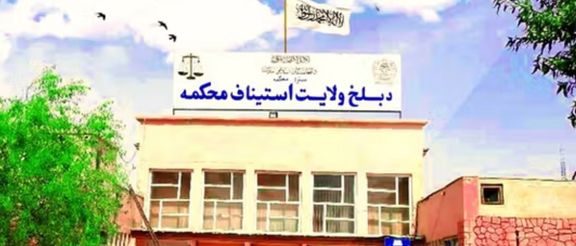
The Taliban’s Supreme Court announced that an individual accused of theft was publicly flogged in Kaldar district, Balkh province, on Wednesday, 26 March.
The Taliban’s Supreme Court announced that an individual accused of theft was publicly flogged in Kaldar district, Balkh province, on Wednesday, 26 March.
The court stated that the person received 37 lashes and was sentenced to one year and six months in prison following a ruling by local judicial authorities, approved by the Taliban’s highest court.
Details about the trial process, including whether the individual had legal representation, were not disclosed in the statement. The flogging was carried out in public, a practice the Taliban frequently employs across Afghanistan for those their courts deem guilty.
Such punishments have fuelled widespread fear and intimidation among Afghan communities. International human rights organisations have repeatedly criticised the Taliban’s justice system, highlighting the absence of fair trial mechanisms under their rule.

Richard Bennett, the UN Special Rapporteur on Human Rights in Afghanistan, has urged FIFA to allow Afghan women footballers in exile to resume international competition, condemning the Taliban’s systematic gender discrimination.
In a Wednesday post on X, Bennett expressed solidarity with the athletes.
“I support the call by the Sport & Rights Alliance for FIFA to take a strong stand against systematic gender oppression and ensure that Afghan women footballers in exile, who are barred from playing in Afghanistan, can return to international competition,” he wrote.
The Sport & Rights Alliance had previously echoed this demand on X, pressing FIFA to address the discrimination that prevents exiled Afghan women footballers from participating. Human Rights Watch and other organisations have similarly urged FIFA and the alliance to facilitate their return to competitive matches.
In a recent letter, FIFA reaffirmed its commitment to monitoring the situation of women’s football in Afghanistan. The organisation stressed that supporting women’s football remains a priority and that it is exploring practical, sustainable ways to improve Afghan women and girls’ access to the sport.
The United Nations Assistance Mission in Afghanistan (UNAMA) has voiced “deep disappointment” as the Taliban’s ban on girls’ education enters its fourth year, coinciding with the start of the new academic year.
In a statement, UNAMA chief Roza Otunbayeva stated that the Taliban disregards the Afghan people’s demands.
She added that the ban not only jeopardises girls’ futures but undermines peace and well-being for all Afghans. She warned that the policy exacerbates Afghanistan’s already severe human rights, humanitarian, and economic crises, further isolating the country from the global community.
The new school year began approximately a week ago, yet girls above the sixth grade remain barred from classrooms, a restriction enforced by the Taliban’s Ministry of Education since their 2021 takeover. The ban extends to universities, where female students have also been excluded for four consecutive years.
Otunbayeva highlighted the closure of girls’ schools as a primary obstacle to Afghanistan’s recovery. She said that it dims prospects for improvement and must be lifted.
The ongoing denial of education to Afghan girls has drawn widespread condemnation. Amnesty International, UNICEF, and prominent global figures have renewed calls for the Taliban to reverse the policy. Despite this, the Taliban has shown no willingness to relent, maintaining its stance amid mounting pressure.
Amrullah Saleh, former Vice President of Afghanistan, has labelled the Taliban a covert proxy for Western intelligence agencies, particularly the United States, in an interview with India’s Deccan Herald published Wednesday.
Saleh cast doubt on US President Donald Trump’s pledge to recover American weapons from the Taliban, suggesting it may be a symbolic gesture rather than a substantive policy.
"I do not know if it is just one of those headline-media slogans or if it will be backed by real actions," Saleh said of Trump’s call to retrieve weapons valued at £5.5 billion ($7 billion). He speculated that Trump aims to "publicly ride the Taliban once to show that they are under control, and then the US will start to tap them, hug them, and feed them more than before.”
Saleh, a vocal critic of the Taliban, claimed that nearly 100,000 NATO and US weapons have vanished since the group’s 2021 takeover of Afghanistan. He said "We know their serial numbers and the location from which they went missing. The word ‘missing’ is strange. It can mean stolen, sold or simply sent to secret location for secret purposes."
Reports since the Taliban’s return to power suggest American arms are surfacing beyond Afghanistan’s borders. Pakistan has accused the Taliban of arming the Tehreek-e-Taliban Pakistan (TTP) and Baloch militants, who are using these weapons against Pakistani forces. Similar claims have emerged from India, with allegations of US-made arms appearing in Kashmir.
Pakistan has repeatedly pointed to Afghanistan as a sanctuary for the TTP, a charge the Taliban denies despite evidence of growing insurgent activity.
Saleh also critiqued India’s warming relations with the Taliban, accusing New Delhi of sidelining Afghan factions that favour a pluralistic system. He suggested India is engaging the Taliban to mitigate terrorism risks or subtly influence the group’s structure. However, he warned that the Taliban’s inherent nature makes them a destabilising force.
The US National Intelligence Agency has excluded Afghanistan from its latest annual report on terrorist threats to national security, released Tuesday, despite documented evidence of Islamic State (ISIS) and Al-Qaeda presence in the Taliban-controlled nation.
This marks a stark shift from last year’s assessment, which referenced Afghanistan six times and the Taliban eight times.
The 2025 US Intelligence Community’s global threat report highlights Al-Qaeda leadership in Iran and its operatives in Somalia, Syria, and West Africa, but omits any mention of their activities in Afghanistan. This comes despite United Nations Security Council reports confirming Al-Qaeda and ISIS-Khorasan (ISIS-K) fighters remain active there. A UN report recently noted senior Al-Qaeda figures in rural Sar-e Pul, Kunar, Ghazni, Logar, and Wardak provinces, with lower-ranking members residing in Kabul under Taliban protection.
The omission follows the US decision to lift a bounty on Sirajuddin Haqqani, the Taliban’s interior minister, and two other Haqqani Network members. The move coincided with a US delegation visit to Kabul, led by Adam Boehler, Donald Trump’s hostage affairs envoy, and Zalmay Khalilzad, former US envoy to Afghanistan. The Taliban subsequently released an American hostage.
Taliban spokesperson Zabihullah Mujahid told Al Arabiya on Tuesday that discussions with Trump’s team included requests to control Afghanistan’s embassy in Washington and reopen the US embassy in Kabul. “We are awaiting their response,” he said.
The report identifies ISIS-K as a rising threat, describing it as the most capable South Asian affiliate for launching attacks abroad. It warns of the group’s efforts to expand into Central Asia, Iran, Russia, and the West, using online platforms to recruit and inspire attacks. Last year’s attacks in Russia and Iran, alongside arrests of ISIS supporters in Europe and the US, highlight its growing operational reach.
Al-Qaeda, meanwhile, retains its intent to target the US and its citizens, the report states. Leaders, some based in Iran, have sought to exploit anti-Israeli sentiment over the Gaza conflict to galvanise attacks against Israel and the US.
The report acknowledges the capabilities of Tehreek-e-Taliban Pakistan (TTP) and its historical ties to Al-Qaeda but stops short of addressing Pakistan’s repeated assertions that TTP uses Afghanistan as a safe haven. The UN has warned of TTP’s cross-border activities, yet the US assessment remains silent on the issue.
The Taliban insists it has suppressed ISIS-K in Afghanistan, yet the group’s Khorasan branch continues to stage attacks within the country. Last year, US intelligence flagged ISIS-K’s plans to target foreign entities in Afghanistan, alongside the Taliban’s restrictive policies on women and girls and its failure to address the nation’s humanitarian crisis.
The exclusion of Afghanistan from this year’s report raises questions about evolving US priorities as the Taliban seeks diplomatic engagement with Washington.
Zabihullah Mujahid, the Taliban spokesperson, stated that Taliban officials discussed several issues during recent talks with a US delegation.
In an interview with Al Arabiya on Tuesday, Mujahid confirmed that the Taliban requested the US hand over control of Afghanistan’s embassy in Washington. The Taliban also asked the US to reopen its embassy in Kabul.
The Taliban spokesperson said they are awaiting a response from the US delegation.
Last week, a US delegation visited Kabul, led by Adam Boehler, advisor to Donald Trump on hostage affairs. Former US envoy to Afghanistan Zalmay Khalilzad was also part of the delegation. During their visit, they met with Taliban Foreign Minister Amir Khan Muttaqi.
After the US visit, the Taliban released George Glezmann, an American citizen who had been held captive. Following Glezmann’s release, the US removed bounties previously placed on Taliban Interior Minister Sirajuddin Haqqani and two other Haqqani network members.
Mujahid called the removal of these bounties a positive step toward better relations with the US.
He emphasized the reopening of Afghanistan’s embassy in Washington to provide consular services to Afghans in the US. Mujahid also expressed hope for reopening the US embassy in Kabul. He stressed the need to improve bilateral ties based on mutual interests.
The US closed its embassy in Kabul following the withdrawal from Afghanistan in August 2021. Currently, US diplomats handling Afghan affairs operate from Qatar.
Mujahid confirmed that the US delegation returned home with requests and demands from the Taliban. However, he did not disclose further details and said the Taliban is waiting for the US to take the next step.
The US continues to demand the release of Mahmood Shah Habibi, an Afghan-American former official who remains in Taliban custody. Washington has also cooperated with the Taliban on intelligence against ISIS.
Over the past three and a half years, the US has provided nearly $3 billion in aid to Taliban-controlled Afghanistan. The Taliban expects this aid to continue.