Afghanistan Exports First Dried Fruit Shipment To Europe Via Herat-Khaf Railway
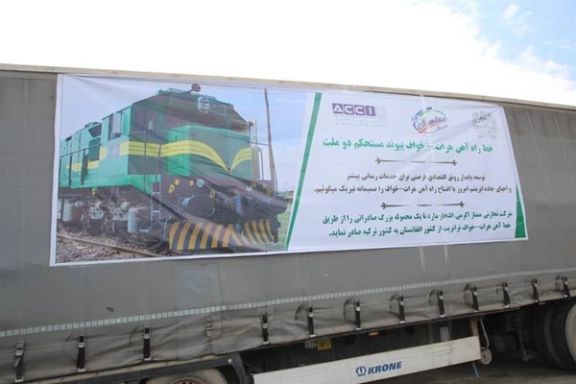
Afghanistan has sent its first export shipment to Europe, valued at £950,000, via the Khaf-Herat railway, according to the Taliban governor’s office in Herat.
Afghanistan has sent its first export shipment to Europe, valued at £950,000, via the Khaf-Herat railway, according to the Taliban governor’s office in Herat.
The cargo, consisting of 200 tonnes of dried fruits such as pistachios, raisins, almonds, and pine nuts, was dispatched to Türkiye and Europe through the Afghanistan-Iran rail corridor.
The Iranian embassy in Kabul confirmed the shipment’s transit, highlighting its role in boosting Afghanistan’s economy. The consignment was sent off in the presence of Herat’s Taliban governor, Iran’s consul general, and representatives from both public and private sectors. The Taliban governor’s office stated on Thursday that the shipment, processed in Herat, was the first collected nationwide by the Akrami Group of Companies for export to Europe.
Over the past three months, the Khaf-Herat railway has facilitated the transport of more than 35,000 tonnes of goods, the governor’s office added. The Iranian embassy underscored that this rail corridor, developed in collaboration with Iran, is set to enhance Afghanistan’s economic prospects.

Western nations are quietly aligning with United Nations efforts to reintegrate the Taliban into the global community under the guise of counterterrorism, according to a report by French newspaper Le Monde.
The report, published this week, reveals that several Western countries have been establishing discreet communication channels with the Taliban, marking a shift from their earlier positions.
Le Monde notes that since early 2025, European and Scandinavian nations have resumed diplomatic engagement with Taliban officials. These interactions, kept low-profile, are presented as efforts to bolster counterterrorism and maintain regional influence. The report suggests that political realism has overtaken human rights concerns, particularly regarding women’s rights and education access, in Western approaches to Afghanistan.
According to the paper, surveillance footage from late 2024 showed foreign diplomatic convoys departing Kabul airport, hinting at CIA meetings with Taliban intelligence and political leaders—the first such encounters on Afghan soil since the Taliban’s return to power. For the few Western diplomats in Kabul, this signals a new phase in relations with the hardline regime.
The Taliban has framed the release of American prisoners as a gesture of “goodwill,” with its Ministry of Foreign Affairs expressing a desire for genuine engagement with the United States and others based on mutual interests. In a meeting with Adam Boehler, the US Special Presidential Envoy for Hostage Affairs, Taliban Foreign Minister Amir Khan Muttaqi stressed moving beyond the 20-year war to build political and economic ties.
Following these talks, the United States lifted sanctions on three senior Taliban figures: Interior Minister Sirajuddin Haqqani, Abdul Aziz Haqqani, and Yahya Haqqani. Le Monde also reports frequent visits to Kabul by British diplomat Robert Dickson and German diplomat Rolf Dieter Reinhardt, both based in Doha, alongside Danish and Dutch counterparts. While a French diplomat from Qatar has visited Afghanistan once, French intelligence maintains a steady presence, though France and Canada resist normalising ties.
The report speculates that Western governments are unofficially supporting a more moderate Taliban faction, led by the Haqqani Network under Sirajuddin Haqqani, which favours pragmatism. This contrasts with the strict policies of Taliban leader Hibatullah Akhundzada. Despite internal divisions, Le Monde concludes that Taliban unity remains paramount, upheld even by the Haqqanis, ensuring their ongoing control.
The World Food Programme (WFP) has projected that 3.5 million Afghan children will experience malnutrition this year, the highest level in four years, signalling an escalating crisis.
The UN agency also estimates that 1.2 million pregnant and breastfeeding mothers in Afghanistan are currently malnourished and require urgent treatment and nutritional support.
In a report published on Wednesday, WFP indicated that around 15 million Afghans need emergency food aid to survive. It revealed that 8 out of 10 families cannot afford even basic, low-nutrient food, with three-quarters of households borrowing money to cover essentials.
Mona Shaikh, WFP’s head of nutrition, described the worsening conditions, stating, “People are in a very difficult situation. We are seeing more and more women and children coming to the clinics. Many of these mothers are very young.” She added, “If mothers are malnourished, their children will also suffer,” noting that the influx of women seeking help at healthcare facilities has consistently surpassed projections.
The report underscored WFP’s role as a critical lifeline for women struggling to feed themselves and their children, while pointing to Taliban restrictions that continue to marginalise women, forcing them into desperate measures. On Tuesday, WFP cautioned that without immediate funding, its child malnutrition prevention programmes in Afghanistan, Yemen, and Syria could halt within months. The agency requires $1.4 billion to maintain operations across 56 countries in 2025.
International organisations have reported a sharp rise in humanitarian needs since the Taliban’s takeover, with poverty and hunger intensifying. However, in his recent Eid al-Fitr address, the Taliban’s supreme leader rejected claims of economic hardship, calling them “propaganda of malicious circles and intelligence organizations” and urging Afghans to dismiss such narratives.
The Taliban has signed contracts worth 20.75 billion Afghanis (over £230 million) with domestic and foreign companies for ten power generation projects, aimed at producing 228 megawatts of wind, thermal, and solar energy across Afghanistan.
The agreements, announced on Thursday by officials from the Taliban-run electricity company, Breshna, also include the construction of substations and the expansion of power lines in various cities.
The projects encompass seven power generation facilities, two initiatives to complete the 110-kilovolt Kajaki-Kandahar transmission line, and one focused on substations in Qalat, Zabul, and eastern Kandahar. Specific developments include 43.2 MW of wind power and 5 MW of solar power in Herat, 50 MW of gas-powered electricity in Jowzjan, 40.25 MW of solar power in Balkh, 40 MW in Logar, 40 MW in Nangarhar, and 10 MW in Laghman. Additional efforts involve building a substation in Mohammad Agha district of Logar and finalising power line expansions from Zabul to Kandahar.
Details of the private companies awarded the contracts remain undisclosed by the Taliban. At the signing ceremony, Breshna Chief Executive Abdul Bari Omar said, “the company is striving to enhance power supply by relying on domestic energy sources.”
Afghanistan currently faces a severe energy crisis, as highlighted by a United Nations Development Programme (UNDP) report. With only 40 percent of households connected to electricity, the country relies on imports for over 75 percent of its energy needs, primarily from Central Asia.
A 2022 report by the Special Inspector General for Afghanistan Reconstruction (SIGAR) noted that Afghanistan spends £172 million annually on imported electricity, which constitutes over 80 percent of its power supply. The report also underscored the Taliban’s challenges with technical expertise, staffing, and revenue to maintain the nation’s energy infrastructure.
Rana Sanaullah, a senior adviser to Pakistan’s prime minister, has indicated that the March 31 deadline for expelling undocumented Afghan refugees is not final and may be reconsidered.
Speaking to ARY News on Wednesday night, Sanaullah said the Pakistani government would decide after reviewing the results of Special Envoy Sadiq Khan’s recent visit to Kabul. He emphasised the deadline is flexible, not fixed.
Referring to Khan’s discussions with Afghan officials, including Taliban representatives, Sanaullah suggested changes to the refugee policy could be made based on those talks.
He added that Pakistan will take a decision aligned with its national interests, despite various statements made on the issue.
Pakistan previously announced plans to expel hundreds of thousands of Afghan refugees, including undocumented migrants and Afghan Citizen Card (ACC) holders, after March 31.
Authorities have justified the move by alleging the involvement of Afghan nationals in terrorist attacks inside Pakistan.
Taliban leader Hibatullah Akhundzada called for unity and warned against internal divisions in his Eid al-Fitr message released on Thursday.
In the statement, Akhundzada cited a Quranic verse urging Muslims to avoid disputes in matters of jihad. He described unity as the key to success, encouraging Taliban members to strengthen it and remain alert to “enemy conspiracies.”
Akhundzada emphasised his commitment to defending Afghanistan’s Islamic system and Sharia-based governance, while notably omitting any mention of women’s rights or the ongoing ban on girls’ education beyond sixth grade.
He claimed Afghans now celebrate Eid in safety and happiness under Taliban rule. Akhundzada contrasted this with previous conditions, when he said citizens faced bombings, house searches, imprisonment, and funerals instead of celebrations.
Addressing economic concerns, Akhundzada dismissed reports of widespread poverty in Afghanistan as “propaganda” aimed at discouraging people. However, international organisations, including the United Nations, report that nearly half of Afghanistan’s population faces poverty and unemployment. The UN Office for the Coordination of Humanitarian Affairs recently noted that almost 23 million Afghans require humanitarian aid.
In his message, Akhundzada praised the Taliban’s Ministry for the Propagation of Virtue and Prevention of Vice, saying its efforts had significantly reduced wrongdoing. He called for further cooperation between the Taliban and the public to eliminate corruption and uphold Islamic morals.
Akhundzada instructed Taliban-controlled institutions to align educational curricula with Sharia law, reinforcing the implementation of Islamic punishments under Hanafi jurisprudence in Taliban courts.
On international affairs, Akhundzada condemned Israeli attacks on Gaza, describing them as acts of oppression and horror. He urged Islamic countries to support Palestinians in reclaiming their rights, emphasising that the issue of Palestine concerns the entire Muslim world.
Since regaining power, the Taliban have faced widespread international condemnation for severe restrictions imposed on women and girls. Akhundzada, who governs from Kandahar, continues issuing restrictive decrees that have drawn sharp criticism globally.