UAE Envoy Visits Kabul, Pledges Humanitarian Aid & Stronger Ties With Taliban
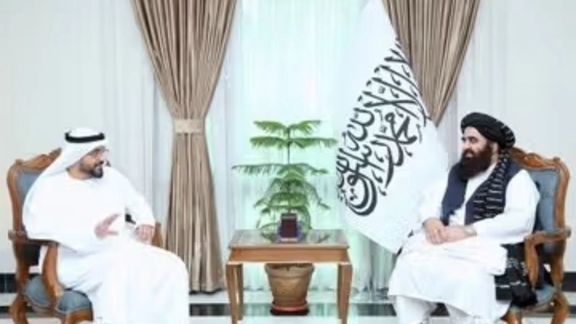
The United Arab Emirates (UAE) has reiterated its firm and ongoing commitment to providing humanitarian aid to the people of Afghanistan.

The United Arab Emirates (UAE) has reiterated its firm and ongoing commitment to providing humanitarian aid to the people of Afghanistan.
In a statement issued by the Ministry of Foreign Affairs, the UAE confirmed that Saif Mohammed Al Ketbi, the UAE’s Special Envoy to Afghanistan, had emphasised the country’s dedication to deepening cooperation with Afghanistan. This includes support for refugee repatriation, addressing humanitarian needs, and contributing to the country’s stability and development.
Al Ketbi, accompanied by a high-level UAE delegation, visited Kabul last Thursday. He held meetings with senior Taliban officials, including Amir Khan Muttaqi, the Taliban’s Acting Foreign Minister; Abdul Salam Hanafi, Deputy Prime Minister for Administrative Affairs; and Nooruddin Azizi, Minister of Industry and Commerce.
According to the statement released on Monday, the talks focused on ways the UAE can support both humanitarian and development efforts in Afghanistan.
Al Ketbi also discussed strengthening economic ties and supporting reconstruction projects during his meeting with the Taliban’s commerce minister.
The statement underlined Al Ketbi’s reaffirmation of the UAE’s “steadfast commitment and continued support” for the Afghan people.
Separately, the Taliban’s Ministry of Industry and Commerce stated that both sides agreed on enhancing trade relations. They reportedly discussed the potential appointment of a Taliban commercial attaché in the UAE, the establishment of an Afghanistan trade centre to manage imports and exports, and facilitating the participation of Afghan industrialists and traders in the Gulfood exhibition in Dubai.
The Taliban’s Ministry of Foreign Affairs also noted that discussions between Muttaqi and Al Ketbi covered the expansion of bilateral ties, visa facilitation, and regional developments.


Andrey Serenko, head of the Russian Centre for Contemporary Afghanistan Studies, has warned that Afghanistan is heading toward a fresh civil war. He claimed that the Taliban’s survival is temporary and largely due to support from the United States.
In a recent interview, Serenko said the Taliban regime is unsustainable and will not endure—even with American funding or the rise of Sirajuddin Haqqani, despite international support for him.
He argued that once a civil war begins, foreign actors will withdraw, leaving Russia with no choice but to intervene. However, Serenko acknowledged that Moscow is not currently prepared to do so due to its ongoing war in Ukraine and the pressure of international sanctions.
Still, he urged the Kremlin to start preparing for future instability in Afghanistan. He stressed the need for a multi-faceted foreign policy, warning against reliance on a single approach. Serenko advised that Russia should engage with various Afghan factions to safeguard its long-term interests.
He said that internal divisions within the Taliban have worsened since they took power. While the group initially tried to maintain unity, infighting and rivalry have escalated.
In addition to internal fractures, Serenko pointed to growing armed resistance. He named groups such as the National Resistance Front and the Afghanistan Freedom Front, which continue to launch attacks—particularly in areas where Taliban officials now fear to appear after dark.
US Support: The Taliban’s Lifeline
Serenko accused the United States of propping up the Taliban regime to avoid renewed instability. He questioned who would implement the Doha Agreement if the Taliban collapsed, implying this concern drives continued US engagement.
He described the US as the Taliban’s primary financial backer and claimed Washington handed over power in Afghanistan to the group. This, he argued, explains why American support continues.
Serenko dismissed any notion that the Taliban’s past resistance to US forces makes them potential allies for Russia, calling the idea “absurd.” He insisted no other country cooperates with the Taliban as extensively as the US does.
Despite this backing, Serenko predicted the Taliban’s rule will not last. He said their three and a half years in power are not significant in historical terms. He compared the situation to previous Afghan regimes, noting the communist government survived over a decade before falling, while the republican government collapsed in just three days. He suggested the Taliban will meet a similar end.
Russia’s Taliban Delisting Decision Raises Concerns
Serenko also addressed Russia’s recent move to consider removing the Taliban from its list of terrorist organisations. When asked about the benefits of this action, he expressed scepticism.
He warned that delisting the Taliban would not make them allies. Instead, it could damage relations with anti-Taliban resistance groups that still look to Russia for support.
Russian state media previously reported that the Prosecutor General’s Office has asked the Supreme Court to temporarily remove the Taliban from the list. The court is expected to review the request on 17 April.

Women’s rights and human rights activists have called on Amnesty International, UNAMA, the UN Human Rights Council, and other global bodies to urgently intervene in the case of Qadriya, a domestic violence survivor from Baghlan province.
They say the Taliban have placed her life in danger by handing her over to her father—who had previously called for her to be stoned to death.
Qadriya, 28, had warned in a video recorded from Kiligai Prison in Baghlan that the Taliban planned to release her into her father’s custody. She expressed fear for her life and said she might be killed once returned to her family home.
On Saturday, 5 April, the Taliban freed her and handed her over to her father. Her current whereabouts remain unknown. A group of activists has described the handover as a “criminal act.”
Campaigners from within Afghanistan, particularly from the Purple Saturdays Movement, have appealed to international human rights organisations, foreign governments, and justice advocates to raise their voices and protest on Qadriya’s behalf.
The statement stressed that Qadriya is not a criminal, but a woman who has endured prolonged abuse and violence.
In her video message, Qadriya revealed that her father filed a complaint against her in a Taliban court two years ago, demanding she be sentenced to death by stoning. At the time, she had fled to her sister’s home in Kabul to escape domestic violence in her father’s household.

The United Nations Assistance Mission in Afghanistan (UNAMA) has called on donor countries to maintain their support for the Afghan people in 2025. The agency warned that 22.9 million Afghans remain in urgent need of humanitarian assistance.
The appeal comes ahead of the Afghanistan Coordination Group meeting, set to take place this week in Istanbul, Türkiye. In a statement received by Afghanistan International, UNAMA stressed the critical importance of sustained international aid.
The meeting will bring together representatives from donor countries, international financial institutions, and UNAMA officials.
Indrika Ratwatte, UN Humanitarian Coordinator and Deputy Special Representative of the UN Secretary-General for Afghanistan, emphasised the need to preserve key resources and systems that support the Afghan population.
She also highlighted the importance of transitioning from emergency aid to long-term, sustainable solutions. Ratwatte described this shift as vital not only for Afghanistan but also for the wider region and the global community.
In 2024, international humanitarian partners secured $3.21 billion to address humanitarian and basic needs in Afghanistan.
UNAMA noted that the United Nations 2024 Annual Results Report for Afghanistan will be released alongside the Istanbul meeting. The report details the progress achieved through international support over the past year.
The statement added that donor contributions have enabled the UN to deliver life-saving aid and improve essential services across the country, including services for women and girls.

Pakistan’s current plan to expel millions of Afghan refugees back to Afghanistan is sweeping in scale, dangerously short-sighted, and irresponsibly politicised. The Taliban regime’s response, meanwhile, has been equally dismal and reprehensible.
The history of Afghan refugees in Pakistan is one of stark contrasts. On one hand, the host communities—particularly in FATA, Khyber Pakhtunkhwa, and Balochistan—have shown extraordinary compassion and hospitality. On the other hand, the Pakistani military and state authorities have frequently politicised and manipulated the refugee issue in pursuit of ill-conceived foreign and security policies. However, the current actions by the Pakistani government represent an entirely new level of recklessness and irresponsibility.
International human rights organisations, refugee advocacy bodies, and the United Nations have repeatedly urged Pakistan to refrain from this humanitarian catastrophe. Citing fears of persecution and serious threats to life upon return to Afghanistan, UN experts have “urged Pakistan to immediately halt mass internal relocations, deportations, arrests, evictions, intimidation, and other forms of pressure on Afghans... and to uphold the absolute and non-derogable principle of non-refoulement”. Similar appeals from Pakistani citizens, civil society leaders, and political figures have also gone unheeded.
The justifications offered by Pakistani policymakers for this callous campaign are largely unfounded. Afghan refugees are not responsible for Pakistan’s deepening woes—be they related to security, economic decline, poor governance, systemic discrimination, or widespread public discontent. Drawing upon the support of the Afghan diaspora abroad, as well as their own resilience and hard work, these refugees have, in fact, contributed more to their host country than they have taken.
The true motivation behind the Pakistani government’s latest actions appears to be political frustration—an attempt to pressure the Taliban into aligning with Islamabad’s security agenda. For over two decades, Pakistan offered sanctuary and support to the Taliban, defying the appeals of Afghanistan, the U.S., and a coalition of over 40 countries. This era of international counterterrorism was marked by deception on a grand scale and unfulfilled promises from Pakistan. Yet the Taliban now seem either unwilling or unable to rein in Tehrik-e-Taliban Pakistan (TTP), who are partly to blame for the ongoing violence and instability within Pakistan.
There is little doubt that supporting the Taliban’s return to power was a grave strategic miscalculation by Pakistan—one whose consequences both countries are now forced to endure. But to assume that the Taliban will shift their policies in response to the plight of Afghan refugees, merely to satisfy Islamabad’s security concerns, is an even greater error in judgement.Compounding this is the expectation of cordial relations between the two nations, even as millions of Afghans are expelled under conditions marked by egregious abuses and mistreatment—experiences that have deeply shocked both Afghanistan and the international community.
The Taliban leadership undeniably bears significant responsibility for the current suffering of millions of innocent Afghans—just as it is responsible for the widespread human rights abuses and the systemic oppression of women and girls within Afghanistan. These violations are the primary drivers of mass displacement and the principal reason so many Afghans refuse to return home.
Ultimately, the establishment of a legitimate, accountable state in Afghanistan—one that upholds its obligations to its people and the international community—is essential. Without this, voluntary, safe, and sustainable repatriation of Afghan refugees will remain impossible. Moreover, such a transformation—achieved through an intra-Afghan political settlement—is essential not only for the stability of Afghanistan and Pakistan, but also for the wider security of the region and the world.

The Iranian Embassy in Kabul announced on Sunday that Seyed Mohammad Atabak, Iran’s Minister of Industry, Mining, and Trade, will soon visit Afghanistan.
The announcement followed a meeting between Atabak and Iran’s ambassador to Kabul, Alireza Bikdeli, held in Tehran.
According to the embassy, Atabak highlighted the importance of strengthening economic cooperation with Afghanistan. He confirmed that he would travel to Kabul leading a delegation.
Iran is seeking to expand its trade relations with the Taliban government. Previously, Iran’s Foreign Minister, Abbas Araghchi, also visited Kabul.
Iran currently holds the largest volume of trade with Taliban-ruled Afghanistan. Official trade between the two sides is valued at around four billion US dollars.
Taliban officials have encouraged foreign investment in Afghanistan’s mining, oil, and gas sectors.
To further enhance trade and support cross-border commerce, the governor of Iran’s South Khorasan province recently announced plans to open an Iranian consulate in Farah. In return, the Taliban will open a consulate in Birjand.
The tone of Iranian officials towards the Taliban shifted following a visit by a high-ranking US delegation to Kabul.
During his recent visit, Araghchi praised the Taliban’s control over Afghan territory. He said the return of Afghan refugees would be gradual and respectful, in line with Taliban requests.
Araghchi also declared that a new chapter in Iran’s relationship with Taliban-led Afghanistan has begun.