Around 6000 Afghan Migrants Deported From Iran, Pakistan, Says Taliban
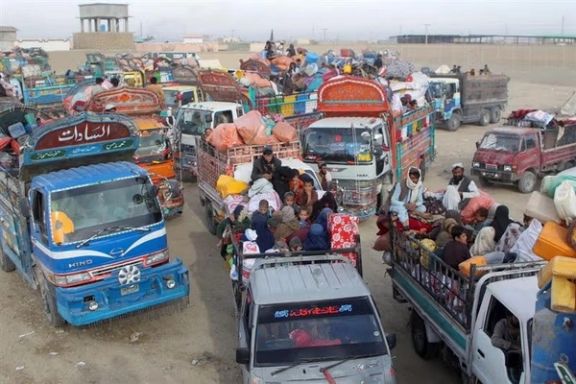
The Taliban’s commission for addressing migrants’ issues announced that a total of 5,932 Afghan migrants were deported from Iran and Pakistan on Tuesday, 8 April.

The Taliban’s commission for addressing migrants’ issues announced that a total of 5,932 Afghan migrants were deported from Iran and Pakistan on Tuesday, 8 April.
According to the commission’s statement, 3,743 individuals were expelled from Pakistan, while 2,189 were deported from Iran.
The report detailed that 3,500 families re-entered Afghanistan via the Torkham border crossing, 243 families through Spin Boldak, 1,549 individuals via Pul-e-Abrisham and 640 migrants from Islam Qala.
In response to the surge in deportations, Hamdullah Fitrat, the deputy spokesperson for the Taliban, confirmed that a commission meeting was held to address the challenges faced by returning migrants. The commission also announced the establishment of a temporary camp for returnees at the Torkham crossing.
In a separate development, the Taliban’s Ministry of Refugees and Repatriations stated that 40 Afghan migrants were deported from Pakistan after completing prison sentences.
These measures come amid intensified deportation efforts by both Iran and Pakistan. Reports indicate that Pakistan has launched mass expulsions following the expiration of a deadline for the voluntary return of Afghan nationals, with hundreds of Afghan migrants reportedly being detained and deported daily.
Concerns remain among several returnees regarding inadequate access to drinking water, food and other essential necessities at the Taliban-operated camp at Torkham.


Mohammad Reza Aref, Vice President of Iran, during a visit to Khorasan Province, called for strengthening cross-border relations with neighbouring countries, particularly Afghanistan.
He highlighted the significant opportunities that nations like Afghanistan and Pakistan present for Iran’s border provinces, including Khorasan.
Emphasising the crucial role of provincial governors in fostering these ties, Aref stated, “We hope Khorasan Razavi becomes a successful model for international cooperation.”
He further noted that President Pezeshkian’s administration aims to enhance the province’s position in national economic development and bolster its prominence in trade with neighbouring countries.
Aref also referred to the 300-million-strong market of the broader Iranian civilisational region, underlining Iran’s commitment to exporting goods and services, especially in technical and engineering sectors. He stressed the importance of mutual engagement with this market.
According to Aref, border provinces have the necessary authority to expand ties with neighbours. Central Asia, along with proximity to Afghanistan and Pakistan, offers valuable opportunities for Khorasan Razavi.
Pointing to shared cultural and historical links, Aref encouraged the full utilisation of these connections and expressed hope that, with effective management, the province could serve as a successful model for decentralising authority to other provinces.
These remarks come amid growing ties between officials in Iran’s Razavi and South Khorasan provinces and the Taliban in Herat and other Afghan border regions. Recently, the governor of South Khorasan announced plans to open an Iranian consulate in Farah and a Taliban consulate in Birjand.
Following deteriorating Taliban-Pakistan relations, Iran has emerged as Afghanistan’s most significant economic partner, with bilateral trade reaching approximately USD 4 billion.

The humanitarian organisation Médecins Sans Frontières (MSF) has reported the first confirmed cases of child malnutrition in a refugee camp on the Greek island of Samos.
According to MSF, six children, aged between six months and six years, from Afghanistan and Syria are suffering from acute malnutrition and are in urgent need of medical assistance.
The Samos Reception and Identification Centre, funded by the European Union, opened in 2021 as a replacement for the former Vathy camp, which once accommodated up to 7,000 people. MSF noted that the six malnourished children entered the facility earlier this year.
Amnesty International has previously criticised conditions at the camp, citing instances of overcrowding, water shortages, and lack of essential services, which it described as “inhumane and degrading.”
While MSF stated that it cannot conclusively link the malnutrition cases to the children’s stay in the camp, it warned that insufficient food supplies and limited access to healthcare have significantly endangered their wellbeing.
“No child should suffer from malnutrition due to systemic neglect,” said Christina Psarra, MSF’s director general in Greece. She called for immediate intervention, highlighting that children make up approximately one-quarter of the camp’s population.
In response, Greece’s Ministry of Migration described the reported cases as isolated incidents. The ministry asserted that conditions in the camp do not indicate a broader issue of malnutrition, and noted that residents are provided with three meals per day.
According to United Nations data, Greece formerly the epicentre of Europe’s migration crisis in 2015 and 2016 has seen an increase in migrant arrivals in 2024. The country has received nearly one-third of all refugee entries to southern Europe from the Middle East and Africa so far this year.

The Taliban have reportedly suspended all Mushaira poetry events across Afghanistan, citing economic pressures and recent criticism voiced during literary gatherings.
Sources confirmed to Afghanistan International that the group's Ministry of Information and Culture has issued a verbal directive ordering provincial departments to halt the cultural programmes until further notice.
The Mushaira events, held over the past four years in various provinces, have been part of the Taliban’s efforts to promote cultural unity. However, the recent suspension follows a high-profile incident at the Naranj Gul festival in Nangarhar province, where poets recited critical verses and urged the Taliban’s supreme leader to appear publicly in Kabul.
Sources report that on Monday, the Taliban also cancelled the Gul-e-Arghawan poetry festival in Parwan province. Officials allegedly attributed the cancellation to bad weather, although local observers reported that weather conditions were favourable.
The Taliban have yet to issue an official statement on the matter.
While the Taliban had used the Mushaira events as a cultural tool, the gatherings have remained tightly controlled. Only poets and cultural figures aligned with the group's ideology were permitted to participate. Women have been entirely excluded, and romantic or critical poetry has been strictly prohibited.
The cancellations have sparked discontent not only among independent cultural voices but also from some pro-Taliban users on social media, who criticised the decision to suspend a programme intended to foster national cohesion.

The Trump administration has eliminated the remaining $562 million in aid to Afghanistan, a decision termed by the United Nations as potentially catastrophic.
The UN’s World Food Programme (WFP) warned the move “could amount to a death sentence for millions of people facing extreme hunger and starvation.”
According to US officials, the aid cuts could worsen humanitarian crises and increase instability in a country already reeling from years of conflict under Taliban rule. Officials caution that deteriorating conditions could push vulnerable populations toward extremist groups such as ISIS-Khorasan.
This funding reduction is part of a broader strategy that has seen over $1.3 billion in US humanitarian aid slashed globally. Cuts include $237 million from Syria, $170 million from Somalia, $107 million from Yemen, and $12 million from Gaza. These nations are grappling with ongoing conflicts and humanitarian emergencies, compounded by the loss of crucial U.S. support.
Sarah Charles, former head of the US Agency for International Development’s Office of Humanitarian Assistance, and nine other sources — including six current officials — confirmed the cuts to Reuters. “Every remaining USAID award for Afghanistan was terminated,” a source said, with funding to the WFP, a UN agency supporting Afghan women and girls, and at least six NGOs halted.
Five sources also stated that US aid to Afghan refugees, managed by the Department of State’s Bureau of Population, Refugees, and Migration, has been discontinued.
The UN estimates that 23 million people in Afghanistan, over half of them children, require humanitarian assistance. The WFP reported it reached nearly 12 million Afghans last year, with a focus on women and girls experiencing “extreme hunger.”
In 2024, the US has contributed $206 million to Afghan aid efforts, down from $736 million in 2023, when it was the largest donor. The UN Population Fund (UNFPA) has also cancelled a $24 million grant for reproductive health services in Afghanistan and a $17 million grant for Syria.
Cindy McCain, executive director of the WFP, said on X (formerly Twitter), “Cutting aid will deepen hunger, fuel instability, and make the world far less safe.”
In addition to the humanitarian fallout, the cessation of aid may destabilise Afghanistan’s economy. Humanitarian dollars flowing through UN agencies have helped stabilise the Afghan currency, and US officials warn the absence of such support could increase economic turmoil and migration pressures.

The Taliban’s Ministry of Refugees and Repatriation has strongly reacted the forced deportation of Afghan migrants from Pakistan, calling the move “contrary to Islamic principles, human rights, and international laws.”
In a statement issued on Tuesday, the ministry said no entity should use migrants as instruments for achieving political objectives. The Taliban also addressed similar actions by Iranian authorities, urging both Pakistan and Iran to halt what it described as the "violence and mistreatment of migrants."
According to the statement, Afghan migrants in Pakistan are being unlawfully detained from their homes, shops, and public spaces, then transferred to prisons before being forcibly expelled. The Taliban further claimed that the assets of Afghan migrants are being confiscated and their household goods seized.
“We urge the Islamic Republic of Pakistan and Iran to exercise patience and tolerance when dealing with migrants, and to respect the principles of good neighbourliness, Islamic values, and international law,” the statement read.
The ministry noted that despite the Taliban’s repeated calls for the voluntary repatriation of migrants through a joint mechanism based on mutual understanding and adequate preparation, Pakistan has initiated mass deportations.
The Taliban reiterated that while they are prepared to receive returning Afghan citizens, the ongoing mistreatment of migrants by neighbouring countries is "unacceptable and intolerable."
The group also appealed to international organisations, humanitarian agencies, and Afghan investors to urgently intervene and address the challenges faced by returning migrants.
With the deadline set by Pakistan for the expulsion of undocumented migrants now expired, thousands have been returned to Afghanistan. According to a recent report by the International Organization for Migration, more than 8,000 undocumented migrants and Afghan Citizen Card (ACC) holders were deported through the Torkham and Spin Boldak border crossings in the past two days alone.