• العربية
  • پښتو
  • فارسی
Brand
  • Afghanistan
  • Sport
  • Markets
  • Afghanistan
  • Sport
  • Markets
  • Theme
  • Language
    • العربية
    • پښتو
    • فارسی
  • Afghanistan
  • Sport
  • Markets
All rights reserved for Volant Media UK Limited
volant media logo

Taliban Rejects UNAMA’s Call To End Executions As ‘Intolerable Insult To Islamic Law’

Apr 16, 2025, 13:31 GMT+1

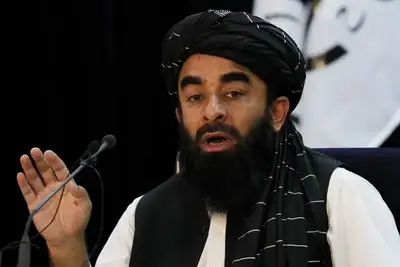
The Taliban’s Ministry of Foreign Affairs has reacted the United Nations Assistance Mission in Afghanistan (UNAMA) for urging an end to the use of capital punishment, calling the request “an insult to Islamic rulings, irresponsible, and intolerable.”

In a statement released on Wednesday, the ministry asserted that the implementation of the death penalty is an integral and non-negotiable part of Islamic Sharia law. It called on UNAMA to refrain from issuing similar criticisms in the future.

The ministry confirmed that four individuals were executed in the provinces of Badghis, Nimruz, and Farah after what it described as a “thorough judicial process.” It claimed the cases passed through three levels of court proceedings and that the accused had access to legal defence throughout all stages.

The Taliban warned UNAMA that public criticism of Sharia-based rulings contradicts the mission’s role and constitutes behaviour that the group considers “intolerable.” The statement added that the Taliban views the enforcement of Sharia punishments, including the death penalty, as a religious obligation.

Citing what it called the “proven effectiveness” of capital punishment in ensuring justice and maintaining social order, the Taliban defended its use of executions as a means of upholding Islamic legal principles.

The comments follow a statement by UNAMA condemning the execution of four men by the Taliban across three provinces. Two of the men were executed publicly in Qala-e-Naw, the capital of Badghis; another in Zaranj, Nimruz; and one in the city of Farah.

UNAMA said the executions violated the fundamental right to life and called on the Taliban to impose an immediate moratorium on the death penalty in Afghanistan.

The executions have drawn widespread condemnation from international human rights organisations and several governments.

Most Viewed

Taliban Issue New Family Law Rules On Marriage & Divorce
1

Taliban Issue New Family Law Rules On Marriage & Divorce

2

UN Funding Should Support Trump Policy Goals, Says US

3

Pakistan Dismisses Taliban Denial Over Bannu Police Attack

4

Taliban Governors, Intelligence Chiefs Hold Security Meet In Northern Afghanistan

5

China, Qatar Discuss Taliban-Pakistan Tensions & Regional Stability

•
•
•

More Stories

Khalilzad Says Pakistan May Be Using Afghan Deportations To Transfer ISIS Fighters

Apr 16, 2025, 11:32 GMT+1

Zalmay Khalilzad, former US Special Representative for Afghanistan Reconciliation, has expressed concern that Pakistani institutions may be using the ongoing deportation of Afghan refugees as a cover to transfer Islamic State (ISIS) militants into Afghanistan.

In a post published on X (formerly Twitter) on Wednesday, Khalilzad wrote: "Knowledgeable people tell me that they are concerned that the Pakistan establishment might well be using the expulsion of Afghan refugees as a cover to send ISIS terrorist to Afghanistan. I share this concern."

The remarks come amid increasing scrutiny over the humanitarian and security implications of Pakistan’s mass deportation campaign, which has seen hundreds of thousands of undocumented Afghan nationals forced to leave the country.

Since the Taliban’s return to power in Afghanistan in 2021, ISIS has carried out numerous deadly attacks across the country.

Pakistan has previously accused the Taliban of failing to curb the growing threat posed by ISIS. In March 2025, Pakistan’s Permanent Representative to the United Nations, Munir Akram, warned of rising terrorist threats originating from Afghan soil. He asserted that the Taliban had been ineffective in controlling ISIS and alleged Taliban collusion in attacks conducted by the Tehreek-e-Taliban Pakistan (TTP) against Pakistan.

Akram called for the UN Security Council to urgently address the threat of terrorism emanating from Afghanistan.

The Taliban, however, have repeatedly denied such accusations and claim to have taken significant steps to eliminate ISIS presence within the country.

Pakistan Victim Of Terrorism It Once Fostered In Afghanistan, Says Indian FM

Apr 16, 2025, 10:08 GMT+1

India’s Minister of External Affairs, S. Jaishankar, on Tuesday accused Pakistan of playing a “double game” with both the Taliban and the former Afghan government — a strategy he said has ultimately backfired following the withdrawal of United States forces from Afghanistan.

Speaking at Charotar University of Science and Technology (CHARUSAT), Jaishankar asserted that Islamabad had long supported terrorism in the region, only to fall prey to the very extremist networks it once cultivated.

“Whatever benefits they were getting out of the double game also disappeared. Moreover, the very terrorism industry they had promoted came back to bite them,” he stated.

Jaishankar argued that Pakistan’s strategic miscalculations have left it isolated in Afghanistan, especially in light of increasing attacks by Pakistani militants on the country’s own security forces since the Taliban’s return to power in 2021. This, he noted, came despite Islamabad’s decades-long backing of the Afghan Taliban against the former Western-supported government in Kabul.

The foreign minister also issued a pointed warning to Pakistan, cautioning that continued support for cross-border terrorism would bring “consequences.”

India and Pakistan have long accused each other of harbouring and supporting militant groups. In a notable shift, Pakistan has recently alleged that the Afghan Taliban — once seen as its close ally — is now cooperating with India.

Jaishankar highlighted what he described as a stark contrast between the two South Asian nations, framing India as a country advancing in economic and global stature, while portraying Pakistan as stuck in outdated policies of instability and proxy warfare.

“During this period, we have grown economically and politically, and our standing in the world has improved. But Pakistan continued the old playbook,” he said.

While Indian officials have typically maintained a cautious tone when discussing the Taliban, Jaishankar’s comments stand out as one of the clearest acknowledgements by a senior Indian leader that the group was a product of Pakistani patronage of terrorism.

Kabul To Host Seventh Pakistan–Taliban Joint Coordination Committee Meet

Apr 16, 2025, 09:05 GMT+1

The Taliban have announced that the seventh session of the Afghanistan–Pakistan Joint Coordination Committee will take place in Kabul.

Taliban spokesperson Zabihullah Mujahid stated on X (formerly Twitter) that the meeting will address “resolving potential disputes along the Durand Line and facilitating ease for the people on both sides.” He noted that these meetings are held alternately in Islamabad and Kabul.

According to Mujahid, the Pakistani delegation will be led by Mohammad Sadiq Khan, Pakistan’s Special Envoy for Afghanistan, while the Taliban delegation will be headed by Abdul Qayyum Zakir, the group’s Deputy Minister of Defence.

Sadiq Khan arrived in Kabul on the morning of Wednesday, 16 April, leading a high-level Pakistani delegation. Diplomatic sources confirmed to Afghanistan International that the visit is scheduled to be a one-day trip.

This meeting comes amid heightened tensions between the two sides. Pakistan has accused the Taliban of allowing Afghan territory to be used as a base for attacks against it, while the Taliban have, in turn, alleged that Pakistan is supporting ISIS by harbouring, training, and equipping its fighters.

In December 2024, Taliban Defence Ministry spokesperson Inayatullah Khwarizmi declared that the group does not recognise Khyber Pakhtunkhwa as part of Pakistan. The ministry also confirmed at the time that it had launched attacks across the “so-called Durand Line.”

UN Special Envoy Visits Paktia, Taliban Highlight Calls for Aid & Condemn Deportations

Apr 15, 2025, 17:05 GMT+1

The Taliban governor’s office in Paktia Province has announced the visit of Roza Otunbayeva, Head of the United Nations Assistance Mission in Afghanistan (UNAMA), to the south-eastern region.

According to a statement released on Tuesday, Otunbayeva met with Taliban Deputy Governor Inamullah Salahuddin and condemned Pakistan’s forced deportation of Afghan migrants. The statement quoted Otunbayeva as saying: “We condemn Pakistan’s actions, which forcibly expel Afghan migrants in violation of all principles.”

The Taliban also claimed that Otunbayeva pledged UNAMA’s support in mobilising international assistance for small businesses, education, agriculture, and essential services for returning migrants.

During the meeting, Salahuddin reiterated the Taliban’s interest in engaging with the international community in areas such as trade and development. He urged UNAMA to help convey to the world that Afghanistan is “on a path to stability and progress.”

As of now, Otunbayeva has not publicly commented on the visit.

Rights Activists Urge UN To End Forced Deportations Of Afghans From Iran, Pakistan

Apr 15, 2025, 15:45 GMT+1

In an open letter addressed to the United Nations, and the international community, a group of rights activists and former military personnel has raised concerns over the forced deportation of Afghan migrants from Pakistan and Iran.

The letter, endorsed by 44 movements, organisations, councils, associations, and cultural and social groups dedicated to supporting women, migrants, and other vulnerable populations, urges immediate action to halt these deportations.

The signatories highlight that Pakistan and Iran are deporting Afghan migrants without assessing their individual circumstances, a practice they argue violates the international obligations of both nations and fundamental human rights principles.

Field reports and documentation cited in the letter indicate that these deportations disproportionately affect high-risk groups, including former military personnel and security forces of Afghanistan’s previous government, women activists, journalists, human rights defenders, civil society leaders, religious and ethnic minorities, and unaccompanied or orphaned children.

The letter warns that forcibly returned individuals face severe risks in Afghanistan, including identification, arrest, torture, disappearance, execution, or extrajudicial punishment by the Taliban. It further underscores the dire situation for women and girls in Afghanistan, where Taliban-imposed restrictions exacerbate vulnerabilities. The forced return of women, the letter states, constitutes a grave breach of human rights, amounting to psychological torture and gender-based violence.

The coalition calls on international institutions and member states to establish emergency resettlement mechanisms, formalise the legal status of Afghan migrants, and hold relevant agencies—particularly the UN Refugee Agency—accountable for ending forced deportations. The letter stresses the urgent need for coordinated global action to protect Afghan migrants and uphold their rights.