• العربية
  • پښتو
  • فارسی
Brand
  • Afghanistan
  • Sport
  • Markets
  • Afghanistan
  • Sport
  • Markets
  • Theme
  • Language
    • العربية
    • پښتو
    • فارسی
  • Afghanistan
  • Sport
  • Markets
All rights reserved for Volant Media UK Limited
volant media logo

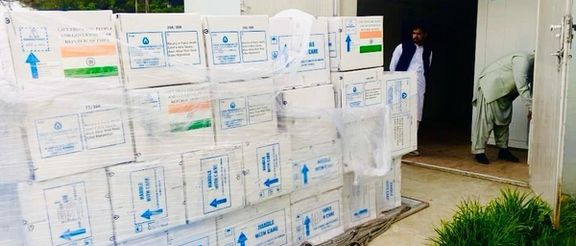
India Donates Nearly Five Tonnes Of Vaccines To Afghanistan

Apr 23, 2025, 14:30 GMT+1

The Taliban’s Ministry of Public Health announced on Wednesday that the Government of India has donated 4.8 tonnes of vaccines to Afghanistan. The shipment includes vaccines vital for the prevention of tetanus, hepatitis B, and influenza.

According to the ministry, these vaccines are expected to save thousands of lives across the country, where healthcare services have been severely affected by prolonged instability and funding cuts.

Earlier, on World Hepatitis Day, the ministry reported that approximately 15000 people in Afghanistan had been diagnosed with hepatitis in the past year, 12000 of whom were infected with hepatitis B and 1300 with hepatitis C. Abdul Wali Haqqani, the Taliban’s Deputy Minister for Health Services, confirmed these figures.

The World Health Organization (WHO) has continued to call for increased testing, treatment, and vaccination to combat hepatitis in Afghanistan. WHO estimates suggest that over 100000 people in the country have contracted hepatitis over the past decade.

The donation comes at a critical time, as many healthcare centres across Afghanistan have closed following the suspension of US foreign aid, contributing to a surge in preventable infectious diseases.

Most Viewed

Taliban Ignore Afghanistan’s Interests By Backing Militants, Says Pakistan Army Chief
1

Taliban Ignore Afghanistan’s Interests By Backing Militants, Says Pakistan Army Chief

2

United Nations Delivers Education Kits To Four Million Afghan Children

3

Taliban Renews Call For China To Launch Aynak Copper Mine

4

Taliban Leaders In South-West Hold Security Meet In Kandahar

5

Afghan Deportations Is Strategic Mistake, Says European Parliament Member

•
•
•

More Stories

Afghanistan’s Economic Growth Lags Behind Population Increase, Says World Bank

Apr 23, 2025, 11:13 GMT+1

In its latest report released on Wednesday, the World Bank stated that Afghanistan’s economy is projected to grow by 2.5 percent in the fiscal year 2024–2025, slower than the country’s population growth rate.

The Bank further forecasts that economic growth will average just 2.2 percent in the fiscal year 2025–2026.

The report also notes a weakening growth outlook for South Asia amid rising global economic uncertainty. It highlights that enhancing domestic revenue collection could improve resilience across the region and help mitigate the impact of future economic shocks.

Regional economic growth is projected to slow to 5.8 percent in 2025.

Martin Raiser, World Bank Vice President for South Asia, emphasised the need for structural reforms across the region to strengthen economic resilience and foster job creation and sustainable growth.

The World Bank’s previous report, published in February, described Afghanistan’s economy as fragile due to ongoing financial isolation, political instability, and a shortage of skilled human resources. It warned that further reductions in foreign aid could suppress aggregate demand and exacerbate economic challenges.

This warning coincides with the United States' suspension of humanitarian aid to Afghanistan. Observers caution that continued aid suspensions or a complete halt in aid could push the country towards a humanitarian crisis.

According to the United Nations, over half of Afghanistan’s population is in need of humanitarian assistance.

747 Afghan Refugee Families Return From Iran, Pakistan As Deportations Increase

Apr 23, 2025, 09:53 GMT+1

The Taliban-controlled Bakhtar News Agency reported on Wednesday, 23 April, that 747 Afghan refugee families have returned to Afghanistan from Iran and Pakistan within the past 24 hours.

According to the report, 336 families entered the country via the Torkham crossing, 218 through Spin Boldak, and 193 families crossed the border at Islam Qala.

This announcement comes as both Iran and Pakistan have stepped up their efforts to expel Afghan migrants. Pakistan’s Ministry of Interior stated yesterday that 100,529 Afghan refugees have returned to Afghanistan over the past three weeks.

The second phase of Pakistan’s deportation campaign began in April, targeting both undocumented Afghan migrants and those holding “Afghan Citizen Cards.”

AFF Claims Responsibility For Attack On Taliban Forces In Kunduz

Apr 23, 2025, 09:01 GMT+1

Following reports of an explosion in Kunduz province on Tuesday, the Afghanistan Freedom Front (AFF) announced that its fighters had targeted Taliban forces in the Bandar Khan Abad area.

According to the AFF, two Taliban members were killed and two others wounded during the guerrilla operation.

Local sources reported that the blast occurred near the entrance gate of the Sixth Police District, adjacent to the Counter-Narcotics Directorate building in Kunduz city. In a statement released late that night, the AFF said its fighters had ambushed a military vehicle transporting Taliban personnel.

So far, the Taliban have not issued a response. Taliban officials typically seek to suppress media coverage of attacks by opposing armed resistance groups and remain silent on such incidents.

World Must Press Taliban To Negotiate With Opposition, Says Vienna Process Host

Apr 22, 2025, 17:00 GMT+1

Wolfgang Petritsch, President of the Austrian Institute for International Affairs, has urged the international community to pressure the Taliban into dialogue with opposition groups.

As host of the Vienna Process on Afghanistan, he emphasised the need for political solutions to the country’s ongoing crisis.

In an exclusive interview with Afghanistan International, Petritsch stressed the importance of inclusive political dialogue and urged anti-Taliban political figures and groups to actively participate in the upcoming Vienna talks. He emphasised that decisions about Afghanistan must be made with full involvement from Afghan stakeholders themselves.

Petritsch stated, “Since 2023, there have been ongoing discussions on creating a roadmap. Now is the time for opposition leaders to act decisively and work towards a unified and actionable plan.” He underlined the importance of establishing initial contact with the Taliban as a first step towards meaningful negotiations.

Highlighting the aims of the Vienna Process, Petritsch noted that the objective is not to provoke further conflict, but to open the door to intra-Afghan dialogue. “The Taliban are a political reality in Afghanistan,” he said. “We must avoid additional war and instead focus on ways to bring all sides to the negotiating table.”

He stressed that global actors particularly the United States, the European Union, and influential regional powers must apply coordinated pressure on the Taliban to compel them to engage with non-Taliban political and military forces.

Petritsch also suggested that moderate voices exist within the Taliban who may be open to the idea of elections and inclusive governance. He pointed to the Doha Agreement, in which the Taliban committed to dialogue with all Afghan factions, and said that these commitments must now be fulfilled.

“The goal is to transform intra-Afghan dialogue into a practical and constructive political process,” he added.

Since the fall of the former Afghan government, the Vienna Process has emerged as the most prominent international platform for the Afghan opposition. Its fifth session was held in February, with participation from key figures such as Ahmad Massoud of the National Resistance Front and Yasin Zia of the Afghanistan Freedom Front.
Over 100000 Afghans Deported From Pakistan Since April 1

Apr 22, 2025, 15:00 GMT+1

More than 100,000 Afghan nationals have been deported from Pakistan over the past three weeks, according to figures released by Pakistan’s Ministry of Interior.

The deportations are part of the second phase of Islamabad’s crackdown on undocumented migrants, primarily targeting Afghan citizens.

As of 1 April, a total of 100,529 Afghans have been expelled, out of an estimated three million Afghan refugees residing in Pakistan, according to the United Nations. The campaign has intensified across several provinces, including Islamabad, Khyber Pakhtunkhwa, and Balochistan.

In March, Pakistani authorities announced the renewed deportation drive, accusing Afghan migrants of involvement in drug trafficking and “supporting terrorism.” The statement was followed by widespread arrests and detentions, prompting concerns from human rights groups and international organisations.

Many of the deported Afghans had lived in Pakistan for decades, some arriving as early as the 1980s during the Soviet invasion of Afghanistan. The return to a Taliban-ruled Afghanistan, which is currently facing one of the worst humanitarian and economic crises in its history, has left many in shock and despair.

The International Committee of the Red Cross (ICRC) has raised alarm over the growing humanitarian crisis. With approximately 5,000 migrants returning to Afghanistan each week, the organisation warned that millions are now facing deepening poverty and widespread displacement. The ICRC noted that more than half of Afghanistan’s population is reliant on humanitarian assistance.