• العربية
  • پښتو
  • فارسی
Brand
  • Afghanistan
  • Sport
  • Markets
  • Afghanistan
  • Sport
  • Markets
  • Theme
  • Language
    • العربية
    • پښتو
    • فارسی
  • Afghanistan
  • Sport
  • Markets
All rights reserved for Volant Media UK Limited
volant media logo

Taliban Publicly Flogs Man For Theft In Ghazni

May 1, 2025, 13:31 GMT+1

The Taliban’s Supreme Court has announced that a man convicted of theft was publicly flogged in Ghazni province. According to the court, the individual received 39 lashes and was sentenced to three years in prison.
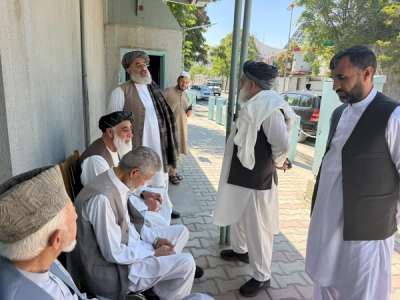
In a statement issued on Thursday, 1 May, the court said the punishment was administered publicly by the primary court of Qarabagh district the previous day. The man’s identity has not been disclosed.

The incident marks another instance of the Taliban’s enforcement of its strict interpretation of Sharia law, which includes corporal punishment for certain crimes. Public floggings, executions, and amputations have drawn international condemnation since the group’s return to power in August 2021.

While the Taliban claims such punishments serve as a deterrent and are carried out following legal procedures, human rights organisations continue to criticise the lack of transparency, due process, and the use of punishments deemed inhumane under international law.

Most Viewed

NRF Leader Praises EU Lawmakers For Opposing Taliban Normalisation
1

NRF Leader Praises EU Lawmakers For Opposing Taliban Normalisation

2

Afghan Private Sector Delegation Visits Uzbekistan To Boost Trade

3

At Least 28 Killed In Afghanistan Floods & Severe Weather

•
•
•

More Stories

Over 4700 Afghans Deported From Iran, Pakistan In Single Day, Says Taliban

May 1, 2025, 12:15 GMT+1

The Taliban’s High Commission for Migrants’ Affairs has said that a total of 4721 Afghan nationals were deported from Iran and Pakistan on Wednesday alone, marking one of the largest single-day returns in recent months.

According to a statement released on Thursday, 3206 Afghans were expelled from Pakistan, while 1515 were deported from Iran. The commission said the deportees entered Afghanistan through various official border crossings, including Torkham, Spin Boldak, Bahramcha, Angoor Ada, Islam Qala, and Pul-e-Abrisham.

Of those returned, 1551 individuals have been relocated to different provinces, including Ghazni, Logar, Khost, Paktia, Paktika, Baghlan, Takhar, Balkh, Jowzjan, and Kunduz.

The commission also noted that 7.7 million Afghanis in cash assistance was distributed among the returnees to help them resettle. It did not provide details on how the funds were allocated or the criteria used for distribution.

The Taliban authority, which provides daily updates on migration, said that 3868 Afghans were deported from Iran and Pakistan the previous day, reflecting a sharp rise in expulsions this week.

The recent wave of deportations comes amid heightened pressure from neighbouring countries to repatriate undocumented Afghan migrants, many of whom have fled conflict, persecution, or economic hardship. Human rights organisations have repeatedly raised concerns over the forced returns, citing risks of abuse, instability, and lack of support infrastructure inside Afghanistan.

Taliban Governor Urges China To Expand Trade, Invest In Cold Storage & Infrastructure

May 1, 2025, 10:52 GMT+1

Yousuf Wafa, the Taliban-appointed governor of Balkh province, has called on China to enhance its economic engagement with Afghanistan by investing in cold storage facilities and standardised agricultural production centres.

The request was made during a meeting with the Chinese ambassador in the northern city of Mazar-i-Sharif.

Wafa emphasised the need for greater reciprocity in trade, urging that containers bringing Chinese imports into Afghanistan should not return empty. He pointed to the imbalance in trade, driven by Afghanistan’s heavy dependence on imports and limited domestic production capacity.

A statement from the governor’s office indicated that the Chinese ambassador reaffirmed Beijing’s commitment to a number of infrastructure projects across Afghanistan. These include solar energy initiatives and the construction of dams in Kandahar province, with implementation set to begin later this year.

The ambassador also highlighted the China–Kyrgyzstan–Uzbekistan–Afghanistan transport corridor as a critical development for improving regional connectivity. He suggested the corridor could help transform Afghanistan into a more robust trading economy, boosting both exports and imports. Additionally, he stated that China does not levy tariffs on Afghan exports, a move designed to stimulate trade.

Wafa reiterated his request for the establishment of direct flights between Balkh and China to further ease commercial exchange. He also called for immediate investment in cold storage and standardised packing centres in the Nayeb Abad area, which he said would enable Afghan fruit and vegetable producers to meet export standards and better access Chinese markets.

He extended an open invitation to Chinese investors to explore business opportunities in Afghanistan, particularly in the agricultural and infrastructure sectors.

China remains one of the few major powers engaging economically with Afghanistan under Taliban rule, though its involvement is largely focused on short-term, high-yield projects. Despite signing an agreement for the large-scale Aynak copper mine project years ago, progress has stalled due to the project’s long timelines and substantial capital demands.

Analysts suggest that China continues to view Afghanistan as a high-risk environment for investment. Russian researcher Alexander Knyazev recently commented that Chinese firms prefer small-scale ventures with quicker returns. While major undertakings like Aynak remain dormant, smaller oil companies are actively operating in northern Afghanistan, drawn by the relatively fast turnaround in the petroleum sector.

UN Official Warns Afghanistan Faces Deepening Crisis Despite End Of War

May 1, 2025, 10:04 GMT+1

Tom Fletcher, the United Nations Under Secretary-General for Humanitarian Affairs, has stated that despite the cessation of active conflict, Afghanistan continues to grapple with profound and multifaceted crises.

In an interview with Agence France-Presse, Fletcher expressed grave concern over the decline in humanitarian aid to the country. He said during a visit on Wednesday to a mobile health clinic in Kunduz. that there are 17 crises around the world requiring urgent attention, and Afghanistan is at the top of that list.

The senior UN official’s visit comes amid a significant decrease in global humanitarian assistance to Afghanistan. The United States, which had provided the largest share of humanitarian aid amounting to USD 3.71 billion since the Taliban’s return to power, has now suspended its support.

Following a meeting with a group of women at the mobile health centre, Fletcher remarked that those who justifies the reduction in aid, should listen to a mother who cycled for three hours to reach a medical centre, only to lose her child upon arrival.

While critics of the Taliban have largely welcomed the suspension of international aid citing misuse of funds by the de facto authorities the United States has also justified its decision on the same grounds.

Fletcher described the decline in humanitarian assistance as “cruel” and added that the impact of aid cuts was not immediately visible, but “we now clearly see how devastating this decision has been for vulnerable communities.”

He identified the plight of Afghan women as one of the country’s “accumulated crises.” Following meetings with Taliban officials in Kabul and Kandahar, Fletcher emphasised the importance of “dialogue to shift perspectives” on women’s rights.

Fletcher also sounded the alarm on the effects of climate change, calling its impact on Afghanistan “deeply concerning” and warning that it would intensify the demand for humanitarian assistance potentially even more so than during periods of conflict.

He concluded by noting that this dire humanitarian context is exacerbated by widespread poverty, decades of instability, and protracted warfare.

Nearly 4000 Afghan Migrants Deported From Pakistan, Iran In Single Day, Says Taliban

Apr 30, 2025, 16:31 GMT+1

The Taliban’s High Commission for Migrants’ Issues has announced that at least 3868 Afghan migrants were deported from Pakistan and Iran within a 24 hour period.

According to a statement released by the commission, 1808 individuals were deported from Iran, while 2055 were returned from Pakistan. The deportations took place on Monday via several key border crossings, including Torkham, Spin Boldak, Angoor Ada, Bahramcha, Islam Qala, and Pul-e-Abrisham.

The commission stated that 1106 of the returnees have been relocated to various provinces, including Ghazni, Logar, Khost, Paktia, Paktika, Baghlan, Takhar, Balkh, Jowzjan, and Kunduz. The returnees reportedly received a combined total of 6.9 million Afghanis in humanitarian assistance.

The Taliban’s commission, which provides regular updates on migrant deportations, had previously reported that 5727 Afghans were expelled in a single day including 4484 from Pakistan and 1243 from Iran.

Pakistan has significantly intensified deportation efforts following the 30 March deadline it set for the voluntary return of undocumented migrants. According to the UN Refugee Agency (UNHCR), more than 120000 Afghan nationals were expelled by Pakistan during the first 25 days of this phase.

The UNHCR has raised concern over the plight of Afghan women and girls among the returnees, many of whom are returning to an environment where they face severe restrictions on education, employment, and social participation.

Taliban Abolishes Political Deputy PM Post, Dismisses Over 250 Staff Members

Apr 30, 2025, 15:23 GMT+1

Taliban leader Hibatullah Akhundzada has issued a verbal decree abolishing the office of Deputy Prime Minister for Political Affairs, leading to the dismissal of 255 employees, including senior officials, according to multiple sources in Kabul.

Two sources familiar with the matter confirmed that the directive was implemented on Tuesday, 29 April, resulting in the complete closure of the office of the Taliban's Deputy Prime Minister for Political Affairs. Among those removed were Maulawi Zakir, the chief of staff of the deputy prime minister, and Mohammad Hassan Haqyar, a senior adviser.

The move eliminates nearly all of the office’s approximately 300 administrative roles, with only 45 staff primarily tasked with securing the Sepadar Palace retained in their positions.

Following the restructuring, Sepadar Palace has come under the control of Abdul Kabir, currently the Taliban’s Minister of Refugees. Sources report that Kabir, who previously held the now-defunct position of Deputy Prime Minister for Political Affairs, will use the palace as both his residence and office.

Despite his reassignment, Abdul Kabir has yet to assume responsibilities at the Ministry of Refugees, reportedly due to security concerns and dissatisfaction with the role. Since his appointment, he has continued to operate from Sepadar Palace.

The Taliban leadership has not issued an official statement on the elimination of the office and the position. However, on the same day the decree was enforced, the Prime Minister’s Office announced the removal of an additional 222 positions from the administrative structure of the group's premiership, also on the orders of Akhundzada.