• العربية
  • پښتو
  • فارسی
Brand
  • Afghanistan
  • Sport
  • Markets
  • Afghanistan
  • Sport
  • Markets
  • Theme
  • Language
    • العربية
    • پښتو
    • فارسی
  • Afghanistan
  • Sport
  • Markets
All rights reserved for Volant Media UK Limited
volant media logo

Media Workers Face Threats, Detention, Torture Under Taliban, Says UN

May 3, 2025, 12:51 GMT+1

The United Nations Assistance Mission in Afghanistan (UNAMA) has announced that media professionals in Afghanistan are enduring threats, detention, torture, and mistreatment due to severe restrictions imposed by the Taliban.

Female journalists are particularly affected, according to a UNAMA statement released on World Press Freedom Day.

Roza Otunbayeva, the UN Secretary-General’s Special Representative for Afghanistan, emphasised the critical role of media in fostering an informed and dynamic society. “In Afghanistan, we are seeing the steady erosion of a free and independent media,” she said, underscoring that a robust media environment is vital for transparency, public trust, and good governance.

Richard Bennett, the UN Special Rapporteur on Human Rights for Afghanistan, echoed these concerns in a statement on Saturday. He described freedom of expression as essential for upholding all human rights and urged the Taliban to release all detained journalists immediately.

UNAMA also highlighted emerging challenges posed by the rapid advancement of artificial intelligence (AI). Patricia McPhillips, UNESCO’s representative in Afghanistan, warned that AI could be misused to spread misinformation, promote hate speech, and enhance censorship and surveillance of journalists and the public, posing significant risks to freedom of expression.

Most Viewed

Taliban Order Cut To Residential Fibre-Optic Internet In Kabul, Say Sources
1

Taliban Order Cut To Residential Fibre-Optic Internet In Kabul, Say Sources

2

Taliban Leader Adviser Arrested In Kandahar Over Alleged Bribery

3

Taliban Besieged TOLOnews Offices After Journalist Detentions, Say Sources

4

Taliban Urges Turkmenistan To Implement 24-Hour Operations At Torghundi Port

5

Exiled Media Watchdog Urges UN, EU To Seek Release Of Journalists Held By Taliban

•
•
•

More Stories

Turkmenistan Ready To Export Medicines, Equipment To Afghanistan

May 3, 2025, 11:35 GMT+1

Turkmenistan has expressed its willingness to export medicines and medical equipment to Afghanistan, aiming to strengthen bilateral cooperation in healthcare.

The announcement was made during a meeting in Ashgabat between representatives of Turkmenistan’s Ministry of Health and Medical Industry and a delegation of Afghan doctors from a hospital in Herat.

Turkmen media reported that the discussions focused on deepening partnerships in the pharmaceutical industry and medical technologies. The Afghan delegation specifically requested the supply of high-quality, affordable Turkmen medicines to address healthcare needs in Afghanistan.

The Turkmen side provided insights into the operations of its pharmaceutical and medical equipment manufacturing companies, highlighting their capacity to meet international demand.

In a related humanitarian effort, Turkmenistan sent three female doctors to Afghanistan in May 2023 to work at the Torghundi maternity hospital in Herat, providing essential medical services to Afghan women. The initiative was documented by Turkmenistan’s Ministry of Foreign Affairs.

Afghanistan continues to face significant challenges in healthcare, particularly for women and children, under Taliban rule. The Taliban’s restrictions, including bans on girls and women attending schools, universities, and medical training institutions, have exacerbated the crisis.

Afghanistan currently has the highest maternal mortality rate globally, prompting repeated appeals from the Taliban for international support to bolster the country’s healthcare system.

Taliban Must Release All Detained Journalists Immediately, Says UN Special Rapporteur

May 3, 2025, 10:19 GMT+1

Richard Bennett, the United Nations Special Rapporteur on Human Rights in Afghanistan, has called on the Taliban to immediately release all imprisoned journalists and media workers.

His statement was issued on Saturday, 3 May, in a video message commemorating World Press Freedom Day.

Bennett underscored the vital role of free expression, stating: “Freedom of expression is essential for the realisation of all human rights.” He warned that since the Taliban’s return to power, Afghan journalists and media professionals have faced increasing repression, including arbitrary arrests, censorship, harassment, and violence.

“Journalists and media workers face strict censorship. In many cases, they are not even permitted to publish images of living beings. These restrictions are enforced through threats, arbitrary detention, and acts of violence,” he said.

The Afghan Journalists Centre reported a 58 percent increase in violations of press freedom in the past year. Since May 2024, the organisation has documented 215 incidents involving infringements on media freedom, including 175 cases of direct and indirect threats, and 40 instances of journalist detentions.

As of Friday, 2 May, the centre confirmed that ten journalists remain in Taliban custody, with seven sentenced to prison terms ranging from seven months to three years.

In his message, Bennett called on the Taliban to release all individuals detained for exercising their fundamental rights, including journalists, media workers, filmmakers, and civil society actors.

He also raised concerns about the particularly severe restrictions faced by women journalists, stating that they are disproportionately targeted solely on the basis of their gender.

Bennett emphasised the need for the Taliban to end censorship and repression against minorities, and to allow journalists, academics, and political activists to operate freely without fear of persecution.

He described Afghan journalists as “guardians of the truth” and urged the international community to extend greater support to Afghan media professionals, including those in exile.

“Without press freedom, there is no truth; without truth, there is no justice; and without justice, no peace,” he stated.

Despite repeated claims by the Taliban that they support media freedom, international organisations, including Amnesty International, have consistently raised alarm over deteriorating conditions for the press in Afghanistan.

According to the 2025 World Press Freedom Index, Afghanistan ranks 175th out of 180 countries, with a score of 17.88.

Recently, the Taliban enacted a law on the “promotion of virtue,” which bans the publication of images depicting living beings and has led to the suspension of both state-run and private television broadcasts in several provinces. The group has also annulled the Media Law and the Law on Access to Information, further tightening censorship and limiting journalistic freedoms across the country.
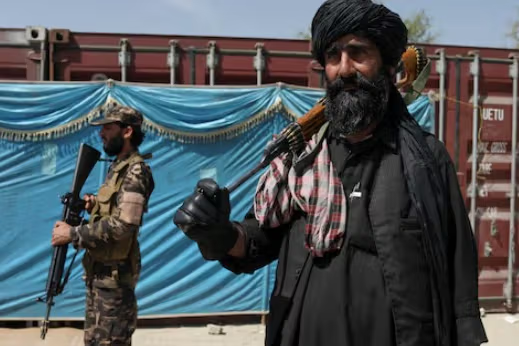
Taliban Leader Makes Rare Trip To Kabul, Urges Strict Enforcement Of Sharia

May 3, 2025, 09:24 GMT+1

Hibatullah Akhundzada, the reclusive leader of the Taliban, made a rare trip from Kandahar to the Afghan capital on Friday, 12 April, to address a one-day conference attended by senior officials of the group.

His unexpected appearance in Kabul underscores internal divisions within the Taliban leadership and a possible attempt to reassert control and unity.

According to Hamdullah Fitrat, deputy spokesman for the Taliban, Akhundzada urged Taliban officials to fulfil their responsibilities based strictly on “principles of Sharia”. He warned against any leniency in the application of Islamic law and claimed that Afghanistan’s political affairs are now in the hands of “righteous individuals”.

In his address, Akhundzada advised Taliban members not to fall prey to “enemy propaganda”, which he said is designed to sow discord and mistrust within the group. “Do not allow yourselves to be divided. Do not be deceived by the enemy’s tactics,” he stated.

The meeting was reportedly attended by the Taliban governor of Kabul, intelligence chief, judicial authorities, district governors, and local commanders. No official images or videos of the event have been released, and Akhundzada, who has never made a public appearance, has not been seen in any of the coverage, raising questions about the format of his speech and the duration of his stay in Kabul.

Akhundzada also emphasised that religious scholars had long been marginalised from both worship and political spheres. “For centuries, scholars were pushed to the periphery. Islamic governance, Jihad, and Sharia remained confined to books. Now, politics in Afghanistan is in the hands of scholars, the Taliban, and righteous individuals,” he asserted.

Despite the strong tone on religious enforcement, Akhundzada reportedly instructed Taliban officials to cooperate with the public and treat people with respect in various aspects of daily life.

Russia Signals Willingness To Cooperate With Taliban In Fight Against ISIS-K

May 2, 2025, 16:49 GMT+1

Russia’s Special Envoy for Afghanistan, Zamir Kabulov, has announced that Moscow is prepared to assist the Taliban in combatting the Islamic State Khorasan Province (ISIS-K), which he described as a “common enemy” of both countries.

Speaking in an interview with RIA Novosti, Kabulov stated that Russia would provide all possible support to the Taliban through its specialised security agencies. “ISIS-K is our mutual adversary,” he said. “Moscow stands ready to offer assistance using all relevant structures.”

Recognition of the Taliban Still Uncertain

However, Kabulov avoided answering a direct question on whether Russia is prepared to formally recognise the Taliban government. He noted that cooperation between Moscow and Kabul is ongoing on a de facto basis but did not commit to official recognition.

He indicated that the recent decision by the Supreme Court of the Russian Federation to suspend the designation of the Taliban as a terrorist organisation would pave the way for broader cooperation. Kabulov added that once the Taliban’s nominated ambassador arrives in Moscow, it would mark the final step toward formal diplomatic engagement.

The envoy said he had no confirmed information about the ambassador-designate but noted that once details are provided by the Taliban administration, Russia would review the nomination and proceed accordingly.

On 17 April, Russia’s Supreme Court approved a request from the Prosecutor General’s Office to suspend the ban on the Taliban. Judge Oleg Nefedov declared that the ruling would take immediate effect. Kabulov credited the decision to extensive inter-agency work involving the Ministry of Foreign Affairs, the Federal Security Service, the Ministry of Justice, and the Prosecutor General’s Office.

Despite this move, Russia like all other nations has yet to officially recognise the Taliban government.

Interest in Afghan Natural Resources

Kabulov also acknowledged Afghanistan’s substantial natural wealth, including hydrocarbons, precious stones, and rare earth elements. When asked about Russia’s interest in extracting resources such as lithium, he emphasised that comprehensive geological surveys must be completed first.

“Lithium extraction requires significant water resources, which are scarce in Afghanistan,” he noted, suggesting that logistical and environmental challenges remain an obstacle to full-scale operations.

Estonian diplomat Harri Tiido previously told Ukrinform that Russia’s growing engagement in Afghanistan is motivated by both economic and geopolitical interests, including access to lithium reserves. Tiido asserted that Moscow seeks to establish an ally in the region as a counterweight to Western influence.

Cooperation with the West on Afghanistan

Kabulov also addressed the prospect of engagement with the western countries on Afghan affairs. He stated that Russia is open to cooperation, including with the United States, but expects “constructive measures,” such as the unfreezing of Afghanistan’s foreign assets held in Western financial institutions.

He downplayed the recent US decision to impose tariffs on Afghan goods, noting that trade between Washington and Kabul is minimal totalling less than $10 million annually. However, he warned that such actions could further isolate the Taliban and drive them closer to regional powers such as Russia.

Afghanistan Ranks Above Iran In Press Freedom Index, But Remains Among Worst Globally

May 2, 2025, 14:01 GMT+1

Afghanistan has been ranked 175th out of 180 countries in the 2025 World Press Freedom Index, placing it marginally ahead of Iran but still among the world’s most repressive environments for journalists, according to Reporters Without Borders (RSF).

Released on Friday, 2 May, the annual RSF index gave Afghanistan a press freedom score of 17.88, just ahead of Iran, which ranked 176th with a score of 16.22. At the bottom of the list were Syria, China, North Korea, and Eritrea. In contrast, Norway, Estonia, and the Netherlands topped the index, recognised for their strong protection of journalistic freedoms.

Afghanistan’s position marks a slight improvement from 2024, when it ranked 178th with a score of 19.9. However, RSF continues to classify the country as facing a “very serious” situation for press freedom, placing it among the five worst nations globally for media rights.

The report attributes Afghanistan’s dire ranking to the Taliban’s growing repression of independent media and the widespread economic collapse of media outlets. According to RSF, financial instability has emerged as one of the gravest threats to press freedom worldwide, with three-quarters of global media organisations now facing severe economic difficulties.

“The conditions for practising journalism have deteriorated in half of the countries assessed,” RSF said, warning that without urgent support and reform, many media outlets face collapse. The organisation called for concrete action to safeguard press freedom, ensure access to reliable information, and support the survival of independent journalism.

Afghanistan has also been described as one of the most dangerous countries for journalists. In 2024, it plummeted from 152nd to 178th in the rankings, with escalating crackdowns on media by the Taliban.

According to the Afghan Journalists Center, the Taliban closed 22 media outlets over the past year. The group also documented 172 cases of press freedom violations, including arrests, detentions, and intimidation of journalists.

In addition to media closures, the Taliban have imposed increasingly restrictive laws under the “Propagation of Virtue and Prevention of Vice” framework. This includes bans on broadcasting or publishing images of “living beings” a directive that has further crippled visual journalism and creative content.