• العربية
  • پښتو
  • فارسی
Brand
  • Afghanistan
  • Sport
  • Markets
  • Afghanistan
  • Sport
  • Markets
  • Theme
  • Language
    • العربية
    • پښتو
    • فارسی
  • Afghanistan
  • Sport
  • Markets
All rights reserved for Volant Media UK Limited
volant media logo

Taliban Governors Meet With Interior Ministry Officials In Kabul

May 8, 2025, 18:23 GMT+1

Several provincial governors affiliated with the Taliban travelled to the Afghan capital for meetings with senior officials from the Ministry of Interior, according to a statement released by the ministry.
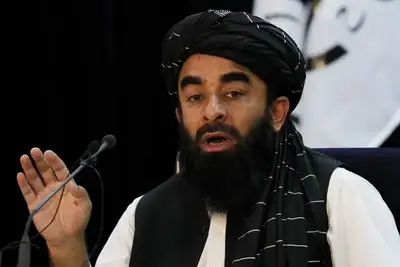
The governors held talks with Mohammad Nabi Omari, Deputy Minister of Interior, and Zainullah Aaber, chief of staff of Interior Minister Sirajuddin Haqqani. During the meetings, the governors presented reports on their respective provinces and briefed officials on local governance activities.

Photographs published by the Interior Ministry showed the presence of Sher Ahmad Haqqani, Governor of Laghman; Mustafa Azizullah, Deputy Governor of Nangarhar; and Mohammad Edrees Anwari, Governor of Parwan.

All appointments within the Taliban administration are made by the group’s supreme leader, Hibatullah Akhundzada. However, recent reports suggest growing dissatisfaction within the ranks, particularly from Interior Minister Sirajuddin Haqqani, over what is perceived as excessive centralisation of decision-making power in Kandahar.

Most Viewed

Taliban Order Cut To Residential Fibre-Optic Internet In Kabul, Say Sources
1

Taliban Order Cut To Residential Fibre-Optic Internet In Kabul, Say Sources

2

Taliban Leader Adviser Arrested In Kandahar Over Alleged Bribery

3

Taliban Besieged TOLOnews Offices After Journalist Detentions, Say Sources

4

Taliban Urges Turkmenistan To Implement 24-Hour Operations At Torghundi Port

5

Exiled Media Watchdog Urges UN, EU To Seek Release Of Journalists Held By Taliban

•
•
•

More Stories

90 Percent Of Afghan Households Faced Economic Shocks In 2024, Says UNDP

May 8, 2025, 15:35 GMT+1

A new report from the United Nations Development Programme (UNDP) reveals that 90 percent of Afghan households experienced economic shocks in 2024, driven by a worsening humanitarian crisis and deepening socio-economic instability.

According to the report, 65 percent of households were directly affected, marking a 35 percent increase compared to 2023. The UN agency warns that Afghanistan is sliding further into severe economic distress, with growing inequalities disproportionately impacting women and rural communities.

The European Union delegation in Kabul echoed these concerns, noting that restrictions on women and girls imposed between 2024 and 2026 are projected to cost the Afghan economy more than $920 million.

The UNDP assessment found that nine out of ten households have lost key productive assets, sources of income, and access to employment opportunities. Many families have been forced to reduce daily consumption and cut essential expenses, significantly weakening their resilience to future shocks.

Despite these challenges, Afghanistan recorded its first positive gross domestic product (GDP) growth since 2019, with a modest 2.7 percent increase between 2023 and 2024. However, the UNDP cautioned that this recovery is fragile. The country’s trade deficit grew sharply, reaching $6.7 billion in the first three quarters of 2024, up from $5.1 billion during the same period in 2023.

The report attributed the widening deficit to declining domestic production and limited job creation, underlining Afghanistan’s continued reliance on imports and foreign aid.

It further noted that 75 percent of the population faced livelihood insecurity in 2024, a six percent rise from the previous year. Rural areas, home to 71 percent of Afghans, remain critically underserved, with limited access to healthcare, sanitation, and sustainable economic opportunities.

The report also highlighted deteriorating conditions in housing, healthcare, and access to basic goods, compounded by economic and climate-related shocks.

Women-led households, rural populations, and internally displaced persons were identified as the most affected groups, having suffered the greatest drops in income and spending. The ongoing restrictions on women’s education and employment continue to deepen gender inequality, pushing Afghan women further into poverty and social exclusion.

Afghanistan Not Priority But Key To Moscow’s Geopolitical Strategy, Says Russian Envoy

May 8, 2025, 14:06 GMT+1

Zamir Kabulov, the Russian president’s special envoy for Afghanistan, stated that while Afghanistan is not among Moscow’s top foreign policy priorities, it holds critical importance due to its geopolitical positioning.

In an interview with the Russian radio station Komsomolskaya Pravda, Kabulov described Afghanistan as a strategic transit corridor connecting northern Eurasia, including Russia, to southern Asia, enhancing its value as a geopolitical bridge.

Kabulov stressed that normalising relations with the Taliban was essential for promoting Russia’s regional interests. However, he noted that formal engagement remains constrained by legal barriers, particularly the Taliban’s continued designation as a terrorist organisation in Russia.

That designation was officially suspended on 17 April, when Russia’s Supreme Court approved a request from the Prosecutor General’s Office to lift the ban on the Taliban’s activities. Supreme Court Judge Oleg Nefedov confirmed the ruling would take effect immediately.

Kabulov emphasised that full legal recognition of the Taliban is necessary to enable Russian governmental bodies, private companies, and NGOs to sign valid contracts and engage in official dealings with Afghanistan. He did not elaborate on the next steps in the recognition process.

Reflecting on historical ties, Kabulov said that during the Soviet era, commercial exchanges with Afghanistan were virtually non-existent, limited mostly to humanitarian and development aid. In contrast, he argued, Russia now sees strategic incentives to engage more substantively with Afghanistan.

According to Kabulov, a stable governing authority in Kabul is vital for containing terrorism and other cross-border threats that could affect Russia and its allies. Still, he warned that the Taliban cannot maintain power indefinitely through coercion alone. He underscored the need to address Afghanistan’s deep socioeconomic challenges and to prioritise national development, particularly efforts to meet basic human needs such as food security.

Nearly 5000 Afghan Migrants Deported From Iran, Pakistan In Single Day, Says Taliban

May 8, 2025, 12:40 GMT+1

The Taliban’s High Commission for Addressing Migrants’ Issues has announced that a total of 4978 Afghan migrants were deported from Pakistan and Iran on Wednesday.

According to the commission, 3105 migrants were returned from Pakistan and 1873 from Iran. The deportations took place via multiple border crossings, including Torkham, Spin Boldak, Bahramcha, Angoor Ada, Pul-e-Abrisham, and Islam Qala.

Upon arrival, the returnees reportedly received a combined total of 7 million Afghanis in assistance. The Taliban also stated that 666 of the returnees were transferred from Kabul to various provinces, including Ghazni, Balkh, Jowzjan, Baghlan, Takhar, Kunduz, Logar, Paktia, and Paktika.

The large-scale deportations come amid growing concerns over the treatment and welfare of Afghan migrants in neighbouring countries. The United Nations High Commissioner for Refugees (UNHCR) recently reported that more than 250000 Afghans were returned from Pakistan and Iran during the month of April alone.

The agency has warned that many of those forced to return are now facing dire conditions, with a significant proportion being women and girls, who remain especially vulnerable under Afghanistan’s current socio-political climate.

Taliban Confirms Removal & Ban Of Hundreds Of Books Across Afghanistan

May 8, 2025, 11:40 GMT+1

The Taliban have confirmed that hundreds of books have been banned and removed from libraries and bookstores across Afghanistan over the past three years.

Abdulhaq Emad, head of copyright at the Taliban’s Ministry of Information and Culture said that the content of these books deemed inconsistent with Islamic Sharia, national unity, or the group’s ideological principles.

Emad made the announcement during a conference in Kabul on Wednesday. He stated that the Taliban have actively prohibited the publication, sale, and distribution of books considered incompatible with their regime.

Since regaining power in 2021, the Taliban have significantly tightened censorship across Afghanistan’s publishing sector, resulting in the withdrawal of thousands of books from circulation. Titles covering political theory, philosophy, law, and social issues have been among the most targeted.

In addition to suppressing independent publications, the Taliban have also banned several university textbooks, further restricting academic freedom and access to diverse sources of knowledge within higher education institutions.

Taliban, Turkmenistan Foreign Ministers Discuss Accelerating TAPI Pipeline

May 8, 2025, 10:07 GMT+1

Taliban Foreign Minister Amir Khan Muttaqi and Turkmenistan’s Foreign Minister Rashid Meredov held virtual talks this week to review progress on key regional infrastructure projects, with particular emphasis on expediting the TAPI gas pipeline.

In a statement issued on Wednesday, the Taliban’s Ministry of Foreign Affairs said the two sides explored ways to strengthen political and economic ties between Afghanistan and Turkmenistan. Their discussions also covered diplomatic engagement and the advancement of joint initiatives, particularly the TAPI pipeline, which is designed to transport Turkmen natural gas through Afghanistan to Pakistan and India.

Muttaqi characterised relations between the two nations as “stronger than ever” and stated that the current regional environment is conducive to expanding bilateral cooperation. He reaffirmed the Taliban’s commitment to major regional development projects.

According to the ministry’s statement, Foreign Minister Meredov welcomed recent developments related to the TAPI project and outlined Turkmenistan’s plans to enhance cooperation in areas such as railway construction, trade, and regional transit. He also pledged to ease visa procedures for Afghan traders in the near future.

Both foreign ministers agreed to maintain high-level consultations aimed at accelerating implementation of the TAPI pipeline, expanding rail connectivity, enhancing electricity transmission, and deepening overall economic cooperation.