• العربية
  • پښتو
  • فارسی
Brand
  • Afghanistan
  • Sport
  • Markets
  • Afghanistan
  • Sport
  • Markets
  • Theme
  • Language
    • العربية
    • پښتو
    • فارسی
  • Afghanistan
  • Sport
  • Markets
All rights reserved for Volant Media UK Limited
volant media logo

Haqqani Meets With Chinese, Pakistani Envoys To Boost Trilateral Cooperation

May 11, 2025, 15:53 GMT+1

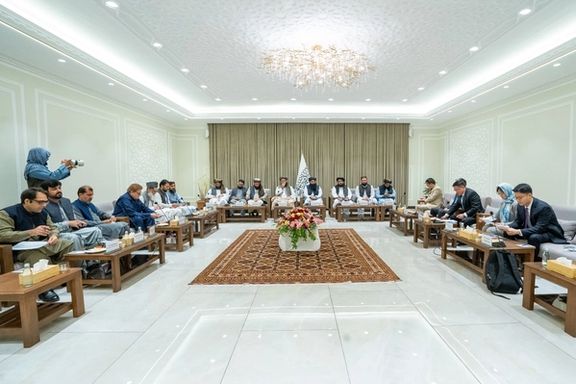
Sirajuddin Haqqani, the Taliban’s Minister of Interior, has met with the special envoys of Pakistan and China to discuss the expansion of trilateral political and economic cooperation.

The meeting marks the first time Haqqani has hosted a high-level foreign delegation at the Ministry of Interior following a prolonged public absence.

On Sunday, 11 May, Abdul Mateen Qani, spokesperson for the Taliban’s Interior Ministry, announced that Haqqani held talks with Yue Xiaoyong, China’s Special Envoy for Afghanistan, and Mohammad Sadiq, Pakistan’s Special Envoy, along with their respective delegations.

The discussions reportedly focused on strengthening regional ties through engagement and mutual respect. Haqqani emphasised the Taliban’s view that political and economic cooperation, as well as broader regional understanding, could be fostered through constructive dialogue.

According to Qani, both delegations pledged to convene the sixth trilateral foreign ministers’ meeting in Kabul, as part of the ongoing diplomatic engagement between the Taliban, China, and Pakistan.

The meeting follows a report by the Express Tribune, a Pakistani media outlet, which cited informed sources as saying that during earlier talks with the Taliban’s Foreign Minister, Amir Khan Muttaqi, the parties agreed to limit India’s role in Afghanistan strictly to diplomatic representation.

Most Viewed

Taliban Order Cut To Residential Fibre-Optic Internet In Kabul, Say Sources
1

Taliban Order Cut To Residential Fibre-Optic Internet In Kabul, Say Sources

2

Taliban Leader Adviser Arrested In Kandahar Over Alleged Bribery

3

Taliban Besieged TOLOnews Offices After Journalist Detentions, Say Sources

4

Taliban Urges Turkmenistan To Implement 24-Hour Operations At Torghundi Port

5

Exiled Media Watchdog Urges UN, EU To Seek Release Of Journalists Held By Taliban

•
•
•

More Stories

Afghanistan Among 10 Most Dangerous Countries For Christians

May 11, 2025, 15:08 GMT+1

Afghanistan has been named one of the ten most dangerous countries in the world for Christians, according to the World Watch List 2025, a new report published by the American think tank Gatestone Institute.

The report highlights that over 380 million Christians worldwide face varying levels of persecution, violence, and discrimination due to their religious beliefs. Afghanistan ranks tenth on the list, following countries such as North Korea, Somalia, Yemen, Libya, Sudan, Eritrea, Nigeria, Pakistan, and Iran.

North Korea tops the list as the most repressive country for Christians, while the remaining nine are all Muslim-majority states. The report states that nearly 70 per cent of the world’s most severe cases of Christian persecution occur in Muslim-majority nations.

Regarding Pakistan, the report notes: “Roughly a quarter of all blasphemy accusations [in Pakistan] target Christians, who make up just 1.8 per cent of the population.”

In the case of Afghanistan, the report states: “In Afghanistan, leaving Islam and converting to Christianity is punishable by death under Islamic law. This has been increasingly enforced since the Taliban assumed power in 2021.”

It further explains that most Afghan Christians are converts from Islam, making it nearly impossible for them to practise their faith openly. “If converts are discovered, the family, clan or tribe may try to preserve its ‘honour’ through pressure, violence, or even murder,” the report adds.

The report also notes that discovery by the authorities often forces Afghan Christians into exile, with women and ethnic minorities facing disproportionately harsh treatment.

Human Rights Watch has previously described the state of religious freedom in Afghanistan as dire. It warned that under Taliban rule, the country has become a “nightmare” for religious freedom and broader human rights. Shia Muslims, Sufis, Ahmadis, Hindus, Sikhs, Christians, and other religious minorities all face threats of violence and systemic persecution.

According to Gatestone Institute figures, more than 4400 Christians were killed for their faith in 2024. Over 4700 were unlawfully detained, and more than 7600 churches or Christian institutions were attacked or destroyed globally.

Taliban, Pakistan, China Agree To Limit India’s Role In Afghanistan To Diplomatic Presence

May 11, 2025, 13:49 GMT+1

The Express Tribune, a Pakistani media outlet with close ties to the country’s military establishment, has reported that during a recent trilateral meeting, the Taliban, China, and Pakistan agreed to restrict India’s role in Afghanistan to that of a diplomatic mission.

Citing informed diplomatic sources, the outlet stated that the Taliban supported Islamabad’s position on conducting an impartial investigation into the recent Pahalgam attack and chose to maintain its distance from the Indian bloc.

The report, published on Sunday, 11 May, indicated that the meeting focused on a regional reassessment and the potential expansion of the China–Pakistan Economic Corridor (CPEC) into Afghanistan. The Taliban were said to have quietly backed Pakistan’s stance amid ongoing tensions between Islamabad and New Delhi.

The closed-door trilateral meeting took place on Saturday at the Ministry of Foreign Affairs in Kabul and was hosted by the Taliban’s Foreign Minister, Amir Khan Muttaqi. According to Taliban sources, discussions centred on economic and security cooperation, as well as broader regional stability.

It was also reportedly agreed that the Taliban would host the sixth round of the trilateral dialogue between China, Pakistan, and the Taliban in Kabul. This would mark the first time such a meeting is held at the foreign ministerial level under the Taliban’s administration.

Tribal Elder Abducted, Killed By Unidentified Gunmen In Samangan

May 11, 2025, 13:04 GMT+1

Local sources said that Mohammad Akbar Niazi, head of the People’s Council for Khuram Wa Sarbagh district in Samangan province, was abducted from his home by unidentified armed men and later found dead with gunshot wounds.

According to eyewitnesses and associates, Niazi was taken from his residence in the city of Aybak at approximately 7:00 p.m. on Thursday. The assailants reportedly told him they were escorting him to a meeting. His body was discovered on Saturday evening in the Kipna Garcha Mountain area of Samangan, bearing multiple bullet wounds and signs of torture.

Niazi, a respected tribal elder, had no known personal disputes, according to his relatives. He had previously served in the same role under the former government, where he was active both as head of the district council and as a neighbourhood representative.

Friends of the deceased confirmed that he had been shot at least six times, and that his body showed clear signs of torture.

Sources also noted that one of Niazi’s sons had worked in the Samangan Provincial Finance Department under the previous government and maintained close ties with former officials in Kabul.

Family members say they have filed complaints with the Taliban’s police command in Samangan and other relevant institutions. However, no suspects have been arrested to date, and local Taliban authorities have not issued any official statement regarding the incident.

Taliban Foreign Minister Invited To Visit China

May 11, 2025, 11:48 GMT+1

Zia Ahmad Takal, a Spokesperson for the Taliban’s Ministry of Foreign Affairs, has announced that Yue Xiaoyong, China’s Special Envoy for Afghanistan, has extended an invitation to Amir Khan Muttaqi, the Taliban’s Foreign Minister, to visit China later this month.

The exact date of the visit has not yet been confirmed.

In a post on X, Takal stated that during a meeting between Muttaqi and Xiaoyong, the two sides discussed political relations and economic cooperation.

According to reports from the meeting, Muttaqi expressed his appreciation for China’s ongoing support of the Taliban administration and commended the progress achieved in bilateral trade.

Takal noted that the Chinese envoy reaffirmed Beijing’s commitment to continued support for Afghanistan.

This development follows a joint visit to Kabul on Saturday by China’s and Pakistan’s special envoys for Afghanistan. During their visit, the envoys held a joint meeting with the Taliban’s Minister of Commerce and Industry to discuss regional economic cooperation and trade relations.

While neither China nor Pakistan has formally recognised the Taliban’s rule, their approaches to the regime have diverged. Over the past four years, China has maintained a more consistent and cooperative relationship with the Taliban than Pakistan, having accepted the Taliban-appointed ambassador and established an active diplomatic presence in Afghanistan.

Taliban Leader Calls Intelligence Agency ‘Backbone’ Of The Regime

May 11, 2025, 10:49 GMT+1

In a recent gathering held in Kandahar, Taliban leader Hibatullah Akhundzada declared that the group’s intelligence apparatus constitutes the “backbone” of its regime.

According to an official statement released by the Taliban, Akhundzada urged intelligence officers to neutralise both the overt and covert “subversive” plans of the enemy.

In a statement issued on Saturday by Taliban spokesperson Zabihullah Mujahid, Akhundzada addressed the Taliban’s General Directorate of Intelligence (GDI), instructing them not to allow any disrespect or insult toward Islamic values and religious symbols.

He further called on the intelligence services to collaborate with other governmental bodies in enforcing Sharia law and shaping public opinion in line with Islamic principles.

Despite the gravity of the event, the Taliban did not release any photographs or video footage of their leader’s attendance at the seminar.

The Taliban’s General Directorate of Intelligence is widely regarded as one of the group’s most feared and repressive institutions. Reports indicate that the majority of arrests in Taliban-controlled Afghanistan are carried out by the GDI, with detainees often subjected to brutal methods, including torture and humiliation while in custody.

Nevertheless, Akhundzada instructed intelligence officers to avoid arresting individuals based on suspicion alone, to treat people with compassion, refrain from mistreating prisoners, protect confidential information, and remain committed to enforcing Islamic law.

Multiple reports have emerged documenting the deaths of detainees in Taliban prisons, particularly in facilities run by the GDI.

Over the past four years, the Taliban have arrested thousands of individuals, including journalists, civil society activists, former military personnel, and employees of the previous government, on a variety of charges.

Last year, Richard Bennett, the United Nations Special Rapporteur on Human Rights in Afghanistan, reported that women held in Taliban prisons had been subjected to sexual violence. According to the report, several “credible sources” testified to instances of rape and sexual assault within these facilities. Bennett expressed deep concern over the scale of sexual abuse against female detainees.

At least ten women have independently told Afghanistan International that they were subjected to sexual violence while in Taliban custody. Eight of them reported being raped, while two others stated that Taliban members filmed and photographed their naked bodies during interrogations.

Morteza Behboudi, an Afghan-French journalist who was imprisoned for seven months by the Taliban’s intelligence agency, stated that his teeth were pulled out and he was tortured with electric shocks and forced injections. He revealed that he was tortured daily during the first three months of his detention.