• العربية
  • پښتو
  • فارسی
Brand
  • Afghanistan
  • Sport
  • Markets
  • Afghanistan
  • Sport
  • Markets
  • Theme
  • Language
    • العربية
    • پښتو
    • فارسی
  • Afghanistan
  • Sport
  • Markets
All rights reserved for Volant Media UK Limited
volant media logo

Taliban Bans Journalists From Filming Shalimar Festival In Kandahar

May 14, 2025, 09:27 GMT+1

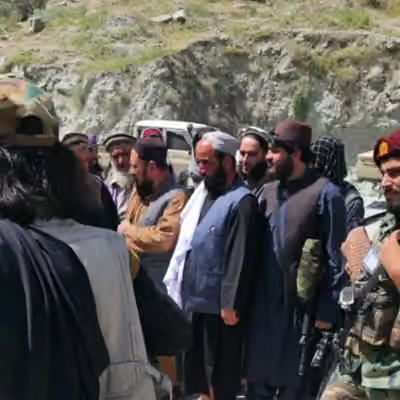
The Taliban has banned filming and photography at the traditional Shalimar Festival in Kandahar province, warning journalists not to produce visual reports of the event, sources told Afghanistan International.

The annual celebration, held in the Arghandab district of Kandahar, marks the arrival of spring with the ripening of berries and typically lasts between 20 to 40 days. It includes traditional wrestling, Attan dancing, singing, and other cultural programmes.

However, local sources reported on Tuesday, 13 May, that the Taliban’s Ministry for the Propagation of Virtue and the Prevention of Vice is prohibiting journalists from capturing images or footage of the festival or its participants.

Officials from the ministry in Arghandab reportedly detained several journalists for hours and warned them against any visual documentation.

“Officials from the Propagation of Virtue directorate in Arghandab summoned seven journalists who were filming the festival. They were informed that, by order of the provincial governor and the Taliban leadership, all filming and photography are strictly forbidden,” one source said.

According to the same source, Taliban officials also deleted all photos and videos recorded by journalists at the event.

Festival attendees told Afghanistan International that Taliban forces were actively patrolling the area in vehicles, regularly urging people to “align themselves with Sharia”.

Since the Taliban’s return to power, many aspects of the Shalimar Festival have been restricted. Singing and the performance of the Attan, a traditional Pashto dance, have been banned, despite their cultural significance.

Most Viewed

Taliban Order Cut To Residential Fibre-Optic Internet In Kabul, Say Sources
1

Taliban Order Cut To Residential Fibre-Optic Internet In Kabul, Say Sources

2

Taliban Besieged TOLOnews Offices After Journalist Detentions, Say Sources

3

Taliban Leader Adviser Arrested In Kandahar Over Alleged Bribery

4

Exiled Media Watchdog Urges UN, EU To Seek Release Of Journalists Held By Taliban

5

Taliban Urges Turkmenistan To Implement 24-Hour Operations At Torghundi Port

•
•
•

More Stories

EU, Uzbekistan Stress Ongoing Dialogue on Afghanistan Issues

May 13, 2025, 16:10 GMT+1

Ismatulla Irgashev, Uzbekistan’s Special Representative for Afghanistan, met with Eduards Stiprais, the European Union’s Special Representative for Central Asia, to discuss the ongoing situation in Afghanistan.

During the meeting, both sides highlighted the importance of maintaining dialogue on Afghan-related matters. Uzbekistan’s Ministry of Foreign Affairs announced that the meeting took place on Monday, 12 May. According to the ministry’s statement, the two sides not only addressed regional issues but also stressed the need to expand bilateral cooperation on Afghanistan-related matters.

The ministry added that both Uzbekistan and EU representatives called for continued, regular, and constructive dialogue to tackle issues concerning Afghanistan, reaffirming the need for ongoing consultations.

While Uzbekistan has not formally recognised the Taliban government, it aims to preserve and strengthen its relations with the group and has held multiple meetings with officials from various countries on this matter.

Recently, Uzbekistan’s Special Envoy for Afghanistan also met with the Polish Foreign Ministry’s Special Representative for Afghanistan, where both sides emphasised the importance of enhancing cooperation on Afghan-related issues.

Taliban Publicly Flogs Individual In Badakhshan Province

May 13, 2025, 14:40 GMT+1

The Taliban announced on Tuesday that a man in Yaftal district of Badakhshan province was publicly flogged on charges of "sexual relations."

According to the Taliban’s statement, the man was sentenced to 39 lashes by the group’s primary court, with the punishment carried out publicly.

The flogging took place on Tuesday, 13 May, in the courtyard of the Taliban’s district police headquarters in Yaftal, attended by local Taliban officials and residents of Badakhshan.

The Taliban's Supreme Court announces incidents of corporal punishment almost daily. The United Nations and various human rights organisations have repeatedly urged the Taliban to cease such practices.

Rights groups have criticised the Taliban’s judicial system, noting that it lacks proper standards, and that defendants are denied access to fair trial procedures, including legal representation.

Nearly Half Of Married Afghan Women Suffer Physical Abuse, Says UK Mission To Afghanistan

May 13, 2025, 13:46 GMT+1

The UK Mission to Afghanistan, citing the World Health Organization (WHO), stated that married Afghan women are subjected to physical violence, sexual abuse, and emotional harassment. According to the data, 46 per cent of married Afghan women have experienced physical violence.

In a post on the social media platform X on Tuesday, 13 May, the UK Mission stated: "46 percent of married Afghan women face physical abuse, 34 percent emotional abuse, and 6 percent sexual violence." It stressed the crucial role of men in ending such violence. Quoting a 29-year-old man from Paktika, Afghanistan, named Adam, it added: "Supporting women and girls is not a sign of weakness, it is a mark of true character. We must be their allies, friends, and advocates for their rights."

These concerns follow a recent report by the Afghanistan Analysts Network, which revealed that divorce has become nearly impossible for women under Taliban rule. The report noted that divorce remains a source of shame in Afghan society.

Furthermore, the situation for women continues to worsen due to domestic violence and the severe restrictions on their fundamental rights and freedoms.

Kenyan Court Approves Extradition Of Former Afghan Lawmaker To US

May 13, 2025, 12:10 GMT+1

A court in Nairobi has approved the extradition of Zahir Qadir, former deputy speaker of Afghanistan’s House of Representatives, to the United States, according to his family.

Qadir’s lawyer has requested a 14-day stay on the ruling, seeking time to file an appeal. The appeal is expected to be submitted within the next two weeks, the lawyer confirmed. Jalal Qadir, the former lawmaker's nephew, told Afghanistan International that the decision was made on Tuesday.

Qadir was arrested in Nairobi on 18 April at the request of the US government, facing charges of attempting to traffic narcotics and illegally transferring weapons. The court has ordered that he remain in police custody pending the commencement of extradition proceedings.

In response to the ruling, Qadir’s family has renewed its appeal for intervention from the Taliban, urging the group to act in securing his release. The Taliban had previously pledged to investigate the case, with acting Foreign Minister Amir Khan Muttaqi stating that efforts would be made "as far as possible."

Trump-Era Policy Shift Paves Way For Afghan Deportations As US Ends TPS Protection

May 13, 2025, 10:51 GMT+1

The US Department of Homeland Security (DHS) announced on Monday that it is ending Temporary Protected Status (TPS) for Afghan nationals, a measure granted under the Biden administration.

The move, rooted in a policy shift initiated during the Trump era, has sparked strong criticism from refugee advocates and Afghan-American organisations.

The DHS stated that conditions in Afghanistan have “improved” to the extent that TPS is no longer warranted, and Afghan nationals should begin returning home. As a result, TPS for approximately 14000 Afghan nationals currently residing in the United States will expire in 60 days.

In a statement, US Secretary of Homeland Security Kristi Noem said the administration’s latest assessment determined that Afghan refugees no longer meet the criteria for TPS. She cited improved security, a stabilising economy, and a rise in foreign tourism particularly from Chinese nationals as indicators that it is now safe for Afghans to return.

TPS is a humanitarian programme designed to offer temporary legal status and work authorisation to individuals from countries affected by conflict, natural disaster, or other extraordinary conditions. Afghan nationals have benefited from TPS for decades, particularly following the fall of Kabul in 2021.

Refugee and human rights groups, however, condemned the decision. The Afghan-American Foundation called it a “betrayal” of individuals who had risked their lives in support of US forces during the two-decade war. The foundation’s president noted:

“The sacrifices America’s Afghan allies made were not temporary; the protection we offer them must also be permanent.”

Shawn VanDiver, president of the non-profit organisation Afghan Evac, argued the decision damages US credibility and puts vulnerable lives at risk.

“Afghanistan remains under Taliban control. Human rights abuses, arbitrary detentions, and violence against women are widespread. Ending TPS won’t improve security, it will break up families and worsen instability,” he said.

Since the Taliban takeover in August 2021, approximately 80000 Afghans have arrived in the US under various evacuation and resettlement programmes. Many are in the process of obtaining permanent residency through asylum claims or Special Immigrant Visas (SIVs), while some have already received US green cards. However, around 14600 remain protected solely under TPS and now face the prospect of deportation.

Some of those affected have already received formal notices instructing them to leave the country. Miriam Woods, a schoolteacher in Des Moines, Iowa, described the psychological toll the policy shift is having on her Afghan students.

“One student told me they cry every night. They’re terrified,” she said.

The decision comes amid mounting international concern over the humanitarian crisis in Afghanistan. Reports continue to highlight severe human rights violations, including bans on education and employment for women, persecution of minorities, and widespread food insecurity.

The United Nations High Commissioner for Refugees (UNHCR) last month warned against the forced return of Afghan refugees, stating that such actions could exacerbate the already dire situation and trigger further displacement.

The policy reversal underscores a broader debate over America’s long-term responsibility to its Afghan allies and the role of humanitarian protection in US immigration policy.