Iran Launches Missile Strikes On Israel; Impacts Reported In Ashdod, Lachish

Missiles launched by the Islamic Republic of Iran struck at least four locations across Israel on Monday, according to multiple media reports.

Missiles launched by the Islamic Republic of Iran struck at least four locations across Israel on Monday, according to multiple media reports.
Al Jazeera reported that the missile attacks hit several areas, while The Times of Israel confirmed that emergency medics responded to an impact in Ashdod, a city in southern Israel. Additional reports indicated a missile strike in the Lachish region, located south of Jerusalem.
Earlier in the day, Reuters reported sightings of a missile flying over Jerusalem, followed by loud explosions heard in the surrounding areas.
The Israeli military confirmed that Iran had launched missiles toward Israeli territory and issued urgent warnings for civilians to seek shelter immediately upon hearing sirens.
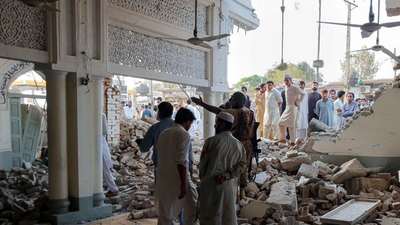

Israeli airstrikes have reportedly targeted Evin Prison in northern Tehran, one of Iran’s most prominent detention centres known for holding political prisoners, according to Iranian media and international news outlets.
CNN reported on Monday that large-scale airstrikes and powerful explosions were heard in northern Tehran. Iranian media published images and accounts suggesting that Evin Prison sustained damage during the attacks.
Reports indicate that the facility’s guard towers, administrative buildings, and court sections were among the areas struck.
Evin Prison has long been associated with the detention of political dissidents, journalists, and activists, and has frequently been the focus of international human rights concerns.
Neither Israeli nor Iranian officials have issued official statements confirming or denying the reported strike. The incident comes amid escalating military tensions between Israel and Iran, with both sides trading accusations of targeting civilian and strategic infrastructure.

German Foreign Minister Johann Wadephul said on Monday that neither the United States nor Israel is pursuing regime change in Iran, citing recent statements by US Vice President J.D. Vince and Israeli officials.
Responding to a question regarding the possibility of a shift in Iran’s political leadership, Wadephul said, “on Both the United States and Israel have clearly stated that regime change is not their objective.”
He noted that Iran currently prefers to engage in talks with European nations but stressed that this approach is insufficient. “European officials have made it clear that meaningful progress cannot be achieved without the resumption of negotiations with the United States,” he said.
Wadephul’s comments come amid renewed diplomatic efforts to address mounting tensions over Iran’s nuclear programme and broader regional instability.

French Foreign Minister Jean-Noël Barrot has said that a lasting resolution to rising tensions between Iran, the United States, and Israel can only be achieved through a negotiated agreement within the framework of the Nuclear Non-Proliferation Treaty (NPT).
In remarks addressing the escalating situation in the region, Barrot reaffirmed France’s commitment to diplomacy and the NPT as the foundation for preventing the spread of nuclear weapons.
“A sustainable solution is only possible through dialogue and adherence to international agreements,” Barrot said, emphasising the need for all parties to return to negotiations in good faith.
France is a signatory to the 2015 Iran nuclear deal, formally known as the Joint Comprehensive Plan of Action (JCPOA), and has consistently advocated for a diplomatic path to curb Iran’s nuclear activities while ensuring regional stability.

More than 2,800 people have been hospitalised in Israel since the beginning of Iran’s missile attacks, according to a report by CNN, citing official Israeli data.
The report states that a total of 2,835 individuals have received medical treatment, including 23 who were seriously injured, 107 with moderate injuries, and 2,555 with minor wounds.
Additionally, 119 people were admitted for psychological distress, including anxiety and trauma triggered by the ongoing missile strikes.
The conflict has seen both Iran and Israel accuse one another of targeting civilian areas. Iranian officials claim their strikes are aimed solely at military sites, while Israeli authorities maintain that residential areas have come under fire.
Earlier, Israeli officials confirmed that 24 people were killed as a result of Iran’s attacks.
The situation remains volatile, with international observers warning of the risk of further escalation in what has become one of the most serious regional confrontations in recent years.

Iranian Foreign Minister Abbas Araghchi has announced that he will travel to Moscow on Sunday for a meeting with Russian President Vladimir Putin, scheduled to take place on Monday, 23 June.
The visit comes amid heightened tensions over Iran’s nuclear programme and recent US strikes on Iranian nuclear facilities.
Speaking ahead of the trip, Araghchi condemned the attacks, saying the United States had shown “no respect for international law” and had crossed a “very significant red line” by targeting nuclear infrastructure.
The meeting with Putin is expected to focus on regional security, strategic cooperation, and the future of the Iran nuclear deal, as concerns grow over the possibility of further escalation between Iran and Western powers.