UN Confirms Limited Iranian Migration Into Afghanistan During Israel-Iran Conflict

The United Nations has confirmed instances of Iranian citizens crossing into Afghanistan following twelve days of heightened conflict between Israel and Iran.

The United Nations has confirmed instances of Iranian citizens crossing into Afghanistan following twelve days of heightened conflict between Israel and Iran.
Arafat Jamal, head of the UNHCR office in Kabul, said on Tuesday that the agency has deployed monitoring teams to Afghanistan’s border crossings and is closely observing the situation.
Speaking just hours before a ceasefire was announced, Jamal noted that while large-scale migration has not yet occurred, the UNHCR is prepared to respond if the flow of Iranians into Afghanistan increases. “If the trend continues, we are ready to support those arriving, in line with our humanitarian mandate,” he said.
Jamal reported that so far, only a few confirmed cases have been recorded, including a small number of Iranian nationals and approximately 30 families with dual Iranian-Afghan citizenship.
He stressed that the current movement does not yet represent a significant migration wave but that the agency remains alert to any developments.
The recent conflict between Iran and Israel, which involved reciprocal missile strikes and air raids, has prompted some residents, particularly from major urban areas in Iran, to flee the country in search of safety.
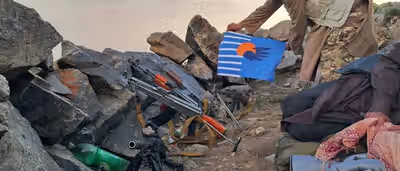

The Taliban have reopened the Kabul office of Rah-e-Farda Television, nearly two months after ordering its closure, sources told Afghanistan International on Tuesday.
The network, owned by former Afghan jihadi leader Mohammad Mohaqiq, was sealed in late April by the Taliban’s Ministry of Information and Culture, citing “repeated complaints” from staff over unpaid wages.
Rah-e-Farda, which includes both radio and television services, is known for its coverage of events linked to the People’s Islamic Unity Party of Afghanistan and Mohaqiq himself. The network has also been noted for its critical reporting on the Taliban.
Since the Taliban’s return to power in August 2021, the network has faced several shutdowns. Following the collapse of the previous government, reports suggested the station was suspended over unpaid frequency fees and other debts. It later resumed operations after meeting Taliban-imposed conditions.
The media environment in Afghanistan has sharply deteriorated under Taliban rule, with widespread censorship, harassment of journalists, and restrictions on independent outlets. Rah-e-Farda’s return to air marks a rare instance of a banned broadcaster being allowed to resume operations.

Roza Otunbayeva, head of the UN Assistance Mission in Afghanistan (UNAMA), has warned that the ongoing conflict between Iran and Israel is exacerbating Afghanistan’s already dire humanitarian and economic situation.
Speaking at a United Nations Security Council briefing on Monday, Otunbayeva said the regional conflict has disrupted trade routes, driven up the cost of essential goods and fuel, and triggered a sharp increase in the number of Afghan migrants returning from Iran.
“Returns from Iran alone in the past few days have exceeded 10,000 per day,” she said, noting that over 600,000 Afghans have returned from Iran and Pakistan in recent months.
She stressed that while local communities and Taliban authorities have made considerable efforts to accommodate returnees, international assistance is urgently needed to ensure a safe and orderly return process.
Otunbayeva also voiced concern about the broader impact of the Iran-Israel conflict on Afghanistan’s stability, warning that the crisis threatens to undermine fragile recovery efforts in a country already burdened by economic hardship and political uncertainty.

The US House of Representatives has passed a bill aimed at preventing the Taliban from benefiting from foreign and humanitarian aid intended for Afghanistan.
The legislation, titled the No Tax Dollars for Terrorists Act, was introduced by Congressman Tim Burchett and approved on Monday.
The bill mandates the US Department of State to develop strategies to block Taliban access to international assistance and to report its efforts to Congress. It also calls on the State Department to urge other countries to withhold financial aid from Taliban-controlled Afghanistan.
While it remains unclear how much US aid the Taliban has directly accessed, former Secretary of State Antony Blinken testified in a congressional hearing that the group may have indirectly obtained approximately $10 million. Reports suggest the Taliban has gained funds by taxing aid deliveries or interfering with their distribution.
Since the Taliban returned to power in 2021, the United States has provided more than $3.5 billion in aid to Afghanistan. Lawmakers including Burchett argue that a significant portion of this assistance has ended up in Taliban hands.
Burchett, a Republican representative from Tennessee, has claimed that up to $40 million in US taxpayer funds may have been delivered to the Taliban using private aircraft. He has also accused the group of maintaining ties with al-Qaeda.
The bill, introduced on 23 June 2025, requires the State Department to compile a report on countries that have provided aid to Afghanistan under Taliban control since 2021.
The legislation builds on previous measures introduced during the Trump administration, which had already curtailed most US aid to Afghanistan over concerns that the Taliban could divert it.

The United Nations Security Council is holding a open briefing on Afghanistan today, Monday, 23 June, as part of its regular quarterly discussions. The session will address the country’s political situation, human rights conditions, and ongoing humanitarian needs.
Roza Otunbayeva, the UN Secretary-General’s Special Representative and head of the UN Assistance Mission in Afghanistan (UNAMA), is expected to brief the Council, alongside Joyce Msuya, Assistant Secretary-General for Humanitarian Affairs, and Sima Sami Bahous, Executive Director of UN Women.
According to an official UN report released on Sunday, the public session will be followed by closed consultations among Security Council members. Several regional countries are also expected to participate in the meeting.
A key focus of today’s discussions will be the Taliban’s restrictive and discriminatory policies, particularly those targeting women and girls. Otunbayeva is also anticipated to present updates on the next steps in the Doha process, an initiative launched in 2023 to coordinate international engagement with the Taliban.
The previous Security Council session on Afghanistan, held on 10 March 2025, raised serious concerns about human rights violations, the growing presence of terrorist groups, and the extension of UNAMA’s mandate. Otunbayeva's forthcoming remarks are expected to address these ongoing issues and outline future UN efforts in the country.

The Taliban’s Ministry of Commerce and Industry has stated that the ongoing conflict between Iran and Israel has had no impact on trade flows or commodity prices in Afghanistan.
Abdul Salam Jawad, spokesperson for the ministry, told the Taliban-controlled Radio Television Afghanistan that “the import, transit, and supply of goods in domestic markets are proceeding normally.” His remarks were published on Monday.
Jawad added that the prices of essential goods remain stable across the country and are consistent with established benchmarks. He dismissed reports of food shortages as “personal opinions” not reflective of the broader market situation.
The comments come amid growing regional concerns about the impact of the Iran-Israel war on neighbouring economies. Earlier, Attaullah Omari, the Taliban’s Minister of Agriculture, warned that rising tensions could disrupt Afghanistan’s trade with Iran. Speaking at the 2025 Russia Economic Forum in St. Petersburg, Omari said the Taliban is in discussions with Moscow to ensure continued food imports.
“We still rely on some food items that come from Iran, and if problems arise there, it will undoubtedly have its effects,” Omari told Reuters.
Iran supplies Afghanistan with a range of goods, including dairy products, while Russia and Kazakhstan remain the country’s primary sources of wheat and flour. Russia also exports sugar and vegetable oil to Afghanistan.
Afghanistan became the largest buyer of Russian flour in 2024 and increased its domestic wheat production by 10 percent last year, reaching 4.83 million metric tonnes. The country’s annual wheat consumption is estimated at 6.8 million metric tonnes.
“For the past four years, since the withdrawal of the Americans, we have been making efforts to provide our essential food supplies ourselves,” Omari said. “The remaining amount, including flour and wheat, is supplied annually by Russia.”