Arrested 27000 Drug Traffickers In Over Four Years, Claims Taliban
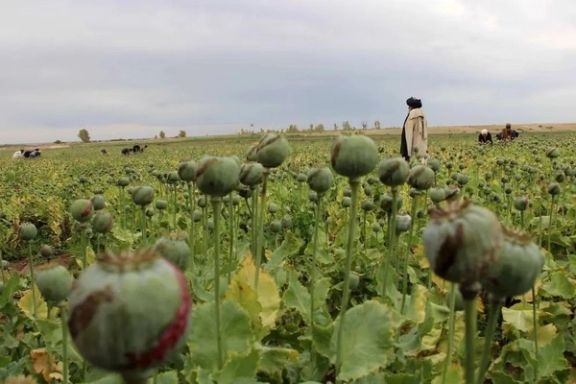
The Taliban said Thursday the group has arrested more than 27000 individuals on drug trafficking charges over the past four years.

The Taliban said Thursday the group has arrested more than 27000 individuals on drug trafficking charges over the past four years.
Abdul Mateen Qani, spokesperson for the Taliban’s Ministry of Interior, made the announcement during an event marking the International Day Against Drug Abuse and Illicit Trafficking. He claimed that the arrests were made without support from the international community or regional countries.
Speaking to Taliban-run Radio Television Afghanistan (RTA), Qani said, “Without the cooperation of the international community, regional, and neighbouring countries, we managed to control narcotics, which we inherited from the past, in a short time and with limited resources.”
He said the Taliban has carried out over 98000 counter-narcotics operations across the country since taking power.
In April 2022, the Taliban’s supreme leader issued a nationwide ban on the cultivation and production of narcotics.
Following the ban, the United Nations Office on Drugs and Crime (UNODC) reported a sharp increase in opium prices. In 2024, the price of opium in Afghanistan reached $750 per kilogram, ten times higher than in 2022.
While UNODC acknowledged a decline in drug production, particularly opium, it noted that high market prices continue to benefit large-scale traffickers.


Indian Defence Minister Rajnath Singh reaffirmed India’s commitment to peace, security and development in Afghanistan during remarks at the Shanghai Cooperation Organization (SCO) Defence Ministers’ Meeting on Thursday.
Singh said that New Delhi’s immediate priorities are delivering humanitarian assistance and continuing its development support to the Afghan people. He highlighted India’s role as Afghanistan’s largest regional development partner and noted that India remains engaged in empowerment and capacity-building efforts despite current political uncertainties.
Addressing SCO member states, Singh stressed the importance of building mutual trust and enhancing cooperation to tackle regional and global challenges. He also underscored the need to hold accountable those who plan, sponsor or finance terrorist activities, including cross-border terrorism.
India has not officially recognised the Taliban government but has maintained informal diplomatic engagement since the group’s return to power in 2021.

The Coordination Council of Afghanistan’s Political and Consular Missions has condemned the violent assault on a two-year-old Afghan child at Moscow’s Sheremetyevo Airport. It has called on Russian authorities to launch an immediate, transparent and thorough investigation.
The incident occurred on the evening of Monday, 23 June, when a 31-year-old Belarusian man reportedly picked up the child, who had fled conflict in Iran with his pregnant mother, and slammed him violently onto the floor of the airport terminal.
According to Russian media, the child sustained severe head injuries and remains in a coma. Authorities have arrested the suspect and launched an investigation into attempted murder.
In a statement shared by the Afghan Embassy in Australia on Thursday, 25 June, the council described the assault as a “brutal and inhumane act” and a clear violation of human dignity. It urged Russian officials to uncover the full circumstances of the attack and ensure justice is served.
“It is imperative to uncover the truth, establish the motives behind this crime, and ensure that the perpetrator is held accountable under the rule of law,” the council said.
The statement stressed that the incident highlights the vulnerability of Afghan refugees and the need for greater international attention to their safety and dignity, particularly that of children and other at-risk groups.
“We urge the Russian authorities to act with the necessary transparency and decisiveness to deliver justice in this case,” the council added.
The motive behind the Belarusian man’s actions remains unclear. Reports suggest the suspect had recently travelled from Kabul to Moscow and was exhibiting erratic behaviour at the time of the incident.
The child was reportedly alone in the terminal when the attack occurred, as his mother had stepped away briefly to collect their luggage. The family had recently arrived in Moscow after fleeing the war in Iran.

The Taliban’s Foreign Minister, Amir Khan Muttaqi, has appointed Saniullah Farahmand, a Turkmen cleric with no prior diplomatic experience, as the group’s “Ambassador Extraordinary and Plenipotentiary” to Türkiye.
The announcement was made during a ceremony at the Afghan embassy in Ankara, where Muttaqi stated that diplomatic ties between the Taliban and Türkiye had been upgraded to ambassadorial level. He described the move as a reflection of “good cooperation and positive relations” and expressed hope that it would help further strengthen bilateral engagement.
Muttaqi also claimed that relations between the Taliban government and Türkiye are now “almost normalised.” He added that Turkish citizens were travelling to Afghanistan “for investment and tourism,” and cited an economic growth rate of “2.7 percent” under Taliban rule.
According to the UN Comtrade database, Türkiye’s exports to Afghanistan in 2024 totalled approximately $210 million.
Farahmand, the new ambassador, holds the religious title of “Sheikh al-Hadith,” signifying his expertise in Islamic traditions. His public social media presence suggests he has primarily been involved in teaching Tajwid (rules of Qur’anic recitation), Qur’anic studies, and Hadith, particularly those of Imam Bukhari.
Despite not formally recognising the Taliban government, Türkiye has maintained a diplomatic presence in Kabul since the fall of the previous administration. The appointment of Farahmand is part of the Taliban’s broader pattern of assigning religious scholars to key government and diplomatic positions.

More than 30000 Afghan migrants returned from Iran on Wednesday, June 25, according to local Taliban officials in Herat province. The sharp increase comes amid heightened tensions in Iran following its recent conflict with Israel.
Ahmadullah Muttaqi, head of the Taliban’s Directorate of Information and Culture in Herat, said that around 600 passenger buses transported the migrants to the Islam Qala border crossing. Posting on the social media platform X, he noted that the return of Afghan migrants from Iran would continue in the coming days, with hundreds more buses expected to arrive at the border.
Muttaqi described Wednesday’s influx as unusually large, even as the number of returnees had been rising in recent weeks.
Taliban authorities said they had distributed water and food to returnees at the border and were working overnight to transfer them to their respective provinces.
The surge in returns follows Iran’s reported intensification of pressure on Afghan migrants, particularly after its military confrontation with Israel. Earlier this week, the governor of Tehran announced that increased security checkpoints had led to a three- to fourfold rise in the arrest and deportation of undocumented migrants.
Iran hosts one of the world’s largest populations of Afghan refugees, many of whom fled decades of conflict and instability. Rights groups have criticised Iran’s recent mass deportations, citing concerns over the treatment of returnees under Taliban rule.

The Taliban have reported a sharp increase in the forced deportation of Afghan migrants from Iran following the recent conflict between Iran and Israel.
Ahmadullah Muttaqi, the Taliban’s Director of Information and Culture in Herat, said that prior to the outbreak of hostilities, approximately 3,000 Afghan nationals were being forcibly deported each day via the Islam Qala border crossing. That figure has now surged to around 10,000 per day since the conflict ended, he said.
Muttaqi noted that, in addition to those forcibly removed, another 1,000 people had been voluntarily returning daily before the war. In the days following the ceasefire, he claimed, voluntary returns have increased to about 4,000 daily.
“Combined, we are now seeing roughly 13,000 people returning from Iran each day, and this could soon rise to between 15,000 and 20,000,” Muttaqi said during a public event.
Despite these claims, Iran’s ambassador to Afghanistan, Alireza Bikdeli, said on Monday that Tehran is not applying “pressure, unjust or illegal actions” against Afghan nationals. He stated that the plan to regulate and repatriate undocumented Afghan migrants began a year ago in consultation with Taliban officials and continues as scheduled.
Reports of detentions of Afghan migrants in Iran during the Iran-Israel conflict have added to concerns over their treatment. Rights groups and Afghan officials have previously criticised Iran’s handling of Afghan refugees, particularly in the wake of increased regional instability.