Karzai Urges National Consensus As Path To Peace
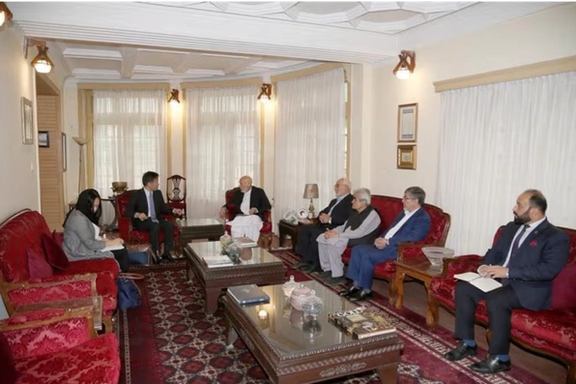
Former Afghan President Hamid Karzai reiterated the need for national consensus as the foundation for lasting peace and stability during a meeting with Japan’s ambassador to Kabul.
Former Afghan President Hamid Karzai reiterated the need for national consensus as the foundation for lasting peace and stability during a meeting with Japan’s ambassador to Kabul.
In a statement shared Monday on social media, Karzai said he met with Ambassador Takayoshi Kuromiya and thanked Japan for its continued support to Afghanistan, particularly in the health and education sectors.
Karzai described Japan as a “historic friend” of Afghanistan and praised its longstanding contributions to the country’s development.
The former president, who has occasionally criticised Taliban policies in indirect terms, again underscored the importance of inclusive governance, girls’ education, and unity among all ethnic groups.

Amnesty International has listed the International Criminal Court’s (ICC) issuance of arrest warrants for senior Taliban leaders as one of the most significant human rights achievements of the year.
In a statement issued Monday, July 15, the rights organisation released a list of 29 human rights wins recorded in the first half of 2025 across countries including Afghanistan, Chile, Cameroon, Türkiye, Ukraine, Saudi Arabia, the United States, and Greece.
Topping the list was the ICC’s arrest warrants for Hibatullah Akhundzada, the Taliban’s supreme leader, and Abdul Hakim Haqqani, the group's chief justice. The two are accused of crimes against humanity.
“These are the first public arrest warrants sought by the ICC in Afghanistan since the country became a member of the court in 2003,” Amnesty International said in the statement.
Despite the ongoing global challenges marked by “fear, division and hatred,” Amnesty noted that activists around the world continued to fight for justice and preserve hope.
The report also highlighted other key developments, including the release of several human rights defenders in Saudi Arabia, US sanctions on companies supplying weapons to Sudan, and new measures to combat violence against women in Algeria.
The ICC announced on July 8 that it had issued arrest warrants for Akhundzada and Haqqani. The move was welcomed by Western governments, Afghan women’s rights activists, and international human rights groups.
The Taliban, however, rejected the court’s legitimacy, stating they do not recognise the ICC and that its decisions would not affect their policies or behaviour.
Afghan migrants in Iran who were deported without recovering their rental deposits can seek assistance through their embassy, according to a senior Iranian official.
Nader YarAhmadi, Director General of the Bureau for Aliens and Foreign Immigrants Affairs at Iran’s Ministry of Interior, said on Monday that Afghan nationals who have not received their housing deposit payments may follow up their claims via the Afghan embassy or consular offices in Iran.
“The Islamic Republic is prepared to help Afghan migrants recover their housing deposits,” YarAhmadi said, as quoted by the Iranian Students’ News Agency (ISNA).
He added that legal and support services are available in several provinces, where welfare offices have been set up to resolve financial disputes between migrants and landlords.
Zahra Behrouz Azar, Vice President for Women and Family Affairs, also stated that migrants may submit documents even after deportation. “Cases will be reviewed and followed up by the Legal Affairs Office for Foreign Nationals,” she said.
In recent weeks, many Afghan migrants deported from Iran have reported that their landlords or employers failed to return their wages or security deposits. Rights groups and humanitarian organisations have raised concerns over the treatment of Afghan migrants, particularly amid the surge in deportations.
Four Taliban ministries have convened a meeting to review books deemed ideologically “deviant,” in a move reflecting the group’s ongoing crackdown on literature it considers contrary to its interpretation of Islam.
State-run National Television, under Taliban control, reported Sunday that the meeting was held on the order of Taliban leader Hibatullah Akhundzada and chaired by Noor Mohammad Saqib, the Minister of Hajj and Religious Affairs.
Officials from the Ministries of Higher Education, Education, Information and Culture, and Hajj and Religious Affairs attended the meeting. According to the report, the ministries have been instructed to assess books collected from libraries, schools, and public institutions and to launch public awareness campaigns warning against such materials.
Saqib said the review process will be led by religious scholars and conducted “in accordance with Sharia principles.” A joint committee is expected to develop official guidelines to facilitate the effort.
Since retaking power in August 2021, the Taliban have intensified censorship efforts, banning hundreds of titles they view as incompatible with their ideology. The Ministry of Information and Culture has previously removed books from schools, bookstores, and libraries that it labelled as promoting un-Islamic or anti-Taliban ideas.
The Taliban define “deviant” books as those that oppose or fail to support their views. A special book review commission established by the group has halted the publication and distribution of hundreds of titles, and banned the sale or reprinting of at least 100 books.
Former British envoy in Afghanistan Nicholas Kay says Russia’s decision to recognise the Taliban could encourage some neighbouring countries to follow suit, though it is unlikely to alter the stance of Western governments.
Speaking on Sunday, in an interview with Afghanistan International, Kay said Russia’s engagement with the Taliban is not new, noting that Moscow has maintained covert ties with the group for years.
He added that aome regional states may recognise the Taliban because of their national interests, but this move will not affect the position of the West.
He noted that regional countries tend to view Afghanistan as a source of economic opportunity, while Western nations are more concerned with terrorism, narcotics trafficking, and migration. He stressed that Russia is also uneasy about China’s growing presence in Afghanistan and is seeking to reassert its influence.
Despite the Taliban’s return to power in 2021, Kay said that the group’s lack of adherence to civil, political and women’s rights continues to block international recognition. He added that until the Taliban respects basic rights, there is no prospect of recognition by the West.
Kay also highlighted what he described as the West’s diminishing focus on Afghanistan and said that the country is no longer a priority. Even in its current dire state, it is not receiving the attention or funding it needs.
He concluded that the Taliban’s governance structure is inherently fragile, stressed that the regime is unsustainable and Afghanistan’s diverse society cannot tolerate Taliban rule indefinitely.
A group of retired government employees in Kabul have once again staged a protest over non-payment of their pensions. During a gathering on Saturday, the demonstrators said they would continue their protests until their entitlements are paid.
One of the retirees, Abdul Hakim, said he and his peers are in urgent need of their pensions and should not be subjected to further hardship.
Over the past four years, Afghan retirees have repeatedly protested due to unpaid pensions. However, the Taliban authorities have instructed them to refer to special courts to validate their claims.
Following the Taliban’s return to power in Afghanistan, the pension payments for retired public servants were suspended and have yet to resume.
Retirees say the Taliban show no intention of restoring their pensions.