50 Militants Killed Near Afghan Border, Says Pakistan Army
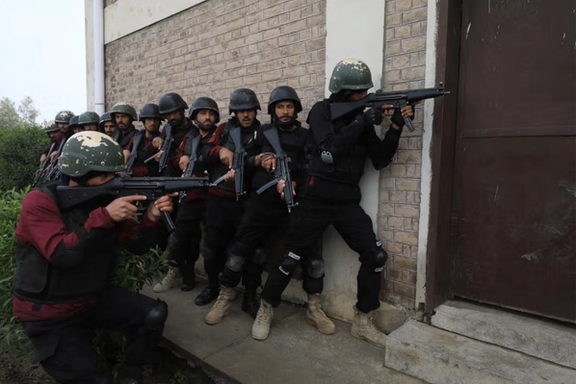
Pakistan’s army said Tuesday it had killed 50 members of Tehreek-e-Taliban Pakistan (TTP) during a four-day operation along the Afghan border in the Sambaza area of Balochistan.

Pakistan’s army said Tuesday it had killed 50 members of Tehreek-e-Taliban Pakistan (TTP) during a four-day operation along the Afghan border in the Sambaza area of Balochistan.
The military said the operation, which began Thursday, also led to the seizure of weapons, ammunition and explosives from the militants.
The statement that security forces remain committed to protecting the country’s borders and neutralising efforts to undermine the peace, stability and progress of Pakistan.
Since the Taliban’s return to power in Afghanistan in 2021, Pakistan has faced a sharp increase in cross-border militant attacks, particularly in the border provinces of Khyber Pakhtunkhwa and Balochistan.
The Islamabad-based Pakistan Institute of Conflict and Security Studies reported that 78 terrorist attacks took place in June, killing at least 100 people. The dead included 53 security personnel, 39 civilians, six militants and two members of local peace committees.
The think tank said 189 people were wounded that month, among them 126 security personnel and 63 civilians.
In total, violence and security operations in June left 175 people dead, including 55 security personnel, 77 militants, 41 civilians and two peace committee members, according to the report.

The United States has designated the separatist militant group Balochistan Liberation Army (BLA) as a foreign terrorist organisation, the State Department said on Monday.It described the move as part of the Trump administration’s commitment to combating terrorism.
The BLA, which seeks independence for Pakistan’s Balochistan province, has claimed responsibility for numerous attacks in the country. In March, the group said it was behind the hijacking of a passenger train travelling from Quetta to Peshawar, an assault that left dozens of passengers and Pakistani soldiers dead.
In 2019, Washington also listed another anti-Pakistan Baloch militant faction, the Majeed Brigade, as a “Specially Designated Global Terrorist” entity.
Under the new designation, providing any form of support to the BLA within the United States is now a criminal offence. The previous designation targeted only the group’s financial assets.
Balochistan, Pakistan’s largest but least populated and most underdeveloped province, has seen at least five separatist uprisings since the country’s founding in 1947. Supporters of the movement accuse Islamabad of exploiting the region’s resources while neglecting its roughly 15 million residents.

Uzbek President Shavkat Mirziyoyev has called for the rapid implementation of the Trans-Afghan railway project, describing it as a vital regional initiative to enhance economic integration and transport connectivity.
Speaking Tuesday at a United Nations conference on landlocked developing countries in Turkmenistan, Mirziyoyev highlighted the strategic importance of the proposed Uzbekistan-Afghanistan-Pakistan railway line. He said regional infrastructure projects such as this would help create a new commercial and economic space and build sustainable transport networks.
The Trans-Afghan railway aims to link Central Asia with South Asia, facilitating trade and boosting economic cooperation across the region.
In July, the Taliban’s Foreign Ministry announced the signing of a feasibility study agreement for the railway line. The agreement was signed in Kabul between the Taliban’s Ministry of Public Works, Uzbekistan’s Ministry of Transport, and Pakistan’s Ministry of Railways. The foreign ministers of Uzbekistan, Pakistan, and the Taliban administration attended the signing ceremony.
Pakistan’s Foreign Minister Ishaq Dar said the railway project would open a new transit corridor between Central and South Asia and play a key role in promoting regional trade and economic growth.

A senior Pakistani official has raised alarm over a resurgence of militant attacks in Khyber Pakhtunkhwa and Balochistan provinces, urging the Taliban to cooperate with Islamabad in addressing escalating insecurity along the shared border.
Speaking during a security meeting in Islamabad on Monday, Deputy Interior Minister Talal Chaudhry said terrorist incidents in Pakistan’s border regions have intensified, resulting in mounting casualties among security forces.
He stressed that without full political backing from the federal government, security agencies would be unable to respond effectively to the growing threats.
Chaudhry said that Pakistan and Afghanistan are neighbours and brothers, noting Pakistan’s longstanding support for peace in Afghanistan. He added that Pakistan has made great sacrifices and it is now time for Afghanistan to fulfil its responsibilities.
The minister added that more than 90,000 Pakistanis have lost their lives in terrorist attacks over the years. He warned that the ongoing violence could have consequences beyond Pakistan’s borders if left unaddressed.
Pakistani authorities have repeatedly accused the Taliban administration in Kabul of sheltering members of Tehreek-e-Taliban Pakistan (TTP), the banned militant group responsible for numerous attacks across the country. The Taliban, however, denies offering sanctuary to the TTP.

Pakistani authorities have resumed the forced deportation of Afghan migrants after deciding not to extend residency deadlines, a move that affects an estimated 1.4 million Afghans holding expired Proof of Registration (PoR) cards.
Officials announced on Monday that the deportations had restarted, drawing sharp criticism from the United Nations High Commissioner for Refugees (UNHCR), which warned the mass returns could worsen instability in Afghanistan.
In addition to PoR card holders, around 800,000 Afghans with Afghan Citizen Cards are also at risk. Pakistani police say these individuals are residing in the country “illegally” and are being detained in the provinces of Punjab, Balochistan, and Sindh.
According to a government notice dated 31 July and obtained by the Associated Press, Afghan nationals without valid passports and Pakistani visas must leave the country under Pakistan’s immigration laws. The statement confirmed the Pakistani government’s decision to deport all Afghans with expired PoR documentation.
Two Pakistani government and security officials told the AP that police across the country have begun detaining Afghan nationals and transferring them to border crossings. Officers have reportedly been ordered to conduct door-to-door searches to identify and arrest undocumented migrants.
Shakeel Khan, commissioner for Afghan refugees in Khyber Pakhtunkhwa province, said that Afghan migrants living illegally in Pakistan are being returned to their country with respect. He added that the operation marks a major step in enforcing the federal government’s directive.
Rahmatullah, a 35-year-old Afghan, said his family settled in Peshawar decades ago but is now preparing to return.
He said that he has five children and is worried they’ll miss out on education, adding that he and his children were born in Pakistan, but they have to leave the country.
Pakistan has hosted millions of Afghans for more than four decades, many of whom fled war, political turmoil, and economic hardship. The current wave of expulsions follows a nationwide crackdown launched in 2023 targeting foreign nationals without legal residence.
UNHCR spokesperson Qaiser Khan Afridi expressed deep concern over the renewed deportations. In a statement, he described the forced returns as a violation of international obligations and urged Pakistan to adopt a more humane and measured approach.

The Islamic Republic of Iran executed five Afghan nationals in July, according to a report released by the Hengaw Organisation for Human Rights on Sunday, 4 August.
The rights group stated that a total of 96 prisoners were executed across Iran during the month, a 74.5 per cent increase compared to July 2024, when 55 executions were recorded. Of those executed last month, five were citizens of Afghanistan.
According to Hengaw, the majority of those executed in July were convicted of drug-related offences. The report did not include the names or personal details of the Afghan nationals.
Iranian authorities have not publicly commented on the report.
Human rights organisations based outside Iran have previously reported a rise in executions of Afghan inmates, particularly following the Taliban’s return to power in Afghanistan in 2021.
In its annual report, Iran Human Rights stated that at least 80 Afghan nationals were executed by Iranian authorities in 2024.
