Pakistan Accelerating Deportations Of Afghan Migrants, Say Taliban

Taliban officials say Pakistan has stepped up the deportation of Afghan migrants, with hundreds of families being forced to return daily.

Taliban officials say Pakistan has stepped up the deportation of Afghan migrants, with hundreds of families being forced to return daily.
Bakht Jamal Gohar, a Taliban representative at the Torkham border crossing, said deportations had recently accelerated, though he did not specify by how much.
Mohammad Hashim Maiwandwal, head of the Taliban-run Omari camp in Torkham, urged aid agencies to provide more assistance to those being sent back.
Meanwhile, Taliban ambassador to Pakistan Sardar Ahmad Shakeeb accused Islamabad of committing “injustice” against Afghan migrants. In a media interview, he said many Afghans in Pakistan hold assets, investments and property, and appealed to Pakistani authorities to allow them time to collect or sell their belongings.
Pakistan has deported tens of thousands of undocumented Afghans since announcing a crackdown on illegal migration last year, a move that has drawn criticism from rights groups and international organisations.

Iran has accused the Taliban of failing to honour a key water treaty and vowed to intensify pressure on the group to secure its share of the Helmand River.
Mohammad Javanbakht, Iran’s deputy energy minister for water affairs, told state-run Tasnim News Agency that this year’s drought and low rainfall had worsened shortages in Iran. He said that under the 1973 Helmand River treaty, Afghanistan is obliged to provide Iran with 820 million cubic metres of water annually.
“Only about 100 million cubic metres of water reached the Chah Nimeh reservoirs this year,” Javanbakht said, describing the shortfall as a serious breach of the agreement. He added that Tehran would now pursue its water rights “more firmly and decisively.”
Iran’s foreign minister has also cited Afghanistan’s failure to meet water commitments as a major challenge in bilateral relations.
Some Iranian officials allege the Taliban have deliberately diverted water into salt marshes to prevent flows into Iran. The Taliban reject the claim, blaming regional drought, but insist they remain committed to the treaty.
During a recent visit to Iran, Taliban foreign minister Amir Khan Muttaqi said providing water for residents of Iran’s Sistan and Baluchestan province was both a humanitarian responsibility and an Islamic duty.

The Taliban have flogged a man and a woman in public in central Afghanistan after convicting them of “moral corruption,” the group’s Supreme Court said.
In a statement on Thursday, the court said a primary court in Jeghatu district of Ghazni province sentenced the pair to three months in prison and 30 lashes. The punishment, which had been approved by the Supreme Court, was carried out in front of local officials, court staff, visitors and residents.
Despite repeated criticism from Afghan citizens, human rights organisations and the international community, the Taliban continue to enforce public corporal punishments.
What the Taliban call ‘moral corruption’
The charge of “moral corruption” is frequently used against young men and women, often after arrests by the Taliban’s Ministry for the Propagation of Virtue and Prevention of Vice. Under the ministry’s rules, any interaction between men and women outside marriage, including phone calls, conversations, attending weddings or other mixed gatherings, travelling without a male guardian, or women appearing in public without one, can be deemed a violation. Dress considered “inappropriate” by the Taliban may also lead to detention.
Rights groups say Taliban courts routinely deny defendants fair trial rights, including access to independent lawyers. Trials are closed to media, civil society and the public. Human rights monitors report that forced confessions and torture are common in detention centres, while punishments are often harsh and inconsistent with international standards.

A planned gathering of Taliban opponents in Pakistan has been postponed after participants faced difficulties obtaining visas, two sources told Afghanistan International.
One participant said the meeting is now expected to take place in the last week of September.
The two-day event, organised by Pakistan’s South Asian Strategic Stability Institute (SASSI), is set to bring together representatives of Afghan political groups, civil society, women’s rights activists and media, alongside Pakistani academics and policymakers. Organisers say the goal is to define common principles for stability, rule of law and a representative government in Afghanistan.
Pakistan’s Foreign Ministry had earlier confirmed the conference, describing it as an “open event” hosted by a think tank. On Friday, ministry spokesperson Shafqat Ali Khan said the gathering would go ahead under SASSI’s auspices.
The meeting has drawn sharp reactions. Former US envoy for Afghanistan Zalmay Khalilzad criticised Pakistan’s decision to host the event, calling it “immature, irresponsible and unfortunate.”
Maria Sultan, head of SASSI, responded that the conference had unsettled Khalilzad’s “peace” and extended an invitation for him to attend as an honorary guest. Afghan women’s rights activist Fawzia Koofi also rebuked Khalilzad, saying Afghans had lost their rights due to his “bad faith and mismanagement” during the peace process. She argued it was better to invite him to the meeting than allow him to see it as a threat.
Although Pakistan has engaged closely with the Taliban since their return to power in 2021, tensions have grown amid worsening security inside Pakistan. Islamabad has accused the Taliban of allowing Tehreek-e-Taliban Pakistan (TTP) fighters to shelter across the border. Analysts say Pakistan’s frustrations with the Taliban’s inaction against the TTP have led it to encourage dialogue with Taliban opponents instead.

Four Taliban diplomats have travelled to Switzerland to help identify Afghan nationals convicted of crimes, in a move Swiss officials described as sensitive but necessary.
Swiss state broadcaster SRF reported that the delegation arrived in Geneva several days ago for a two-day mission, during which they identified 11 convicted individuals and two Afghans who had volunteered to return home.
Daniel Bach, spokesperson for the State Secretariat for Migration (SEM), said the step was required to issue valid travel documents, since the Taliban only recognise papers issued by their own authorities. Documents previously provided by Afghanistan’s embassy in Bern are no longer accepted.
Bach acknowledged the process was “sensitive” because human rights are not respected in Afghanistan, but said Switzerland’s priority was protecting the public from offenders.
Officials stressed that the Taliban delegation remained inside Geneva Airport and carried out only the identification process. SEM confirmed that most cases were successfully verified, paving the way for deportations, though some required additional checks.
The move follows a policy introduced last year by Swiss Justice Minister Beat Jans, under which Afghan nationals convicted of crimes must be deported after serving their sentences. By the end of 2023, five Afghan offenders had been returned. But new Taliban regulations now require Kabul-issued documents for returnees.
Germany has also allowed two Taliban consular staff to be deployed since July to facilitate deportations. Switzerland, however, has said it has no plans to permit Taliban representatives to be permanently based on its territory.

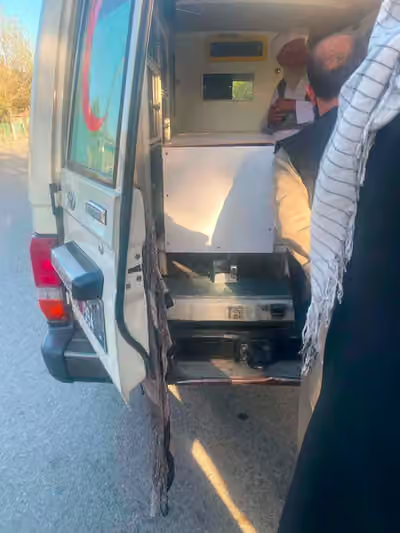
The Taliban are transferring the bodies of 50 Afghan fighters linked to Tehreek-e-Taliban Pakistan (TTP) back into Afghanistan after they were killed in clashes with the Pakistani military, sources told Afghanistan International.
The fighters died about two weeks ago during operations by Pakistan’s army in Sambaza, Balochistan, near the Afghan border. On 12 August, the Pakistani military announced it had killed 50 TTP members in the area and seized large quantities of weapons, ammunition and explosives.
Sources said Friday, that the bodies are being returned to families in several Afghan provinces. According to the sources, about 90 percent of those killed were Afghans from the Hafiz Gul Bahadur faction of the TTP, who had crossed into Pakistan to carry out attacks against Pakistani security forces.
The Hafiz Gul Bahadur group is considered one of the most active anti-Pakistan factions and was previously recognised as a military wing of the TTP. It has carried out multiple deadly attacks against Pakistani security forces in recent years.
Pakistan has long accused the Taliban of harbouring militant groups, including the TTP, and has repeatedly urged them to take action. The Taliban have consistently denied such allegations, insisting Afghan territory will not be used to threaten other countries.
Earlier this week, Pakistan’s envoy to the UN warned that Afghanistan-based militants, particularly the TTP, which is believed to have around 6,000 fighters, pose the most immediate threat to Pakistan’s national security and to regional stability.
Separately, UN experts reported to the Security Council that the Taliban continue to provide a permissive environment for foreign terrorist groups in Afghanistan, which they described as a serious threat to Central Asia and beyond.