Afghanistan Earthquake Death Toll Rises To 1,457, Say Taliban

The death toll from the powerful earthquake that struck eastern Afghanistan has risen to 1,457, with 3,394 people injured, the Taliban said Wednesday.
The death toll from the powerful earthquake that struck eastern Afghanistan has risen to 1,457, with 3,394 people injured, the Taliban said Wednesday.
Taliban spokesman Zabihullah Mujahid said the quake in Kunar province also destroyed 6,782 homes.
Rescue operations are continuing in the province, where bodies are still being recovered, Mujahid said. He added that the wounded are being airlifted to hospitals by helicopter.
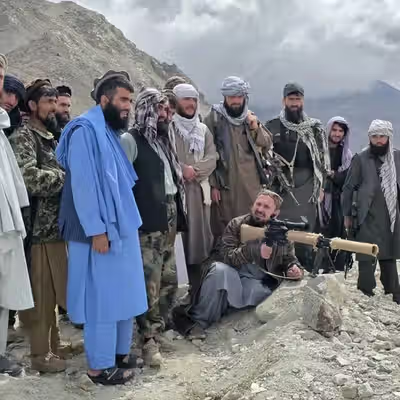
The International Organization for Migration warned Wednesday that thousands of families affected by the recent earthquake in eastern Afghanistan could face the coming winter without shelter.
In a report, the agency said 12 quake-hit districts in Kunar, Nangarhar and Laghman provinces are home to about 2.74 million people. It said the districts of Nurgal and Chawkay in Kunar, Dara-i-Noor in Nangarhar and parts of Laghman were the worst affected, with access to those areas still difficult.
The IOM said many of the displaced in the affected regions including returnee migrants and internally displaced people were already living in highly vulnerable conditions before the quake struck.
The agency added that this disaster has exacerbated Afghanistan’s crises, and with the return of more than 1.7 million people from Iran and Pakistan and widespread economic problems, the situation is becoming even harder.
The organisation stressed that with winter approaching, thousands of families remain without safe shelter, raising the risk of further humanitarian consequences.
Taliban forces clashed with fighters from the National Resistance Front in Baghlan province late Tuesday, local sources told Afghanistan International.
The fighting broke out around 9 p.m. in the Kahgdai area of Nahrin district and lasted for nearly an hour, the sources said. No casualty figures have been confirmed.
The National Resistance Front has not issued a statement confirming the clash or reporting losses among its fighters.
Kahgdai is known as a stronghold of the Resistance Front, which has previously battled Taliban forces in the area. In June last year, two NRF commanders, Abdul Samad Kahgdai and Khairullah, were killed in clashes with the Taliban forces in Nahrin.
The World Health Organization warned Tuesday of severe shortages of medicine and health services for survivors of the earthquake in eastern Afghanistan, saying thousands remain at risk.
Hanan Balkhy, the WHO’s regional director, said the organisation has dispatched medicines, emergency equipment and support teams to affected areas but described the needs as overwhelming.
She added that more than 1,400 people have lost their lives in the tragic earthquake in Afghanistan and more than 3,100 others have been injured. Balkhi added that hospitals are overwhelmed with casualties, the psychological pressure is immense, and there is a risk of disease outbreaks.
She said the WHO sent public health experts to the quake zone within hours of the disaster and has since begun large-scale support operations. Those efforts include delivering 23 tonnes of trauma medicines and emergency supplies, setting up field tents to expand hospital capacity, deploying mobile teams to provide psychological support and strengthening disease surveillance.
Balkhy stressed that survivors urgently need clean drinking water and basic health services. The WHO said it has provided about $4 million to address immediate needs.
UN Secretary-General António Guterres on Tuesday called for additional resources to provide urgent relief to survivors of the earthquake in eastern Afghanistan, saying current humanitarian funding is insufficient to meet the needs.
In a statement, Guterres said the United Nations, working with Taliban authorities, is assessing the situation and mobilising further support for those affected.
As an initial step, the UN has allocated $5 million from its emergency fund to assist relief efforts, he said.
He added that the United Nations in Afghanistan will spare no effort in helping the Afghan people.
The Taliban have again detained Haidar Jan Naeemzoi, a former member of parliament and a prominent elder of the Kuchi community.
He was detained on the orders of Taliban’s Justice Minister Abdul Hakim Sharaee, sources in Kabul told Afghanistan International.
Naeemzoi, a former member of the Lower House of Parliament, was transferred to a Taliban detention centre in Kabul last Thursday, the sources said Tuesday.
According to the sources, the justice minister demanded that the Kuchis hand over disputed lands in Logar province to the Taliban.
Naeemzoi’s family confirmed his arrest, saying Sharaee is pressuring Kuchi elders under the pretext of “seizing state land.” “This is the second time he has been jailed on the orders of the Taliban’s justice minister,” the family said. “The first time he was held in a private prison inside the ministry, but this time he is in a Kabul detention centre.”
The Taliban had previously released Naeemzoi on bail, with the condition that the Kuchis surrender the disputed land in Logar, according to the sources.
Some Kuchi elders argue that the justice minister is fuelling ethnic tensions by labelling as land grabs properties that were allocated under decrees of previous Afghan governments.
Nearly two years ago, Afghanistan International reported the existence of a private prison inside the Taliban’s Ministry of Justice in Kabul, where Naeemzoi was allegedly held. At the time, Sharaee said he had the authority, under orders from the Taliban’s leader, to imprison “land usurpers” for up to 10 days.
Last year, members of the Kuchi community presented documents to Afghanistan International claiming that Sharaee was ignoring decrees issued by former President Hamid Karzai regarding Kuchi settlements.
The Taliban’s Ministry of Justice has not yet commented on Naeemzoi’s latest detention.