Former Taliban Deputy Foreign Minister Reportedly Detained In Qatar

Qatari intelligence has reportedly detained Abdul Rahman Zahid, a former deputy foreign minister of the Taliban, sources told Afghanistan International.

Qatari intelligence has reportedly detained Abdul Rahman Zahid, a former deputy foreign minister of the Taliban, sources told Afghanistan International.
According to people close to him, Zahid has not been in contact since his detention in late August. He was reportedly taken into custody on 22 August, and his whereabouts remain unknown.
Born in 1963 in Kharwar district of Logar province, Zahid served as deputy foreign minister during the Taliban’s first regime and was considered one of the group’s senior figures. Since 2001, sources said, he has engaged in business activities and travelled frequently to Qatar, the UAE, Pakistan and Afghanistan.
A Taliban official in Doha confirmed Zahid’s detention and said discussions with Qatari authorities are ongoing to clarify the reasons. The motive behind his arrest remains unclear.
Zahid was also reportedly detained at Dubai airport in September 2015. He remains under UN Security Council sanctions for alleged links to terrorism and sensitive international activities.
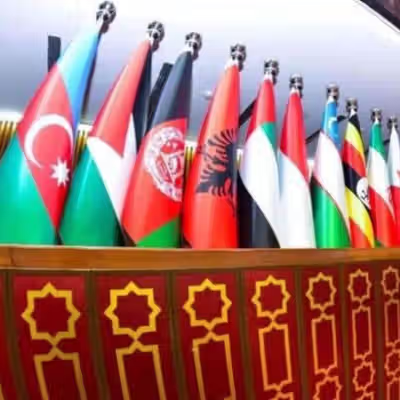
Taliban Foreign Minister Amir Khan Muttaqi has been granted a temporary travel exemption to visit Russia and India next week, a source in the group’s Ministry of Foreign Affairs told Afghanistan International.
According to the source, Muttaqi will travel to Moscow on 6 October to attend the seventh round of the “Moscow Format” talks at the invitation of Russian officials. For the first time, a Taliban delegation will participate as a member rather than a guest. In a statement on 27 September, Muttaqi described the Taliban’s inclusion as an “important step” and expressed hope that such platforms would strengthen trust and foster progress with neighbouring countries.
The UN Security Council sanctions committee confirmed on 30 September that Muttaqi has been authorised to travel to New Delhi between 9 and 16 October. Sources said the trip will revive a previously cancelled visit to India, which had been blocked by sanctions.
Muttaqi had earlier planned to visit Pakistan, but that trip was also cancelled due to travel restrictions.

The Taliban’s Ministry of Education has announced plans to establish a special school in Kabul for high-achieving male students from across Afghanistan.
The school, to be named Sayed Jamaluddin Model High School, will admit top-performing students from grades 7, 8 and 9. In a statement released Thursday, 2 October, the ministry said at least 200 boys have already been identified and admitted, with a target enrolment of around 600 students.
Officials said the school will be equipped with modern facilities and is expected to begin operations soon. However, the ministry did not clarify the selection criteria or how the institution would differ from regular schools.
The initiative is limited to boys, as girls remain barred from education beyond grade 6 under Taliban rule.
The announcement comes amid sweeping changes to Afghanistan’s education system since the Taliban seized power. Science subjects have reportedly been scaled back in favour of religious studies, and many public school teachers have been dismissed and replaced with madrasa-trained clerics.

Richard Bennett, the UN special rapporteur for human rights in Afghanistan, said nationwide internet blackouts should never be imposed, calling them a violation of citizens’ fundamental rights.
His remarks came after internet and telecommunications services were restored this week following nearly two days of nationwide disruption ordered by the Taliban.
“Relieved to hear from people inside Afghanistan who are back online and reconnecting with one another and the world after almost 48 hours of darkness (longer for some),” Bennett wrote on Wednesday. He said cutting access not only disrupts lives but also violates the right to information.
Many Afghans were left without internet access for more than two days, a situation Bennett warned should never be repeated.
UN spokesperson Stéphane Dujarric also welcomed the restoration, saying the Taliban’s shutdown had harmed both Afghanistan’s economic stability and its citizens’ right to free expression and information.
The United Nations previously described the nationwide blackout as an additional crisis compounding Afghanistan’s already severe challenges.

Ali Larijani, secretary of Iran’s Supreme National Security Council, said the Taliban will not cede control of Bagram airbase to the United States, pushing back against remarks by US President Donald Trump about returning to the strategic site.
Larijani said any renewed American presence in the region would face fierce resistance and argued that airstrikes alone cannot topple governments such as Iran’s. He described US military campaigns in the Middle East and South Asia as “deadly for American troops.”
In an interview on Wednesday, Larijani said Washington, with Israeli support, may be able to harm regional countries but cannot maintain control over them. He cited Iraq and Afghanistan as examples where the US was ultimately forced to withdraw.
“Mr Trump said in an interview that we will take Bagram airbase, but the Taliban minister responded that not an inch of land will be given,” Larijani said, highlighting sharp disagreements between the two sides. He dismissed Trump’s threats, asking: “What does it mean that you must take Bagram airbase?”
Referring to the recent 12-day conflict between Iran and Israel, Larijani warned: “Bombing alone does not solve problems. Come down on the ground and they will deal with you. You cannot take a country just with bombing.”
During that conflict, Israel carried out heavy airstrikes on Iran, while Tehran responded with hundreds of rockets. US strikes also caused significant damage to Iranian nuclear facilities. Trump later announced the end of hostilities between Israel and Iran.
Trump has repeatedly raised the prospect of returning to Bagram, warning of “bad consequences” if the Taliban refuse. He has described the US withdrawal from Afghanistan as a “shameful day in American history.”
The Taliban remain under pressure over Bagram, though it is unclear how Washington could re-establish a presence at the base.
Russia, China and Iran have all voiced opposition to any US return. Their foreign ministers, speaking on the sidelines of the UN General Assembly in New York, said a renewed American base in Afghanistan would threaten regional stability and security.

Mahmoud Sayadat, head of the Iran-Afghanistan Joint Chamber of Commerce, said the UN “snapback” mechanism has little impact on Iran’s economic ties with the Taliban administration.
He stressed that the two sides remain “coordinated and aligned” on regional and global developments.
Speaking to an Iranian news agency on 1 October, Sayadat said the effect of the sanctions is minimal because trade with Afghanistan is conducted mainly through land routes. He called for improvements at the Milak border, which links Iran’s Sistan and Baluchestan province to Afghanistan’s Nimruz province, including opening a second bridge to ease cargo movement and boost Chabahar’s role in Afghan transit trade.
According to Iranian officials, annual trade between the two countries through the Dogharoon crossing amounts to around $3 billion.
The remarks follow the European Union’s 29 September announcement that nuclear-related sanctions on Iran, previously suspended, had been reimposed after the activation of the snapback mechanism. The United Kingdom, France and Germany triggered the process a month earlier.
A resolution put forward by China and Russia to block the mechanism failed at the UN Security Council on 26 September, leading to the reinstatement of all UN sanctions on Iran at 3:30 a.m. local time on 28 September.
The European Union subsequently said it would once again freeze the assets of Iran’s central bank and several major lenders, while also reimposing bans on Iranian cargo flights to EU airports. Measures preventing the servicing of Iranian cargo aircraft and ships carrying prohibited goods were also reinstated.