• العربية
  • پښتو
  • فارسی
Brand
  • Afghanistan
  • Sport
  • Markets
  • Afghanistan
  • Sport
  • Markets
  • Theme
  • Language
    • العربية
    • پښتو
    • فارسی
  • Afghanistan
  • Sport
  • Markets
All rights reserved for Volant Media UK Limited
volant media logo

Afghanistan–India Trade Nears $1 Billion, Says Taliban FM

Oct 14, 2025, 08:41 GMT+1

Taliban Foreign Minister Amir Khan Muttaqi said trade between Afghanistan and India has reached nearly USD 1 billion and that conditions are now favourable for expanding economic cooperation between the two countries.
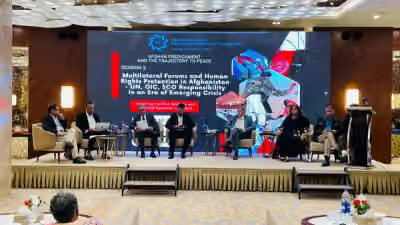
Speaking at a meeting with representatives of Indian industries in New Delhi on Monday, Muttaqi called for simplified visa procedures for Afghan traders to help boost bilateral trade.

According to Indian media reports, the remarks were made during a joint session with members of the Federation of Indian Chambers of Commerce and Industry (FICCI). Muttaqi said that peace and security had been restored in Afghanistan, providing an opportunity for greater economic engagement.

Representatives of India’s private sector at the meeting highlighted ongoing challenges, saying that difficulties in obtaining visas and delays in the transport of goods remain key obstacles to trade. They urged both sides to review visa processes and improve trade routes to prevent delays in Indian investment projects in Afghanistan.

India has been one of Afghanistan’s key regional trade partners in recent years. However, bilateral economic activity has significantly declined since the fall of the previous government and the Taliban’s return to power in 2021.

Most Viewed

Taliban Deputy PM Praises Herat Administration Following Protests & Arrests
1

Taliban Deputy PM Praises Herat Administration Following Protests & Arrests

2

Japan Pledges Nearly $45 Million For Development Projects In Afghanistan

3

Suspect In Vehicle Attack On Girls In Kabul Arrested, Says Taliban

4

3.7 Million Children In Afghanistan Face Acute Malnutrition, Says UN

5

UN Draft Replaces ‘De Facto Authorities’ With ‘Relevant Authorities’ For Taliban

•
•
•

More Stories

Intra-Taliban Clashes Over Gold Mine In Badakhshan Leave 10 Dead

Oct 13, 2025, 16:34 GMT+1
Intra-Taliban Clashes Over Gold Mine In Badakhshan Leave 10 Dead
100%

At least 10 Taliban members were killed in heavy fighting between rival factions of the group in Badakhshan province over control of a gold mine, sources told Afghanistan International.

The clashes erupted on Sunday evening in Yalor village, Yaftal district, between Taliban fighters from Helmand and local Taliban members from Badakhshan. According to the sources, eight Helmandi Taliban and two Badakhshani Taliban were killed in the fighting, which reportedly continued into Monday.

Several others were wounded, though the exact number of casualties remains unclear. Local officials said the district’s head of justice and head of traffic departments were among the dead.

One source said the confrontation was initiated by local Taliban fighters. Another claimed that Taliban members from southern provinces, with the backing of Badakhshan’s Taliban governor and police chief, had “seized” the province’s gold mines, cutting local fighters off from any share of the mining revenue.

The Taliban have not yet commented on the reports. Intra-group disputes over the control of mines and local resources have become increasingly common in northern Afghanistan, where Taliban factions compete for economic influence and revenue.

Taliban Conduct Inquisition On Doctors & Staff At Kabul Hospital

Oct 13, 2025, 14:11 GMT+1
Taliban Conduct Inquisition On Doctors & Staff At Kabul Hospital
100%

The Taliban have launched a religious inquisition targeting doctors and medical staff at Kabul’s Ali Abad Hospital, according to internal documents obtained by Afghanistan International.

The documents reveal that Khalil-ur-Rahman, the hospital’s mosque cleric and a representative of the Taliban’s Ministry for the Propagation of Virtue and Prevention of Vice, has been conducting what he described as “ideological inspections” of doctors and specialists.

In a message sent to the hospital’s WhatsApp working group, Mullah Khalil-ur-Rahman distributed a list of medical personnel and ordered them to report to the hospital mosque on Tuesday to answer religious questions.

In a separate voice message, he warned that all doctors and staff must attend the session, adding that anyone who failed to appear would be “responsible for the consequences.”

This kind of ideological screening is not unique to Ali Abad Hospital. The Taliban’s Ministry for the Propagation of Virtue and Prevention of Vice has reportedly established units across government ministries and departments to monitor employees’ beliefs and enforce strict religious codes, including growing beards, wearing Taliban-style clothing, and attending daily congregational prayers.

Earlier reports indicated that similar tests have been conducted among staff at the Ministry of Public Health. Over the past four years, thousands of Afghan university professors have left the country as the Taliban’s religious police expanded surveillance and religious questioning of students and academics.

The Taliban have also appointed clerics educated solely in traditional religious seminaries, many lacking modern education or administrative experience, to senior positions in ministries and public institutions, further tightening ideological control over Afghanistan’s state apparatus.

Pak Sources Deny Visa Rejection Claim, Say Only Visit Proposal Was Made

Oct 13, 2025, 12:58 GMT+1
Pak Sources Deny Visa Rejection Claim, Say Only Visit Proposal Was Made
100%

A senior Pakistani official has denied Taliban claims that Pakistan’s defence minister, intelligence chief and two generals were denied visas to visit Kabul. The source said that no visa applications were submitted and that only a proposal for a visit had been made.

Speaking to Afghanistan International on Monday, the official said, “It was only a proposal, not a visa request,” rejecting reports that Islamabad’s senior officials had applied for entry into Afghanistan.

Earlier, Taliban government sources in Kabul told Afghanistan International that the Taliban had rejected visa applications from Pakistan’s Defence Minister Khawaja Muhammad Asif, intelligence chief Asim Malik, and two other generals. The sources claimed the officials had submitted visa requests over the past three days.

The conflicting reports over a potential high-level Pakistani delegation come amid escalating tensions between the two neighbours, following a week of deadly border clashes and retaliatory airstrikes.

On Sunday, Pakistan’s Foreign Ministry issued an unusually pointed statement expressing hope that “the Afghan people will be free and have a truly democratic government,” signalling a hardening of Islamabad’s tone toward the Taliban.

Pak–Afghan Border Remains Closed For Second Day After Deadly Clashes

Oct 13, 2025, 11:33 GMT+1
Pak–Afghan Border Remains Closed For Second Day After Deadly Clashes
100%

Key crossings along the Pakistan–Afghanistan remained closed for a second consecutive day on Monday following deadly clashes between Taliban and Pakistani forces over the weekend, sources told Afghanistan International.

The border points at Torkham, Spin Boldak, Ghulam Khan, Angoor Adda and Kharlachi have all been sealed, halting cross-border transport and trade. Pakistani border officials said the closures have brought all commercial activity to a standstill.

Security officials confirmed to local media that the Chaman crossing also remains shut, with heavy security deployed on both sides of the frontier. The blockade has disrupted daily movement and trade flows that serve as a crucial economic lifeline for border communities.

Tensions escalated late on Saturday when Taliban fighters opened fire on Pakistani border posts, an attack the Taliban Ministry of Defence described as retaliation for Pakistani airstrikes inside Afghanistan. Islamabad said it responded with artillery and small-arms fire.

According to Pakistan’s military, 23 soldiers were killed and 29 others wounded in the fighting, while its retaliatory strikes killed more than 200 Taliban and Tehreek-e-Taliban Pakistan (TTP) fighters.

In a strongly worded statement, the Pakistan Army’s media wing urged the Taliban government in Kabul to eliminate terrorist groups operating on Afghan soil and to stop supporting cross-border insurgents.

“Pakistan will continue to take all possible measures to protect its people,” the statement said, warning that any further provocations would be met with “firm and decisive” responses.

Islamabad reiterated that Afghan territory must not be used to launch attacks against Pakistan and renewed its long-standing call on the Taliban to act against militant safe havens along the border.

Iran Seeks To Cut Afghan Migrant Population To Three Percent, Says Official

Oct 13, 2025, 09:58 GMT+1
Iran Seeks To Cut Afghan Migrant Population To Three Percent, Says Official
100%

A senior Iranian official has said the government is working to reduce the number of Afghan migrants in Iran to three percent of the population, down from the current estimate of more than six percent.

Nader Yarahmadi, head of the Interior Ministry’s Centre for Foreign Nationals and Immigrants Affairs, said during a meeting in Yazd that “only legal foreign nationals can remain in the country, and illegal foreigners must be deported,” according to the state-run IRIB News Agency.

He said more than 1.41 million undocumented Afghan migrants have been deported from Iran over the past seven months as part of what he described as efforts to “establish order and security.”

Yarahmadi’s comments come amid growing international concern over the mass deportation of Afghan refugees. UN High Commissioner for Human Rights Volker Türk said earlier that more than 1.9 million Afghans have been expelled from Iran and Pakistan in the past seven months, calling for an immediate halt to all forced deportations.

Iran hosts one of the largest Afghan refugee populations in the world, with millions having fled decades of conflict, economic hardship and Taliban restrictions in their homeland.