
Pakistan’s Defence Minister Khawaja Asif said on Monday that the government will under no circumstances hold talks with Tehreek-e-Taliban Pakistan (TTP) and will instead engage solely with the Taliban in Afghanistan.
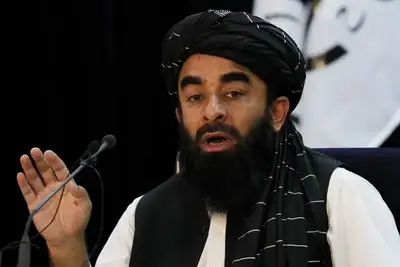
His remarks came after both the Afghan Taliban and Imran Khan, the imprisoned leader of Pakistan’s Tehreek-e-Insaf party, urged Islamabad to resolve its dispute with the TTP through dialogue.
Pakistan and the Afghan Taliban reached a Qatar-mediated ceasefire agreement on Sunday to halt hostilities following a week of border clashes.
Asif said the Taliban delegation in Doha had pledged to restrain Pakistani militants, adding that the continuation of the ceasefire depended on the Taliban’s commitment to that promise. He described the talks as having taken place in a "friendly atmosphere.”
The defence minister also clarified that the draft ceasefire agreement contains only four clauses, dismissing the longer version circulating on social media as fabricated.
He added that further discussions on the ceasefire’s implementation will be held in Türkiye in the coming days, while noting that he remains cautiously optimistic about the Taliban administration’s adherence to the truce.

The German government plans to terminate its special admission programmes for Afghan refugees, citing lengthy immigration procedures and complex bureaucratic obstacles, German broadcaster MDR reported on Monday.
The revelation, featured in the latest episode of MDR’s documentary series titled “Afghanistan and the Refugees, Germany’s False Promises,” sheds light on the growing despair among Afghans who fled to Pakistan following the Taliban takeover of Kabul in 2021. Many had hoped for resettlement in Germany but have since been living for years in uncertainty and under threat of deportation.
According to MDR, Germany’s admission programmes for at-risk Afghans have helped only a small fraction of applicants, hampered by slow processing and administrative barriers. The government now intends to cancel the initiatives entirely.
The report said around 2,000 Afghan citizens who had previously received assurances of relocation from Germany remain stranded in Pakistan awaiting visas. Many are women’s rights activists, journalists, human rights defenders, and former employees of the German military, all of whom face the risk of arrest or execution by the Taliban if forced to return to Afghanistan.
The documentary’s producers warned that such a decision could mark “the official end of Germany’s moral responsibility” toward its former Afghan partners and allies.
Pakistan’s Defence Minister Khawaja Asif said the primary goal of the ceasefire agreement with the Taliban is to eliminate terrorism, which has long destabilised border regions. He said both sides had committed to making “serious efforts” to curb militant activity.
In an interview with Al Jazeera, Asif said Pakistan and the Taliban had agreed to establish joint mechanisms to address security concerns and prevent future clashes. He thanked the Emir of Qatar and the President of Türkiye for their diplomatic efforts in mediating the ceasefire.
Referring to the recent surge in border tensions, Asif said both countries recognised that tackling terrorism is vital for regional peace and stability. He added that the Afghan Taliban also view terrorism as the key source of friction and have pledged to take practical steps to address it. He added that the involvement of Qatar and Türkiye serves as a guarantee of the credibility of this agreement.
Asif noted that Pakistan has endured heavy human and economic losses due to terrorism but expressed hope that the ceasefire would pave the way for peace and stability. The agreement, he said, would also help normalise trade and transit relations between the two neighbours.
He announced that Afghanistan would again be allowed to use Pakistan’s ports for trade, while Afghan refugees holding valid documents and visas would be permitted to remain in Pakistan. Those without documentation, however, would continue to be repatriated.
The minister stressed that the Pakistan–Afghanistan border must be managed “in an orderly manner and in accordance with international standards.”
Asif cautioned that it was too early to declare full satisfaction with the agreement.
A senior aide to the Taliban’s deputy prime minister has disclosed new details of a 2021 meeting between Abdul Ghani Baradar and Pakistan’s former intelligence chief, Faiz Hameed.
The aide, Abdullah Azzam, claimed Baradar warned Hameed that Taliban fighters would respond to Pakistani military actions “in the language of bullets” during a discussion in Qatar over the Durand Line dispute.
In a post on X, Abdullah Azzam, chief of staff to Mullah Baradar, said the meeting took place on June 3, 2021, in Qatar, during discussions on intra-Afghan negotiations. According to Azzam, then–ISI Director-General Faiz Hameed asked Baradar to stop Taliban fighters from firing at Pakistani troops and from obstructing the construction of barbed-wire fencing along the Durand Line.
Azzam quoted Baradar as responding, “I’m responsible for political affairs, why are you talking to me? What you’re saying concerns the military commanders, and they respond in their own language (meaning gunfire).”
Azzam said he attended the meeting as an interpreter and claimed the conversation occurred at Hameed’s request. He added that Hameed told Baradar Pakistani forces had nearly completed fencing along the Durand Line but that Taliban fighters in Bahramcha were resisting the effort. “About 500 Mujahideen have gathered, firing at our forces and preventing the work,” Hameed reportedly said.
Faiz Hameed, who served as ISI chief from 2019 to 2021, became internationally known after the Taliban takeover of Kabul in August 2021, when he was photographed drinking tea with Taliban officials at Kabul’s Serena Hotel. He is now facing charges in Pakistan over political interference, violations of national security laws, and misuse of state resources.
No previous reports from 2021 mentioned a meeting between Hameed and Baradar about the Durand Line, and the former ISI chief has not commented on Azzam’s claims.
Azzam’s account comes amid renewed debate over the Taliban’s stance on the Durand Line, the disputed border between Afghanistan and Pakistan. The controversy resurfaced after Qatar’s Foreign Ministry referred to it as a “border” in a statement about the recent Taliban–Pakistan ceasefire, contradicting the Taliban, who call it an “imaginary line.” Qatar later removed the term from its statement.
Azzam concluded that before regaining power, “the Taliban, while at war with 45 countries, were willing to fight another nation over a single strand of barbed wire, let alone recognise the Durand Line.” He also shared a photo allegedly showing the 2021 meeting, appearing to depict Faiz Hameed praying behind Mullah Baradar in Qatar.
Pakistani authorities have demolished more than 1,200 homes belonging to Afghan refugees in Karachi’s Gulshan-e-Maymar neighbourhood in less than a week, officials confirmed on Monday.
The operation, now in its fifth consecutive day, is part of what authorities describe as an effort to clear “illegally built” settlements.
Out of approximately 3,000 houses in the area, more than a third have already been destroyed. Local media reported that around 14,000 Afghan refugees have left the settlement so far, with the remaining residents expected to be expelled in the coming days.
Nearly 15,000 Afghans had been living in the neighbourhood. Many have returned to Afghanistan following the demolitions, while about 1,500 people remain in the area.
Local officials accused refugees of encroaching on public land, saying the Karachi Development Authority (KDA) owns the 215-acre site, which includes more than 3,200 houses and shops. Amir Fazal Owaisi, head of Karachi’s Anti-Encroachment Department, said the land is worth billions of Pakistani rupees and will be reclaimed by the government.
Refugees, however, dispute the claims, insisting they bought their plots legally and are now being prevented from selling them.
Authorities said the demolition and expulsion of undocumented Afghan refugees in Gulshan-e-Maymar will continue as part of a wider campaign against illegal settlements across Karachi.
The Taliban on Sunday publicly flogged two people in the Pashtun Kot district of Faryab province after convicting them of having an extramarital relationship, the group’s Supreme Court said in a statement.
According to the court, each received 39 lashes and was also sentenced to one year in prison. The floggings were carried out in front of local residents.
Despite repeated international appeals to end corporal punishment, the Taliban continues to impose public floggings for so-called moral offences, reviving punishments reminiscent of its 1990s rule.
Human rights organisations have repeatedly criticised the Taliban’s judicial system, saying it lacks due process and that defendants are denied basic legal rights, including access to defence lawyers.