US-Sanctioned Iranian Airline Launches Flights To Afghanistan

The Taliban governor’s office in Balkh province announced on Saturday that Iran’s Meraj Airlines has begun operating flights to Mazar-e-Sharif, the provincial capital.

The Taliban governor’s office in Balkh province announced on Saturday that Iran’s Meraj Airlines has begun operating flights to Mazar-e-Sharif, the provincial capital.
The United States sanctioned the airline in 2014 for allegedly transporting illicit cargo, including weapons, from Tehran to the Bashar al-Assad regime in Syria.
Meraj Airlines, which is also banned from flying to European Union member states, will operate one weekly flight from Iran to Balkh and three additional flights to Kabul, according to Haji Zaid, the spokesperson for the Taliban governor in Balkh.
Zaid said the first flight arrived in Balkh on Saturday carrying 120 passengers from Iran. He added that the airline plans to run four weekly flights from Iran to Afghanistan in the initial phase of operations.
Until now, only two domestic carriers, the semi-state-owned Ariana Afghan Airlines and the private airline Kam Air, were operating regular flights in Afghanistan.
Meraj Airlines, a private Iranian carrier headquartered in Tehran, began operations in 2010. In August 2014, the US Department of the Treasury sanctioned the company under Executive Order 13224, accusing it of transporting weapons and other illicit cargo from Iran to Syria.
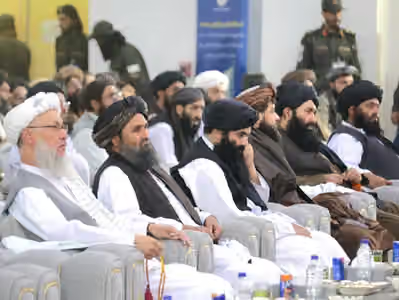
Taliban spokesperson Zabihullah Mujahid confirmed Afghanistan International’s investigative report that families of tribal migrants have been relocated to central Afghanistan.
Afghanistan International previously reported that in January 2025, the Taliban secretly transferred dozens of families linked to Tehreek-e-Taliban Pakistan (TTP) to Ghazni province.
Mujahid made the remarks during an online press conference following the collapse of Taliban–Pakistan talks in Istanbul, where he addressed relations with Islamabad and the security situation in Pakistan.
He said: “The Islamic Emirate relocated those tribal migrant families who were living near the Durand Line and feared persecution in Pakistan, moving them to central areas and constructing camps for them so they could be more easily and securely monitored.”
Mujahid added that “carrying weapons is completely prohibited for tribal migrants in Afghanistan.”
According to Afghanistan International’s investigation, the relocation took place in January 2025 after pressure and attacks from Pakistan prompted TTP leaders to conditionally agree to move some of their families.
The families were transferred from camps in Khost and Paktika, near the Pakistan border, to migrant camps in Ghazni province. Sources said the Taliban pledged not to fingerprint or photograph the families and to provide each household with monthly payments, relocation support, and housing expenses.
A source involved in the transfer said: “The families agreed to move on the condition of privacy and financial assistance.”
According to the source, the Taliban’s Refugees Commission, the Ministry of Interior, the Ministry of Tribes and Border Affairs, and the Ministry of Information and culture participated in the process. Each migrant family member was promised a $40 monthly stipend, $500 for relocation, and additional funding for rent and household needs in Ghazni.
A source close to the TTP told Afghanistan International that Waziristani families were registered under pseudonyms and that only identity cards issued by the TTP were recognised for access to benefits and services.
The Taliban administration has built three residential compounds for the families of Waziristani fighters and other foreign nationals in Ghazni: one in the Malakuddin area of Nawa district, another in the Bagh-e-Atar desert of Qarabagh district’s Gul Koh area, and a third in Dasht-e-Kabuli in Waghaz district.
These settlements comprise single-storey, fortified houses with plans for schools, religious seminaries, health centres, and water supply systems. Barbed wire fences have been installed around the compounds after some displaced Waziristani families initially refused to move there.
The relocation plan reportedly included families affiliated with Hafiz Gul Bahadur’s faction and the TTP from Khost and Paktika provinces. So far, only a small number of families from the Mehsud and Dawar tribes linked to the TTP have moved to the Qarabagh camp.
Security for the camps is being maintained by the TTP, which has deployed its own guards and established an internal administrative structure.
However, Afghanistan International’s latest findings from Ghazni indicate that some of these families have since returned to Khost and Paktika.

The Taliban-controlled Bakhtar News Agency reported on Saturday that 1,744 Afghan refugee families were deported from Pakistan and 65 families from Iran within a 24-hour period.
According to the report, the returnees entered Afghanistan through the Torkham, Spin Boldak, Pul-e-Abrisham, and Islam Qala border crossings.
While Iran has slowed the pace of returning Afghan migrants, Pakistan has intensified deportations in recent months, expelling thousands of Afghans from its territory each day.
These actions have raised growing concern over the humanitarian and security situation facing returnees. The United Nations has warned that the mass deportations have deprived many refugees of access to essential protection and assistance.
Filippo Grandi, the UN High Commissioner for Refugees, said that while Iran and Pakistan have hosted Afghan refugees for many years, the current circumstances pose serious risks to their safety and livelihoods.

Zabihullah Mujahid, the Taliban spokesperson, said that Islamabad has embarked on “a project of creating instability in the region” on behalf of major powers.
Mujahid stated that there is no longer any need for regional countries to mediate between the Taliban and Pakistan.
Speaking at an online press conference on Saturday, he said that from now on, the Taliban would directly share developments with regional states, adding that “Iran, Russia, and the Central Asian countries understand the situation.”
Referring to Pakistan’s recent threats, Mujahid said the Taliban, “in coordination with the people, are ready to defend every inch of Afghanistan’s soil.”
He said that during the Istanbul talks, Pakistan attempted to place responsibility for its internal security on the Taliban, which ultimately led to the collapse of the negotiations.
Mujahid, who also serves as spokesperson for Taliban leader Hibatullah Akhundzada, said Pakistan was trying to portray the Tehreek-e-Taliban Pakistan (TTP) issue as something that emerged after the Taliban’s return to power in 2021, whereas it actually dates back at least two decades.
He recalled TTP attacks in Pakistan’s tribal areas and major cities over the past 20 years and said Pakistani military operations against the group had displaced thousands of civilians.
Mujahid said the TTP was formed as a result of Pakistan’s military campaigns and its decision to allow US drone strikes in the tribal regions, insisting that “this issue has no connection to the Afghan Taliban.”
He explained that, in response to Pakistan’s concerns, families linked to migrants from the tribal areas including members of the TTP have been relocated from the Durand Line border regions to central Afghanistan to allow for closer monitoring.
The Taliban spokesperson said that carrying weapons or engaging in “jihad in Pakistan” without the permission of the Taliban’s supreme leader has been “completely banned.” He added that tribal migrants entered Afghanistan long before the Taliban returned to power.
Earlier, Pakistan’s Defence Minister Khawaja Asif said the Taliban’s refusal to sign a written agreement had caused the deadlock in negotiations, adding that there was now no need for further mediation or dialogue.

Mohammad Reza Hashemi, governor of Iran’s South Khorasan province, announced that the Mahiroud customs terminal ranked first among Iran’s export points to Afghanistan during the first half of the current year.
Hashemi said that in this period, more than 3.05 million tons of goods were exported from Iran to Afghanistan, of which over 1.03 million tons passed through South Khorasan and the Mahiroud border crossing.
He added that the total value of exports to Afghanistan reached $1.15 billion, with goods worth more than $350 million exported via Mahiroud.
Hashemi noted that some goods imported from Afghanistan are items Iran needs but does not produce domestically, calling this a sign of “balance and deepening trade relations” between the two countries.
According to the Tehran Times, trade between Iran and Afghanistan increased by nearly 84 percent in 2024 compared with the previous year, reaching $3.19 billion.
By the end of July, the total value of goods transited through the Dogharoon customs terminal to Afghanistan had reached $1.6 billion, according to official figures.

Zabihullah Mujahid, the Taliban spokesperson said on Saturday that “circles within Pakistan’s intelligence and military” are obstructing progress in the peace talks between the group and Islamabad in Istanbul.
Speaking at an online press conference, Mujahid claimed that these groups are “creating pretexts to push relations toward tension” and are trying to blame Afghanistan’s Taliban for Pakistan’s internal problems, instability, and attacks carried out by Tehreek-e-Taliban Pakistan (TTP).
He described the TTP issue as an “old problem” unrelated to the Taliban in Kabul. Mujahid said the TTP emerged in 2002 following US drone strikes and bombings in Pakistan’s tribal areas, which he alleged were conducted with Islamabad’s consent.
According to Mujahid, the Taliban delegation in Istanbul presented evidence of multiple Pakistani military operations against the TTP that “displaced hundreds of thousands of people from the tribal regions, some of whom later came to Afghanistan.”
Earlier, Pakistan’s Defence Minister Khawaja Asif said the talks had reached a “complete deadlock” and that no further rounds were currently planned.
Asif added that the Taliban delegation had sought verbal assurances during the talks but refused to formalise any agreements. He emphasised that all international negotiations must be concluded through written agreements.
Before the press conference, Mujahid had already confirmed the failure of the Istanbul talks. In a post on X earlier on Saturday, he wrote that the negotiations “produced no results.” He reiterated that the Taliban “will not allow anyone to use Afghan territory against another country.”
Mujahid also accused Pakistan of attempting to place “all security responsibilities on the Taliban while showing no willingness to assume responsibility for Afghanistan’s security or even its own.”
The third round of Taliban–Pakistan talks began on Thursday, November 6, in Istanbul. The first round, held in Doha, resulted in an immediate ceasefire, while the second round, also held in Istanbul, ended without progress.
