• العربية
  • پښتو
  • فارسی
Brand
  • Afghanistan
  • Sport
  • Markets
  • Afghanistan
  • Sport
  • Markets
  • Theme
  • Language
    • العربية
    • پښتو
    • فارسی
  • Afghanistan
  • Sport
  • Markets
All rights reserved for Volant Media UK Limited
volant media logo

Senior Tajik Delegation Arrives In Kabul, Says Taliban

Nov 15, 2025, 10:24 GMT+0

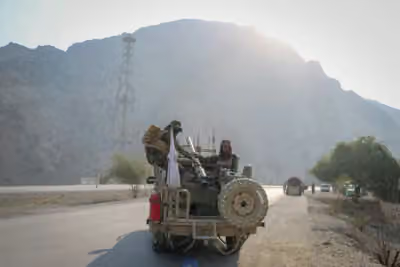
The Taliban-controlled Bakhtar News Agency reported on Saturday that a high-level delegation from Tajikistan had arrived in Kabul. The group reportedly includes officials from Tajikistan’s Foreign Ministry and security agencies.
According to the report, Taliban and Tajik officials are expected to discuss the status of the Afghan Embassy in Dushanbe.

Taliban media outlets said the purpose of the visit is to expand political, economic and security ties between the two sides. Joint development projects have also been listed among the topics set for discussion.

The visit follows a recent trip by several Tajik officials to Kunduz Province, where they met Taliban authorities. Earlier, Yusuf Wafa, the Taliban governor of Balkh and a close associate of Taliban leader Hibatullah Akhundzada, travelled to Dushanbe at the invitation of Tajik officials. During that trip, he called for the Afghan Embassy in Tajikistan’s capital to be handed over to the Taliban.

The Afghan Embassy in Dushanbe remains under the control of a representative of Afghanistan’s former government, although the Afghan consulate in the Tajik city of Khorog operates under the direct oversight of the Taliban’s Foreign Ministry.

Tajikistan is considered one of the Central Asian states that has maintained the least diplomatic engagement with the Taliban over the past four years.

Most Viewed

Taliban Finance Ministry Targeted In Suspected Pakistan-Linked Cyberattack
1

Taliban Finance Ministry Targeted In Suspected Pakistan-Linked Cyberattack

2

Pakistan-Taliban Tensions Cost Trade Sector $850 Million

3

Russia-Taliban Military Agreement Does Not Restrict Strikes On Militants, Says Pakistan

4

Instability & Extremist Activity Rising In Afghanistan, Says Regional Security Bloc

5

Spain Will Stand With Afghan Women, Says Spanish Foreign Minister

•
•
•

More Stories

Pentagon Responds To Taliban Claim, Says It Has Nothing To Add On Drone Activity

Nov 15, 2025, 09:19 GMT+0
Pentagon Responds To Taliban Claim, Says It Has Nothing To Add On Drone Activity
100%

A US Department of Defence official said the Pentagon had no information to provide in response to Taliban claims that American drones continue to fly in Afghan airspace.

The comment was made after Afghanistan International asked the department about remarks by Taliban spokesperson Zabihullah Mujahid, who told an Iranian media outlet that US drones were still entering Afghanistan, reportedly via the airspace of certain neighbouring countries. He said the Taliban had raised the issue in relevant meetings and had urged that the flights be halted.

Mujahid did not specify which neighbouring countries were allegedly being used as transit routes. He had previously accused Pakistan of enabling US drones to access Afghanistan’s airspace.

Before the Taliban’s return to power in 2021, Afghanistan’s air traffic control was largely managed with assistance from foreign governments and NATO. Since then, the issue of drone activity over Afghan territory has continued to attract attention and debate.

Pakistan Rules Out Talks With Terrorist Groups

Nov 14, 2025, 16:31 GMT+0
Pakistan Rules Out Talks With Terrorist Groups
100%

Pakistan’s Foreign Ministry spokesperson, Tahir Andarabi, said Friday that Pakistan has “never refused” to engage in talks with the Taliban but made clear the country will not negotiate with any terrorist organisation.

He said Tehreek-e-Taliban Pakistan (TTP) and the Balochistan Liberation Army (BLA) are enemies of Pakistan, adding that anyone harbouring, abetting or financing them is not considered a friend and a well-wisher of Pakistan and its people.

Andarabi said promises made by the Afghan Taliban authorities have been hollow and unfulfilled. Has said that Pakistan regrets that the Taliban regime is constantly trying to misrepresent the issue of terrorists hiding in Afghanistan as a humanitarian issue.

He added that the Taliban administration is attempting to portray TTP and the BLA as Afghan refugees.

According to Andarabi, some elements within the Afghan Taliban do not seek confrontation with Pakistan, but there is a “strong lobby,” allegedly supported by foreign actors, that aims to “stoke tensions.” He said these elements have engaged in abuses and “outrageous allegations” against Pakistan, eroding whatever goodwill they once had.

He said certain figures in the Taliban are also trying to “instigate Pashtun nationalism in Pakistan.”

Andarabi added that, with the “sharp rise in evidence-based terrorism” originating from Afghanistan since the US withdrawal in 2021, the Taliban can neither deny the reality nor evade responsibility.

He said Pakistan remains committed to resolving bilateral issues through dialogue, but stressed that terrorism emanating from Afghanistan must be addressed “first and foremost.”

Andarabi said terrorist attacks inside Pakistan originating from Afghan territory have increased sharply. He said Pakistan had expected the “Taliban regime” to take action against the TTP.

He said the Taliban claim to control the entire country but “show their inability” when it comes to addressing terrorism originating from Afghan soil.

He stressed that Pakistan has exercised restraint for years despite military and civilian losses and has not escalated tensions. He said Pakistan granted several trade concessions to Afghanistan, but Islamabad’s support “was not reciprocated.” He added that trade and transit with Afghanistan will now only be possible if the Taliban authorities take “clear and concrete steps” against terrorism.

Andarabi said Pakistan has tried in recent years to maintain positive engagement with the Taliban administration. He said taking action against terrorism is the Taliban’s responsibility, and that Pakistan will take all necessary measures to protect its citizens.

Pakistan and the Taliban have held three rounds of negotiations in recent weeks. The first round, held in Doha, produced a temporary ceasefire. The second and third rounds in Istanbul ended without progress.

Pakistan’s Defence Minister Khawaja Asif said the Istanbul talks had reached a “complete deadlock” and that no further round is planned. He said Pakistan’s return “empty-handed” shows that even mediators “no longer have hope in the Afghan Taliban.”

Taliban spokesperson Zabihullah Mujahid later confirmed the failure of the Istanbul talks. In a post on X on Saturday, he wrote that the discussions produced “no results” and added that the Taliban administration “will not allow anyone to use Afghan territory against another country.”

Tajikistan, Pakistan Move To Expand Military Cooperation

Nov 14, 2025, 15:34 GMT+0
Tajikistan, Pakistan Move To Expand Military Cooperation
100%

Tajikistan’s Defence Minister, Emomali Sobirzoda, met Pakistan’s Defence Minister Khawaja Asif, Army Chief Gen. Asim Munir and other senior military officials during a visit to Pakistan to expand military and technical cooperation.

Tajikistan’s Defence Ministry said that Sobirzoda also held a separate meeting with Sahir Shamshad Mirza, chairman of Pakistan’s Joint Chiefs of Staff Committee.

The ministry said Thursday that the two sides discussed military and technical cooperation and considered strengthening “friendship and brotherhood” particularly important amid regional and global instability.

Senior military officials from both countries also discussed holding joint military exercises in Tajikistan and Pakistan, exchanging experience and involving military personnel in training programmes.

According to the ministry, both sides reaffirmed their commitment to expanding military cooperation, especially in the fields of training, counterterrorism and regional security.

In August, Tajik and Pakistani special forces held their first joint counterterrorism exercise, “Friendship-2025,” at the Fakhrobod training ground of Tajikistan’s Defence Ministry in the Khatlon region. About 100 special forces personnel from both countries, airborne and infantry units, took part.

Troops practised the use of modern weapons in counterterrorism operations. Tajikistan’s Defence Ministry said such joint exercises were crucial given the threats posed by international terrorism and extremism.

In recent months, security and counterterrorism consultations between Tajikistan and Pakistan have increased. Officials from both foreign ministries met in Dushanbe in October to discuss cooperation and regional counterterrorism efforts.

In September, Mohammad Sadiq and Khisrav Sohibzoda, the special envoys of Pakistan and Tajikistan for Afghanistan, discussed the growing terrorist threat in the region. Sadiq said both sides emphasised the need to develop “a coordinated and joint strategy” to address the threat effectively.

Both Pakistan and Tajikistan have repeatedly voiced concern over Afghanistan’s security situation, saying the presence of militant groups such as Tehreek-e-Taliban Pakistan (TTP) and Ansarullah in Afghanistan poses a serious threat to the region.

US Drone Flights Over Afghanistan Continue Unabated, Says Taliban

Nov 14, 2025, 14:08 GMT+0
US Drone Flights Over Afghanistan Continue Unabated, Says Taliban
100%

Taliban spokesperson Zabihullah Mujahid said US drones continue to fly over Afghanistan, claiming the aircraft have been operating in the country’s airspace since the Taliban returned to power in 2021.

He said the drones transit through neighbouring states and violate Afghanistan’s sovereignty.

In an interview with Iran’s state broadcaster IRIB, Mujahid repeated the Taliban’s call for the flights to end, saying they must be stopped “as soon as possible” and describing them as a breach of Afghanistan’s airspace. He said Taliban authorities had raised their objections in the limited meetings available to them.

Mujahid did not specify which neighbouring country’s airspace the drones reportedly cross before entering Afghanistan, though he has previously accused Pakistan of providing access to US aircraft.

Mujahid said the Taliban had implemented 70 percent of their programmes during their four years in power. He cited sanctions on Taliban leaders, travel restrictions and the absence of international recognition as the administration’s main challenges.

Addressing criticism over the Taliban’s treatment of the Persian language, he said the group did not hold “a prejudiced view” toward languages in Afghanistan and regarded both Persian and Pashto as part of Afghan culture. His comments came despite multiple controversies, including the recent removal of Uzbek and Persian-language terms from university signboards in northern provinces.

Mujahid also said the Taliban were satisfied with Iran’s policy toward their administration, describing relations over the past four years as “good and brotherly.”

On Iran’s water rights under the Helmand River treaty, he said the Taliban had “no issues” with the agreement and that Iran would receive its share if water levels permitted. He said Iranian delegations had visited Afghanistan and received explanations from Afghan officials.

Mujahid said the Taliban were pursuing a “balanced, economy-focused” foreign policy and sought relations with all countries, including the United States, provided Afghanistan’s sovereignty was respected.

Asked whether US forces could return to Afghanistan, he said the Taliban would “never” allow “even an inch” of Afghan territory to fall under foreign control and insisted no foreign troops would be permitted on Afghan soil.

He also denied reports of a Chinese presence at Bagram air base, saying neither US nor Chinese forces had returned and that the Taliban would not allow any country to establish a military base in Afghanistan.

Central Asia’s Stability Depends on Afghanistan, Says Uzbek President

Nov 14, 2025, 12:42 GMT+0
Central Asia’s Stability Depends on Afghanistan, Says Uzbek President
100%

Uzbek President Shavkat Mirziyoyev said regional peace and stability in Central Asia depend heavily on Afghanistan’s reconstruction and development, arguing that long-term stability is unattainable without addressing Afghanistan’s challenges.

summit of Central Asian leaders in Tashkent, Mirziyoyev wrote that Afghanistan is not a marginal region but a natural part of Central Asia'sshared region. He said the people of Afghanistan continue to face a deep humanitarian crisis.

The president stressed the importance of Afghanistan’s continued involvement in regional and international processes.

Mirziyoyev, whose government maintains broad economic and diplomatic relations with the Taliban, highlighted the significance of the planned Afghan–Trans railway, which is expected to become a key transport link between Central and South Asia. He said the project would create new opportunities for trade, investment and transport connectivity and serve as a foundation for Afghanistan’s economic revival.

He said Uzbekistan is continuing work to provide humanitarian and educational assistance to Afghans, expand cooperation in the energy sector and train specialists for key economic fields.

Mirziyoyev said Afghanistan should form part of a shared space of peace, security, cooperation and development that serves the interests of all regional states and helps build a stable security belt along Central Asia’s southern borders.

Despite Uzbekistan’s close engagement with the Taliban, Central Asian governments remain concerned about security threats emanating from Afghanistan, including the presence of ISIS affiliates and other radical groups.

In October, Mirziyoyev proposed that Russia and Central Asian nations hold high-level consultations on Afghanistan, saying the agenda could include security cooperation and economic projects aimed at ensuring stability and development.

Russia is the only country that has formally recognised the Taliban.