• العربية
  • پښتو
  • فارسی
Brand
  • Afghanistan
  • Sport
  • Markets
  • Afghanistan
  • Sport
  • Markets
  • Theme
  • Language
    • العربية
    • پښتو
    • فارسی
  • Afghanistan
  • Sport
  • Markets
All rights reserved for Volant Media UK Limited
volant media logo

Ex-Senator Calls Taliban ‘Medieval Government,’ Says Afghans Want Change

Nov 21, 2025, 10:14 GMT+0

Former Pakistani senator Mushahid Hussain has said that an overwhelming majority of Afghans are dissatisfied with Taliban rule, describing the group’s governance as “medieval.”

In an interview with Geo News, he claimed that “95 percent” of Afghans are tired of the Taliban and reject their system of government.

Criticising the Taliban’s response to the recent earthquake in eastern Afghanistan, Hussain said women were left calling for help while the authorities prevented others from assisting them. He alleged that Taliban members prioritised saving livestock over helping victims, saying this reflected “a medieval government in the 21st century.”

Hussain also commented on what he described as a shift in Pakistan’s military and security establishment, saying that for the first time in four decades, institutions had moved away from an ideological approach to Afghanistan. He said the conflict was no longer framed as a religious struggle but understood simply as a contest for power.

He argued that the Taliban have no real connection with the Afghan population, describing the group as “installed by the United States.” He claimed that when former ISI chief Faiz Hameed travelled to Kabul in 2021 and was given significant influence, Pakistan “became a viceroy implementing the policies of others.”

Hussain said Afghanistan’s current crisis dates back half a century to the overthrow of King Mohammad Zahir Shah. He argued that Zahir Shah had been the “axis of stability” in the country and said the Bonn Conference’s failure to restore him to power was a major historical mistake.

He further criticised Pakistan’s security institutions, saying they were paying the price for the miscalculations of former military leaders, particularly General Qamar Javed Bajwa and Faiz Hameed. Hussain said those leaders assumed the Afghan Taliban would cooperate on the issue of Tehreek-e-Taliban Pakistan, even though “there is no difference between the Afghan Taliban and TTP; they are the same movement.”

Referring to Hameed’s widely circulated photo at Kabul’s Serena Hotel, Hussain said Pakistan was perceived as having installed the Taliban regime, although he argued that “it was the Americans who brought them to power.”

Hussain concluded that even if the Taliban were replaced, Pakistan had no guarantee the next government would be friendly. He said the best policy for Pakistan was to “leave Afghanistan alone” and stop attempting to shape its political leadership.
Most Viewed

Hibatullah Akhundzada: From Kandahar’s Deserts To Taliban’s Invisible Leadership
1

Hibatullah Akhundzada: From Kandahar’s Deserts To Taliban’s Invisible Leadership

2

Russia Accuses Britain Of Supporting Armed Anti-Taliban Groups

3

Taliban Defence Minister Travels To Russia For Security Conference

4

Iran Moving Towards Taliban Recognition, Says Former Afghan Intelligence Chief

5

Iran Pledges Support For Easing Taliban-Pakistan Tensions

•
•
•

More Stories

Taliban, Indian Envoys In Kyrgyzstan Discuss Expanding Cooperation

Nov 21, 2025, 09:35 GMT+0

Amid increasingly close engagement between New Delhi and Taliban, Abdul Shakoor Haqqani, the Taliban’s ambassador to Kyrgyzstan, has met with India’s ambassador in Bishkek, Birender Singh Yadav.

According to a statement from the Taliban embassy in Kyrgyzstan on Friday, the two diplomats discussed strengthening relations, enhancing economic and trade cooperation and expanding diplomatic engagement. Regional connectivity and humanitarian assistance were also included in the talks.

The statement said both sides viewed the Taliban foreign minister’s recent visit to India as an important step toward developing bilateral ties. They also expressed hope that the visit of Nooruddin Azizi, the Taliban minister of commerce and industry, to New Delhi would create new opportunities for trade, exports and imports.

Azizi travelled to India on Thursday and met several Indian officials, including the foreign minister.

The Taliban has deepened its outreach to New Delhi at a time when relations with Islamabad have deteriorated to their lowest level in years.

TTP Receives ‘Significant’ Support From The Taliban, Says Danish Envoy To UN

Nov 20, 2025, 17:14 GMT+0

Denmark’s deputy representative to the United Nations says Tehreek-e-Taliban Pakistan (TTP) receives “significant” support from the Afghan Taliban, including logistical assistance.

Speaking at a UN Security Council meeting on Wednesday Sandra Jensen Landi said the TTP, with an estimated 6,000 fighters, has become a major threat to regional stability and that some of its deadliest attacks are planned from Afghan territory.

Her remarks come amid a recent spike in attacks targeting security forces and government officials in Pakistan’s border regions, particularly in Khyber Pakhtunkhwa. Islamabad accuses the Taliban of allowing TTP militants to operate from Afghanistan, an allegation the Taliban reject.

At the same meeting, Usman Jadoon, Pakistan’s deputy permanent representative to the UN, said the country has lost more than 80,000 people and suffered billions of dollars in economic losses during its two decades of fighting terrorism. He claimed groups such as Islamic State Khorasan (IS-K), TTP and the Balochistan Liberation Army were active in Afghanistan, receiving support from the Taliban and backing from India.

The Danish envoy also warned that extremist groups such as ISIS and al-Qaeda have expanded their online propaganda and recruitment campaigns, and said countering these efforts requires broad international cooperation.

Security incidents and terrorist attacks in Pakistan have risen sharply since the Taliban returned to power in Afghanistan. In recent months, Pakistan has carried out airstrikes inside Afghanistan targeting TTP fighters and commanders.

The continued airstrikes prompted a Taliban military response, leading to more than a week of clashes along the border last month. Both sides later entered negotiations, resulting in a ceasefire agreement.

Pakistan Planning For Possible ‘Regime Change’ In Kabul, Says New Lines

Nov 20, 2025, 16:32 GMT+0

The American magazine New Lines has reported, citing multiple sources, that Pakistan has resumed political contacts with Afghan figures opposed to the Taliban as tensions between Islamabad and the group intensify.

According to the magazine, Pakistan is exploring options to reshape Afghanistan’s political landscape and is “planning for regime change.”

The report says Islamabad’s shifting security calculations are being driven by several factors, including the Taliban’s growing closeness to India, the failure of peace talks in Istanbul and the rising activity of Tehreek-e-Taliban Pakistan (TTP).

A source close to Pakistan’s Inter-Services Intelligence (ISI) told the magazine that when the former Afghan government under Ashraf Ghani was on the brink of collapse, Faiz Hameed then ISI chief, secretly met with Ahmad Massoud, leader of the National Resistance Front (NRF), in a Gulf country to discuss forming an inclusive government.

New Lines reports that Pakistan has both the military capability and the intelligence networks to target Taliban leaders and shift the political balance in Afghanistan. The magazine says Pakistan could eliminate Taliban leaders “one by one,” citing decades of experience studying the group.

However, the report warns that removing the Taliban could create a power vacuum and trigger a new wave of refugee flows, adding that any such scenario would require Afghanistan’s opposition to be prepared.

According to the magazine, Islamabad hosted several Afghan opposition figures in October, and personalities such as Yasin Zia and Ahmad Massoud have recently re-emerged politically. Sources say Pakistan has reactivated communication channels with representatives of Taliban opponents.

Abdullah Khenjani, head of the NRF’s political committee, told New Lines that the group remains cautious about engaging with Pakistan, arguing that the “Pakistani establishment consistently seeks to manage and contain the opposition.” He said any cooperation must be rooted in Afghanistan’s national interests and would require Pakistan to undergo a fundamental shift in mindset to become a “partner for peace and stability.”

Khenjani added that engagement with Pakistan is a double-edged sword, noting that many opposition figures have long portrayed the Taliban as Pakistan’s proxy and now fear becoming “another project for the ISI.”

Even so, Nasir Andisha, Afghanistan’s ambassador in Geneva and a figure close to the resistance, said “this risk is worth taking” for the opposition.

According to New Lines, if Pakistan decides to place its political influence, experience and financial and military support behind anti-Taliban groups, the battlefield situation could change quickly. The magazine says attacks by the National Resistance Front and the Afghanistan Freedom Front could become more complex and extensive.

The report concludes that such developments could sharply increase the likelihood of Afghanistan returning to a prolonged cycle of violence.

Herat Burqa Crackdown Pushes Afghan Women Out Of Public Life, Says HRW

Nov 20, 2025, 14:34 GMT+0

Human Rights Watch says the Taliban’s enforcement of the burqa in Herat is an attack on women’s autonomy and violates their rights to work, access healthcare and receive other essential services.

The organisation said the mandatory hijab is part of a broader Taliban strategy to control women’s bodies and exclude them from public life.

In a report published on Wednesday the international rights group said each new restriction imposed by the Taliban further isolates Afghan women and removes them from public spaces. It noted that women in Herat and across Afghanistan have continued to resist the Taliban’s decrees.

Human Rights Watch urged the international community to listen to Afghan women and take urgent steps to hold the Taliban accountable and restore their rights and freedoms. Afghan women and UN experts have increasingly described the Taliban’s restrictions as a form of “gender apartheid.”

The organisation said the repression of women in Herat reflects a wider pattern across the country. The Taliban have ordered women to wear clothing that fully covers their bodies and faces, while the group’s “morality law” classifies a woman’s voice as awrah and requires women to be accompanied by a male guardian in public spaces.

On 4 November, Taliban officials in Herat blocked women without burqas from entering the provincial hospital and other government offices, with several women beaten. Since then, women who are not wearing the chadari, the specific garment mandated by the Taliban, have reportedly been denied government services and barred from public places throughout the province.

The enforcement of the chadari in Herat has drawn widespread condemnation from international organisations and human rights advocates. Doctors Without Borders earlier reported a 28 percent drop in female patients at health facilities in the first days after the ban. Amnesty International has said the Taliban are excluding women and girls from every sphere of life and making their existence “unbearable.”

Indian FM, Taliban Commerce Minister Discuss Expanding Trade & Connectivity

Nov 20, 2025, 12:16 GMT+0

Indian Foreign Minister Subrahmanyam Jaishankar has met with Nooruddin Azizi, the Taliban’s minister of industry and commerce, in New Delhi to discuss expanding trade, connectivity and people-to-people ties.

Jaishankar said the meeting also focused on India’s support for Afghanistan’s development and welfare.

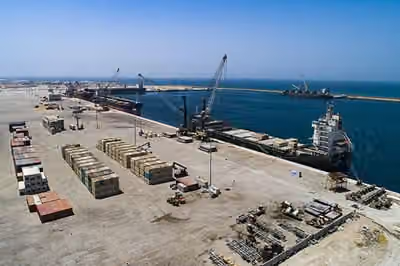
Azizi arrived in India on Wednesday at the head of a Taliban delegation. He said the visit followed an invitation from New Delhi and was aimed at activating and effectively using the capacities of Iran’s Chabahar Port while encouraging Indian investment in the project.

This is the second Taliban ministerial visit to India in less than a month. Earlier, Taliban Foreign Minister Amir Khan Muttaqi travelled to New Delhi, where he and Indian officials agreed to strengthen diplomatic and economic cooperation.

Muttaqi’s visit significantly increased tensions between the Taliban and Pakistan, triggering more than a week of clashes along the border. In response, Pakistan closed key border crossings, prompting the Taliban to announce they would seek alternative trade and transit routes.

Before his departure for New Delhi, Azizi said India offered a suitable market for Afghan goods and that Chabahar Port was the safest route for trade. Indian diplomatic sources said Azizi’s visit provided an opportunity for both sides to explore potential Indian investment in Afghanistan’s mining and hydropower sectors.

The sources also confirmed that Afghanistan has shifted a substantial share of its foreign trade to Iran’s Chabahar Port in recent months in an effort to reduce dependence on Pakistan’s Karachi Port.