Taliban Holding 2,000 Iranian Cargo Trucks At Border, Says Iran
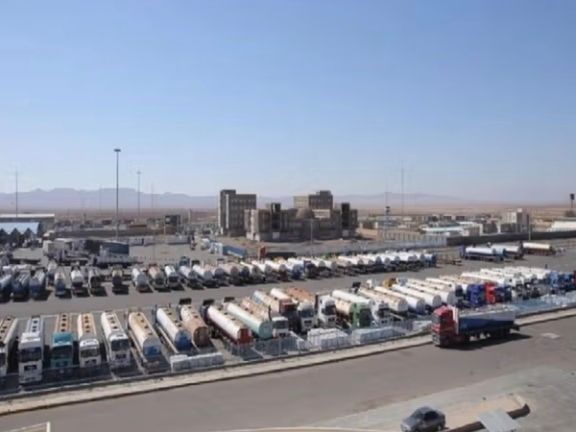
An Iranian border official says more than 2,000 Iranian cargo trucks have been stranded by Taliban authorities at the Islam Qala crossing in Herat.
An Iranian border official says more than 2,000 Iranian cargo trucks have been stranded by Taliban authorities at the Islam Qala crossing in Herat.
This has prompted Tehran to introduce a “one-to-one” system governing the entry and exit of Afghan and Iranian freight vehicles.
Esmail Pourabed, director of the Dogharoon customs post, said on Saturday that Iranian trucks have been held at Herat customs for between nine and fifteen days, delays he described as “unprecedented” in recent months.
He said that during November, more than 12,000 cargo trucks crossed from Iran into Afghanistan through Dogharoon, while 10,739 Afghan trucks entered Iran.
Pourabed urged Taliban authorities to maintain a balanced ratio of truck movements on both sides of the border, saying the current restrictions had forced many Iranian drivers to remain in harsh conditions at the Islam Qala customs terminal.
He added that Iran’s judiciary has now implemented a “one-to-one” plan under which one Iranian cargo truck will be allowed to leave for every Afghan truck entering Iran.

Taliban is seeking to expand pharmaceutical imports from India as it reduces reliance on Pakistan for medical supplies.
Taliban Minister of Industry and Commerce Nooruddin Azizi held talks in New Delhi with India’s Pharmaceutical Export Promotion Council, which expressed interest in increasing its exports of medicines to Afghanistan.
According to a statement from the Taliban commerce ministry on Saturday, the Indian side also signalled readiness for joint investment and the establishment of pharmaceutical production facilities inside Afghanistan. The discussions covered medicine imports, improving product quality, investment opportunities and solutions to current challenges in bilateral pharmaceutical trade.
The ministry said Azizi assured Indian pharmaceutical companies that the Taliban would fully support credible firms operating in Afghanistan.
The talks come as the Taliban shift away from Pakistan for the supply of essential medicines. Earlier, the Taliban Ministry of Finance announced that customs duties on Pakistani pharmaceutical imports would be suspended for three months. Deputy Prime Minister for Economic Affairs Abdul Ghani Baradar instructed Afghan traders to seek alternative routes to Pakistani border crossings and markets.
The commerce ministry added that Afghan pharmaceutical officials and stakeholders will visit advanced pharmaceutical facilities in India. It also said a delegation from India’s pharmaceutical sector will travel to Kabul to explore practical opportunities for establishing production plants and expanding exports.
With three rounds of negotiations having failed, a high-level Turkish delegation led by the head of Türkiye’s intelligence agency is expected to travel to Islamabad next week.
İrfan Neziroğlu, Türkiye’s ambassador to Pakistan, said on Friday that the delegation would include the director of the Turkish intelligence organisation and several senior officials. Türkiye’s energy minister, Alparslan Bayraktar, will also accompany the team.
The planned visit was first mentioned by Turkish President Recep Tayyip Erdoğan during a meeting with Pakistan’s Prime Minister Shehbaz Sharif in Baku.
Highlighting Ankara’s security concerns, Neziroğlu said Türkiye wanted to ensure that no individual or group used Afghan territory to enter Pakistan and carry out terrorist attacks. He said the two neighbouring countries should be able to live “as brothers” and that Türkiye was committed to helping achieve that goal.
Türkiye and Qatar have jointly mediated recent talks between Pakistan and the Taliban, but three rounds of negotiations in Doha and Istanbul have ended without progress. Iran and Russia have also begun attempting to play a mediating role, with Iran planning a regional meeting focused on easing Taliban–Pakistan tensions.
Diplomatic and trade relations between Islamabad and the Taliban authorities remain strained. The Taliban are seeking to expand diplomatic and economic ties with other countries to offset the fallout. The Taliban’s commerce minister is currently in India and has recently visited Iran.
Taliban officials have also been looking for alternative trade routes. Before travelling to India, the Taliban commerce minister held discussions in Iran about increasing the use of ports such as Chabahar and Bandar Abbas as substitutes for Karachi and other Pakistani ports.
Pakistan has said that the normalisation of relations will only be possible if the Taliban demonstrate cooperation and take concrete action against militant groups — particularly Tehreek-e-Taliban Pakistan (TTP).
The Taliban’s Minister of Industry and Commerce and India’s Minister of State for Commerce and Industry have agreed to appoint trade attachés at each other’s embassies in an effort to strengthen economic cooperation.
Bilateral trade between Afghanistan and India is estimated to exceed one billion dollars.
According to Indian media, the agreement was reached during a meeting in New Delhi between Nooruddin Azizi, the Taliban’s commerce minister, and Jitin Prasada, India’s Minister of State for Commerce and Industry. During the talks, Azizi identified mining, agriculture, health, pharmaceuticals, information technology, energy and textiles as key sectors offering new opportunities for collaboration. He urged Indian industrialists to closely examine Afghanistan’s economic potential.
Azizi is in New Delhi for a five-day visit with a Taliban trade delegation.
The agreement also includes reactivating a joint working group on trade, investment and economic cooperation. The newly appointed trade attachés will be tasked with facilitating and supporting commercial engagement.
While in India, Azizi announced a set of Taliban incentives for investors, including a one-percent tariff on raw materials and machinery, free land allocation, reliable electricity and a five-year tax exemption for new industries, particularly those established by returning Afghan migrants.
Earlier on Friday, Afghan officials said air-cargo flights between Afghanistan and India had been reactivated and would resume soon. The announcement was confirmed by Anand Prakash, deputy secretary at India’s Ministry of External Affairs, in the presence of the Taliban commerce minister.
Olarbek Sharshiyev, executive director of the Shanghai Cooperation Organisation’s (SCO) Regional Anti-Terrorist Structure (RATS), has warned that international terrorist groups have increased their activities in Afghanistan and Syria.
He added that they are seeking to establish “sleeper cells” in Central Asia.
He made the remarks at the 11th International Conference of the SCO Regional Anti-Terrorist Structure, held on 20–21 November in Tashkent.
Representatives from the United Nations, the OSCE, INTERPOL, the CIS Anti-Terrorism Centre and the Collective Security Treaty Organisation took part in the conference. Participants discussed preventing citizens from joining radical networks and addressed rising cyber-security threats.
Sharshiyev said leaders of global terrorist organisations had not abandoned plans to deploy militants to Central Asian states using forged documents via third countries. He warned that these networks aim to carry out attacks, establish sleeper cells, collect funds and conduct recruitment campaigns to expand their ranks.
Yevgeny Sysoyev, head of the CIS Anti-Terrorism Centre, told the conference that international terrorist groups based in the Middle East are increasing the movement of fighters into Afghanistan to extend their regional influence.
He said “aggressive recruitment efforts” were under way among Central Asian migrants and noted a rise in online propaganda in Tajik, Kyrgyz, Uzbek and, for the first time, Kazakh.
According to the Uzbek outlet Gazeta.uz, conference participants said the establishment of a Global Centre in Tashkent to address growing security challenges facing SCO member states would be a practical response to emerging threats.
Taliban Minister of Industry and Commerce Nooruddin Azizi has called on Afghan Sikh and Hindu citizens who left for India to return, saying Afghanistan “urgently needs” their presence and skills.
Speaking at a meeting in New Delhi on Friday, Azizi said the Taliban would support members of both communities if they chose to come back.
Addressing a trade forum with Indian officials, Azizi said the Taliban had included support for Sikh and Hindu citizens in their programmes and would continue to do so upon their return. He urged those working in sectors such as healthcare and trade to resume their contributions inside Afghanistan.
Azizi also encouraged India’s private sector to invest in Afghanistan and expand its role in import–export activities.
Sikh and Hindu communities in Afghanistan fled in large numbers after the Taliban returned to power in 2021, citing rising threats and fear of property seizures. Community representatives have told Taliban officials that much of their property in Kabul has been taken over.
A 2024 US State Department report found that Sikhs and Hindus in Afghanistan feared persecution and mistreatment under Taliban rule.
Earlier, Taliban Foreign Minister Amir Khan Muttaqi met senior Sikh and Hindu community members in New Delhi and said the Taliban would guarantee the safety of religious minorities and rebuild their places of worship. Several Sikh gurdwaras in Kabul have been attacked in recent years. Following the deadly 2022 attack on a Sikh temple, the Sikh Gurdwara Management Committee in Delhi urged the Indian government to evacuate remaining Sikh families from Afghanistan.