• العربية
  • پښتو
  • فارسی
Brand
  • Afghanistan
  • Sport
  • Markets
  • Afghanistan
  • Sport
  • Markets
  • Theme
  • Language
    • العربية
    • پښتو
    • فارسی
  • Afghanistan
  • Sport
  • Markets
All rights reserved for Volant Media UK Limited
volant media logo

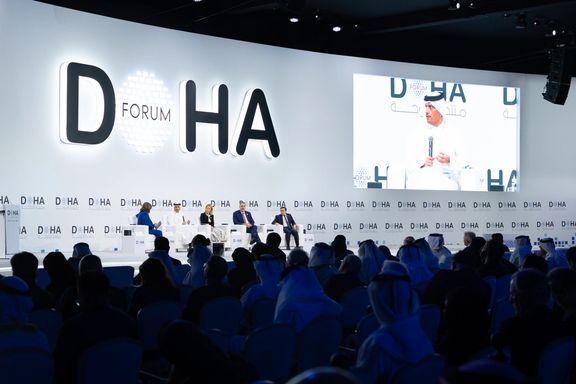
Doha Was Instrumental In Ending Afghan War, Says Qatari FM
Dec 7, 2025, 11:06 GMT+0

Qatar’s Foreign Minister, Mohammed bin Abdulrahman Al Thani, said on Sunday that his country played a central role in bringing an end to two decades of conflict in Afghanistan.

He noted that Doha facilitated talks between the Taliban, the United States, and the former Afghan government.

Speaking on the second day of the Doha Forum in the Qatari capital, Al Thani said Qatar’s mediation efforts have demonstrated that engaging all parties to a conflict is essential for progress in any peace process. He said this approach had been applied in Afghanistan and had delivered results.

Qatar hosted the negotiations between the United States and the Taliban that led to the February 2020 Doha Agreement. Many former Afghan officials and analysts say the accord weakened the then-government in Kabul and hastened the Taliban’s return to power.

Al Thani stressed that Qatar’s foreign policy is grounded in diplomacy and cooperation, adding that Doha continues to rely on these tools to help resolve global crises. He said regional disputes frequently arise both between states and within political factions, which is why Qatar maintains channels of communication with all sides in pursuit of mutually acceptable solutions.

He also said that each conflict has its own dynamics and cautioned against comparing Qatar’s mediation between the United States and Afghanistan with its role in efforts to broker a ceasefire between Israel and Hamas. He noted that, in the latter case, the principal challenge was that Washington initially engaged only with Israel. According to him, meaningful progress emerged only once the United States began speaking to both sides.

The Doha Forum is one of Qatar’s major annual gatherings, drawing government officials, diplomats, researchers, and representatives of international organisations from around the world.

Most Viewed

Taliban Ignore Afghanistan’s Interests By Backing Militants, Says Pakistan Army Chief
1

Taliban Ignore Afghanistan’s Interests By Backing Militants, Says Pakistan Army Chief

2

United Nations Delivers Education Kits To Four Million Afghan Children

3

Taliban Renews Call For China To Launch Aynak Copper Mine

4

Taliban Leaders In South-West Hold Security Meet In Kandahar

5

Afghan Deportations Is Strategic Mistake, Says European Parliament Member

•
•
•

More Stories

Iran Presses Afghan Opposition To Pursue Reconciliation With Taliban

Dec 6, 2025, 17:50 GMT+0

Amid growing regional and international pressure on the Taliban, the Islamic Republic of Iran has intensified its outreach to Afghan political opposition figures in an effort to promote reconciliation and a political arrangement with the Taliban.

Multiple sources say Tehran has recently hosted several political leaders and representatives of anti-Taliban factions.

A well-placed source, speaking on condition of anonymity due to the sensitivity of the issue, told Afghanistan International that Iran is seeking an agreement between the Taliban and the political opposition that would preserve the Taliban’s rule. According to the source, Iran has become the Taliban’s closest regional ally and is increasingly concerned about the consequences of escalating tensions between the Taliban and Pakistan.

The source said the Taliban has served Iran’s interests over the past four years, noting that Iran’s trade volume with Afghanistan under Taliban rule now exceeds its total trade with all European countries.

At the same time, other sources reported meetings in Tehran between Iranian officials and several prominent Afghan opposition figures. According to these accounts, Iranian authorities have held talks with a former vice president, a former deputy chief executive, a former national security adviser, a former foreign minister, representatives of political leaders, members of an anti-Taliban military front, and a former governor of Balkh encouraging them to seek reconciliation with the Taliban.

Hanif Atmar, Afghanistan’s former foreign minister, and a source close to Atta Mohammad Noor, the former Balkh governor, denied to Afghanistan International that they had travelled to Tehran or met Iranian officials. However, images circulated in recent days showed Batur Dostum son of former vice president Abdul Rashid Dostum and leader of the National Islamic Movement Party of Afghanistan at the Espinas Hotel in Tehran. The party has not commented on the purpose of his visit.

Reliable sources told Afghanistan International that Taliban opponents plan to hold a unity meeting in the coming days, bringing together traditional anti-Taliban leaders from the National Resistance Council for the Salvation of Afghanistan and several officials of the former Afghan government.

A forthcoming declaration is expected to emphasise resolving Afghanistan’s political crisis through intra-Afghan negotiations and agreement; restoring national sovereignty through the establishment of a legitimate, representative government; protecting human rights and combating discrimination; and expanding humanitarian assistance.

Iran’s move to rally Taliban opponents comes as Pakistan is also seeking contact and cooperation with anti-Taliban groups. Some sources say a high-level delegation from Jamiat-e-Islami may soon travel to Pakistan. One source said Iran fears Pakistan may empower the opposition and further weaken the Taliban administration, prompting Tehran to push for the opposition to move closer to the Taliban.

Relations between the Taliban and Pakistan have sharply deteriorated in recent months. Pakistani diplomats have openly raised the prospect of “regime change” in Afghanistan and have called for engagement with the Taliban’s opponents.

Australia Introduces Independent Sanctions Regime Targeting Taliban Leadership

Dec 6, 2025, 15:18 GMT+0

Australia’s Foreign Ministry has announced the establishment of an independent sanctions framework targeting at least 140 Taliban individuals and entities, aimed at holding the group accountable for its repression of women and girls.

Australia is the first country to formally integrate a Taliban-specific sanctions system into domestic law.

The ministry said the framework was created in response to the Taliban’s continued suppression of women, girls, minorities and the broader Afghan population since August 2021. The system incorporates into Australian law the Taliban figures and entities already listed under United Nations Security Council sanctions.

Under the new framework, restrictions are imposed on providing weapons, services, training, advice or commercial activity to designated Taliban individuals and entities. Travel bans also apply to those listed.

Simultaneously, Australia announced financial sanctions and travel bans against several senior Taliban officials, whom it described as “so-called ministers,” along with the group’s chief justice, citing their roles in violating women’s rights and undermining governance and the rule of law. Those sanctioned include:

Mohammad Khalid Hanafi

The Taliban minister responsible for the Propagation of Virtue and Prevention of Vice, Hanafi is known for hardline positions on women’s rights. Measures under his leadership include compulsory full-body coverings for women, bans on music and artistic expression, restrictions on foreign media, compulsory mosque attendance, and prohibitions on women travelling without a male guardian.

Neda Mohammad Nadim

The Taliban’s higher education minister, Nadim is aligned with the Kandahar hardline circle loyal to Taliban leader Hibatullah Akhundzada. He banned women from attending universities in 2022 and has said that critics of the Taliban system “deserve death.”

Abdul Hakim Sharei

The Taliban justice minister, educated at Darul Uloom Haqqania in Pakistan, has said the Taliban’s duty is to enforce Islamic law rather than respond to international criticism. He also heads the commission charged with reclaiming land designated as “Emirati land,” a process in which affected individuals cannot file complaints.

Abdul Hakim Haqqani

The Taliban chief justice and a founding member of the movement, Haqqani previously served as chief justice during the 1996–2001 Taliban regime. A close confidant of Akhundzada, he oversees a powerful council of religious scholars.

Australia Tightens Pressure on the Taliban

The Foreign Ministry said the new sanctions regime reflects Australia’s firm stance on Afghanistan’s deteriorating human rights situation. The objective, it said, is to increase pressure on the Taliban over the repression of women and girls and to hold the group accountable.

The framework includes a humanitarian exemption under UN Security Council Resolution 2615 to ensure aid and essential services can continue. Australia has also introduced a group permit system to help facilitate humanitarian work when restrictions arise.

Australian sanctions law applies both within the country and to Australian citizens and entities abroad. Violations carry criminal penalties, including potential imprisonment and substantial fines.

Australia has provided more than USD 260 million in humanitarian assistance to Afghanistan since the Taliban takeover, with an additional USD 50 million allocated for the 2026 fiscal year, prioritising support for women and girls.

Nine Militants Killed in Khyber Pakhtunkhwa As Spin Boldak Clashes Escalate, Says Pakistan

Dec 6, 2025, 13:30 GMT+0

Pakistan’s military said on Friday that security forces had killed nine militants in the Tank and Lakki Marwat districts of Khyber Pakhtunkhwa, as clashes between Taliban and Pakistani border forces continued in Spin Boldak, Kandahar.

In a statement, Inter-Services Public Relations (ISPR) said the militants were killed in two separate operations in the province bordering Afghanistan. It described the fighters as members of the “Fitna al-Khawarij” linked to India, a term the army uses to refer to Tehreek-e-Taliban Pakistan (TTP). Weapons and ammunition were reportedly recovered.

The TTP has not yet commented.

According to ISPR, seven militants were killed in Tank and two in Lakki Marwat during exchanges of fire with Pakistani forces. The army accused them of involvement in targeted killings of civilians and other “terrorist activities” against security personnel.

The announcement came as heavy gunfire was exchanged between Taliban and Pakistani forces in Spin Boldak district. Both sides blamed each other for starting the confrontation.

Taliban officials in Kandahar said three civilians were killed and five others wounded in the border clashes.

Taliban Seek Deeper Ties After Russia, India Back Engagement

Dec 6, 2025, 12:13 GMT+0

The Taliban have welcomed recent statements from Russia and India, with deputy spokesperson Hamidullah Fitrat saying the group maintains positive relations with both countries and seeks constructive engagement with all regional partners.

In a video message on Saturday, Fitrat urged neighbouring states to expand meaningful cooperation with the group to preserve stability and strengthen regional connectivity.

His remarks followed comments by Russian President Vladimir Putin, who told India Today that engagement with the Taliban was necessary because the group represents the current reality in Afghanistan and is fighting “terrorist organizations such as ISIS.” Russia is the only country to have formally recognized the Taliban, and despite concerns over rising extremism, Moscow continues to emphasise engagement and cooperation.

India, too, has expanded its contacts with the Taliban. Following heightened tensions between the Taliban and Pakistan, the group’s foreign and commerce ministers travelled to New Delhi, where they agreed with Indian officials to deepen trade and transit ties. India is also expected to supply medicines to Afghanistan after the Taliban banned pharmaceutical imports from Pakistan.

Afghanistan Dropped From New US National Security Strategy

Dec 6, 2025, 10:52 GMT+0

Afghanistan does not appear anywhere in the newly released National Security Strategy issued by the administration of US President Donald Trump. This marks a significant shift after two decades in which the country featured prominently in Washington’s foreign and security policy.

The 33-page document focuses mainly on restricting migration, countering China, deterring Russia, and strengthening US homeland security. South Asia and the Middle East receive only brief references.

A review of earlier National Security Strategy papers shows that in 2010 Afghanistan was one of Washington’s top security priorities and, after Iraq, appeared most frequently in the text. Its prominence declined sharply in the 2017 and 2022 editions, and it was removed from the list of priority countries. In the 2025 version, Afghanistan has disappeared entirely.

In recent months, Trump repeatedly commented on the Bagram air base and suggested the need to “take it back”, remarks that triggered strong reactions from the Taliban and concern among regional states. Despite those earlier statements, the president has remained silent on Bagram for nearly two months, and the new strategy assigns no role or priority to Afghanistan.

The National Security Strategy, issued by each US administration, outlines the government’s vision for protecting national security, its political and military priorities, major threats, and its approach to global engagement.