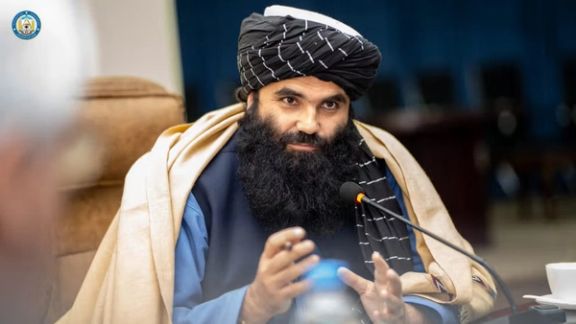
Nasir Ahmad Andisha said Akhundzada disapproves of the repeated visits to Kabul by Zalmay Khalilzad, the former US special envoy for Afghanistan, but is effectively unable to prevent them.
“Drones in the sky and Khalilzad on the ground are keeping Hibatullah Akhundzada under watch,” Andisha told Afghanistan International. He added that the Taliban leader has become “like a ghost” in Kandahar and no longer trusts those around him.
Afghan airspace beyond Taliban control
Andisha’s remarks come as reports of increased drone activity over Afghanistan continue. Taliban officials have repeatedly acknowledged that the country’s airspace is not fully under their control.
In November 2025, Zabihullah Mujahid said US drones were still patrolling Afghan airspace, adding that such flights have continued since the Taliban returned to power and often enter Afghanistan through neighbouring countries.
In a recent incident, sources close to the Taliban said an unidentified flying object crashed on Thursday, January 1, in Maidan Wardak province. The object came down in Maidan Shahr, the provincial capital, though it remains unclear which country it belonged to or what caused the crash.
Internal fractures within the Taliban
Andisha also pointed to growing internal divisions within the Taliban, saying recent reshuffles and purges indicate Akhundzada’s authority is weakening.
In a post on X, Andisha said changes within the Taliban suggest the group is moving towards intensified internal purges. He said Akhundzada’s control appears to be diminishing as rival factions gain strength.
In recent weeks, the Taliban leader has replaced several officials across key institutions, including provincial governors, corps commanders and other local authorities.
Khalilzad’s visits to Kabul
Andisha said Khalilzad’s repeated trips to Kabul have further unsettled the Taliban leader. Although Akhundzada dislikes what Andisha described as “back-to-back visits”, he is effectively powerless to stop them.
Khalilzad arrived in Kabul on December 28, 2025, and met with Amir Khan Muttaqi, the Taliban’s foreign minister. While Khalilzad has described his travel as personal, he has previously visited Afghanistan alongside US officials to help secure the release of American detainees held by the Taliban.
The US State Department told Afghanistan International this week that Khalilzad is not a US government employee and does not represent the United States, describing his activities and visits as personal.
Regional concerns
Andisha also referred to recent international developments, including the US operation in Venezuela, which he said had heightened concerns among authoritarian leaders. Former Taliban ambassador to Pakistan Abdul Salam Zaeef earlier described the US move as a warning to other governments.
According to Andisha, these developments have contributed to Akhundzada’s growing isolation and mistrust, reinforcing what he described as an atmosphere of surveillance and internal tension at the top of the Taliban leadership.