Internet Access in Iran Sees ‘Slight Rise’ After Prolonged Shutdown, Says Watchdog

NetBlocks said indicators show only a very limited restoration of internet connectivity in Iran after more than 200 hours of near-total disruption.

NetBlocks said indicators show only a very limited restoration of internet connectivity in Iran after more than 200 hours of near-total disruption.
In a statement, the global internet access watchdog said overall connectivity remains at about 2 percent, with no signs of a meaningful return of services nationwide.
The assessment comes as Iranian state news agencies have reported the restoration of the so-called “national internet,” a restricted domestic network that limits access to sites hosted outside the country.
Meanwhile, an Iranian Telegram channel reported on Saturday that while some virtual private networks (VPNs) were able to connect, access to Google and other websites hosted outside Iran remained unavailable without a VPN.
The channel added that even with a VPN, many Iranian websites were not accessible, underscoring the continued disruption and fragmentation of online services across the country.
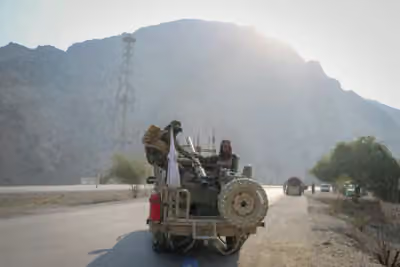
Reuters reported on Friday, citing human rights groups and local residents, that protests in Iran have subsided following a deadly crackdown by security forces. However, Tehran and several other cities remain under a heavy military and security presence, according to the report.
The news agency said that despite reports of sporadic unrest, the Islamic Republic has declared that “calm” has been restored nationwide. It added that state media, amid US threats of possible intervention should the killings continue, have reported further arrests of protesters.
One source told Reuters that Tehran has been calmer since Sunday, adding that drones have been flying over the city and that no signs of protests were observed on Thursday and Friday.
The human rights group Hengaw said no protest gatherings have been held since Sunday, noting that “the security environment remains highly restrictive.” The group told Reuters that its independent sources confirm a heavy military and security presence in cities and towns where protests previously took place, as well as in several areas that had not seen major demonstrations.
A resident in northern Iran, who asked not to be named for security reasons, said the streets appeared calm, although reports of sporadic unrest have continued to emerge.
Hengaw also reported that a female nurse was killed by direct fire from government forces during protests in Karaj. Meanwhile, the government-affiliated Tasnim News Agency reported clashes in Falavarjan, in Isfahan province, on Thursday.
An elderly woman living in a city in northwestern Iran told Reuters that scattered protests, though less intense, were still continuing. State broadcaster Press TV quoted Iran’s police chief as saying that calm had been restored across the country.
Earlier, the editorial board of Iran International, citing reviews of internal sources, medical data and field reports, said the death toll from the protests stood at at least 12,000. CBS News also confirmed the report, putting the number of victims at between 12,000 and 20,000.
However, the US-based human rights group Human Rights Activists News Agency (HRANA) said 2,677 people were killed, including 2,478 protesters and 163 individuals identified as affiliated with the government.

Former Iranian president Mohammad Khatami has described the ongoing protests in Iran as a “major, premeditated conspiracy” involving Israel and the United States. He expressed support for the government of Masoud Pezeshkian.
In a statement, the prominent reformist politician said it would be “unfair to ignore the government’s civil conduct in the early days of the popular protests.” He added that remarks by Israeli officials and expressions of support from the United States left “no doubt about the formation of a major, premeditated conspiracy against Iran.”
Khatami did not refer to reports of protesters being killed by government forces. However, he said that “the entry of violence quickly changed the scene of formally recognising the nation’s right to protest,” a reference to the escalation of unrest.
His comments come amid continued demonstrations across Iran and sharply differing assessments by Iranian officials and critics over the causes of the protests and the government’s response.

The US Department of State said Iran’s leadership has responded to nationwide protests with violence rather than dialogue, accusing the Islamic Republic of threatening neighbouring countries and US interests in the region.
In a statement posted on X by the Persian-language account of the US Department of State, the department said Iranians had “risked everything to demand freedom and justice” and were met with “brutal violence” by the authorities.
“As if that were not enough, the regime is now threatening neighbouring countries as well as United States interests and assets in the region,” the statement said.
The department said the response reflects what it described as a recurring pattern by Iran’s leaders, accusing them of consistently choosing violence over dialogue both toward their own people and the international community.
The statement urged Iran’s leaders to listen to protesters’ demands rather than resorting to force, as tensions continue to rise amid ongoing demonstrations and regional instability.

The foreign ministers of Saudi Arabia and Iran held a phone call on Thursday amid growing regional tensions and speculation about possible US military action against Iran.
Faisal bin Farhan and Abbas Araghchi discussed ways to strengthen regional stability, Saudi Arabia’s Ministry of Foreign Affairs said in a post on X.
In a separate statement, Iran’s Ministry of Foreign Affairs said the Saudi foreign minister expressed concern about the current situation in the region and stressed the importance of diplomacy and regional cooperation to maintain stability and security.
According to the statement, Araghchi said the Islamic Republic would defend Iran’s sovereignty against external threats.

China has reiterated its opposition to any foreign interference in Iran’s internal affairs, following a warning by US President Donald Trump that the United States would take “very strong actions” against Tehran.
Speaking at a regular press briefing, Mao Ning, a spokesperson for China’s Ministry of Foreign Affairs, said Beijing supports the government and people of Iran and hopes they can overcome current difficulties and maintain stability.
Mao said China opposes interference by external forces in the internal affairs of sovereign states and does not support the use or threat of force in international relations.
Her remarks come as tensions have escalated between Washington and Tehran amid widespread protests in Iran and growing international concern over the situation.
