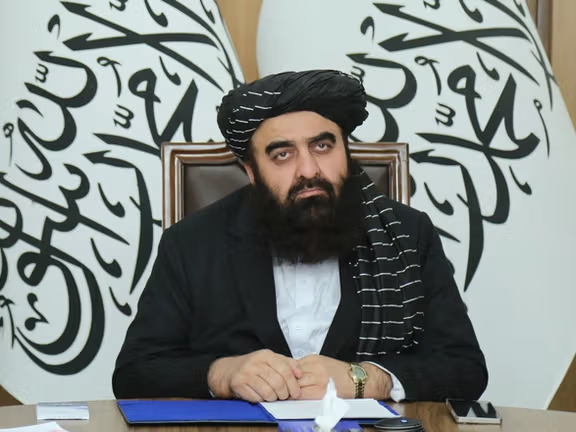
Taliban FM Criticises Internal Infighting, Public Statements
Taliban Foreign Minister Amir Khan Muttaqi criticised internal disputes and public messaging within the group, saying inaccurate statements and media hype could harm the administration’s standing.
Addressing a gathering of cultural figures affiliated with the Taliban at the presidential palace in Kabul on Thursday, Muttaqi said the conduct of Taliban officials is closely watched by Afghans and the international community.
He warned that “manufacturing news and creating hype” damages the administration and that even a single incorrect news report, post or public remark could create problems for the Taliban system.
Muttaqi added that “speech without action” amounts to lying from a religious perspective and said failure to honour commitments leads to distrust.
He said members of the former Afghan government’s security forces had surrendered before the fall of Kabul based on promises and guarantees given by the Taliban.
In part of his remarks, the foreign minister questioned why some individuals, through their conduct, harm the Taliban administration, the public and people’s livelihoods.
Muttaqi stressed that under Taliban rule, reform should begin at the individual level.
A member of the European Parliament has criticised the Taliban’s newly issued penal code, saying it legitimises gender apartheid and the enslavement of women and girls, and argued that normalising relations with the group is unacceptable.
Hannah Neumann wrote on X on Wednesday that accountability for Taliban actions was overdue, adding: “No normalisation with the Taliban!”
The penal code has prompted a wave of domestic and international reactions. Stéphane Dujarric, spokesperson for the UN secretary-general, has urged the Taliban to repeal discriminatory laws and decrees.
Pakistan’s Council of Islamic Scholars has also said the Taliban’s penal code was not drafted in line with Islamic teachings and is “contrary to the Quran and Sunnah”.
The Taliban’s Ministry of Justice has warned that objections to the group’s laws would be treated as a crime and that critics would be referred to judicial authorities.
The code, signed by Taliban leader Hibatullah Akhundzada, includes provisions that critics say fail to criminalise the beating of children, recognise slavery, criminalise dancing, define Sunnis as Muslims while labelling others as heretics, and allow the killing of Taliban opponents.
A cleric aligned with the Taliban urged supporters to wage “jihad” in Pakistan and several Central Asian countries during a funeral ceremony near Kabul, according to remarks made at the event.
Sher Ali Hamad made the comments at a funeral in Guldara district for a man identified as Ayoub, also known as Zakir. Pakistani authorities have said Ayoub was killed in recent clashes between Pakistani security forces and the Pakistani Taliban in border areas near Kunar.
In his speech, Hamad described the political systems of Central Asian states and Pakistan as “parliamentary and infidel,” and called for the overthrow of those governments to establish Islamic rule. He said he would not rest until “the flag of Islam” was raised in Pakistan’s capital, Islamabad.
The remarks come despite repeated statements by Taliban authorities that their administration in Afghanistan poses no threat to the region or the wider world and that they are working to strengthen ties with neighbouring countries.
Central Asian governments and Pakistan have repeatedly expressed concern about the presence and activities of militant groups in Afghanistan.
Pakistani officials have said deadly attacks inside Pakistan are planned from Afghan territory, allegations supported by some international assessments but consistently denied by the Taliban.
Afghan nationals filed the highest number of asylum applications in France in 2025, with 13,800 claims, and had one of the highest approval rates among major nationalities, according to figures from France’s refugee agency.
The French Office for the Protection of Refugees and Stateless Persons said Afghans ranked first among countries of origin for asylum seekers last year. About 78.8 percent of Afghan applicants were granted international protection.
After Afghanistan, the Democratic Republic of Congo recorded 13,200 applications, followed by Haiti with 12,600 and Ukraine with 12,300.
Together, these four countries accounted for more than one-third of all asylum claims lodged in France in 2025, the agency said.
France registered 145,210 applications for international protection by the end of 2025, a decline of about 5.5 percent compared with 2024. The agency said this marked the second consecutive annual drop in asylum applications since the COVID-19 pandemic in 2020.
Despite the overall decrease, approval rates rose. About 41 precent of applications were accepted at the initial review stage in 2025, suggesting improved prospects for applicants compared with the previous year.
Including decisions overturned on appeal, nearly 79,000 people were ultimately granted asylum or international protection in France in 2025, the report said.
Mohammad Shah Amiri, an Ismaili resident of Badakhshan province, was returning home from work on the evening of January 1 when he was ambushed in an alley by an armed man who opened fire from behind a garden hedge at a distance of two to three metres.
The 24-year-old, an employee of Afghan Wireless Telecom company, lived in the Dasht-e-Qargh area along the Kokcha River in Faizabad. A source said the bullet entered behind Amiri’s ear and exited through his forehead.
He continued breathing for several minutes while lying on the ground. A nearby child noticed him and ran to alert others.
A source said Taliban intelligence forces arrived minutes after the shooting but delayed taking Amiri to hospital in their vehicle, saying it was not theirs. He was eventually transported in the same vehicle but died on the way.
Mohammad Shah Amiri
The perpetrator remains unknown. Less than a month later, on January 22, two other Ismaili residents, relatives of Amiri, were shot inside a shop about 50 metres from where his wounded body had been found.
Local sources accuse the Taliban of failing to conduct serious investigations into extrajudicial killings. Residents say Ismailis in Badakhshan have been systematically targeted since the Taliban returned to power.
Taliban authorities often classify such incidents as ordinary criminal cases. Documents from the Taliban-controlled National Statistics and Information Authority, obtained by Afghanistan International, show nearly 6,660 killings were registered as criminal offences between 2021 and 2024.
The Taliban seized power in August 2021. Crimes recorded in the first five months of that year occurred under the previous government.
Over the past four years, Taliban officials have repeatedly claimed to have established nationwide security. Taliban data, however, also show a rise in criminal activity alongside dozens of deadly attacks.
Crime up 60 Percent
Figures published in November 2025 by the Taliban-controlled statistics authority, based on Interior Ministry data, show criminal cases, particularly murder and theft, have risen sharply.
Total criminal cases reached 17,320 in the solar hijri year 1403 (March 2024–March 2025), up from 10,834 in 1400 (March 2021–March 2022). The figure rose to 12,688 in 1401 and 16,186 in 1402, reflecting an overall increase of about 60 precent since the Taliban’s return.
Despite high security spending and claims of stability, crime has continued to rise. The World Bank previously reported the Taliban spent about 96.9 billion afghanis on security in the first nine months of fiscal year 2025.
Previous Taliban Report
Murders and Kidnappings
Between March 2024 and March 2025, 1,734 criminal murders were recorded, compared with 1,502 between March 2021 and 2022, an increase of more than 15 percent.
Kidnappings have also persisted. On January 20, four armed men abducted Mohammad Dawood Hoshmand, a 63-year-old doctor, near his home in Kabul’s Khair Khana area. A week later, his family said they had no information about his fate.
Afghanistan International also published CCTV footage showing a veiled woman abducting a three-year-old child in Mazar-e-Sharif. Taliban police later said the child was recovered and a suspect arrested.
Official data show 224 kidnappings were recorded between 2021 and 2025. While Taliban authorities have announced the rescue of some victims, the fate of many remains unknown.
Mohammad Dawood Hoshmand
Theft Doubles
The statistics authority reported 6,225 thefts between March 2024 and March 2025, compared with 3,102 between March 2021 and March 2022, a 100 percent increase.
Residents say theft is widespread, especially at night. Fatima, a Kabul resident who requested anonymity, said people cannot walk safely despite Taliban claims of security.
Bismillah Taban, former head of criminal investigations at the Interior Ministry, said theft has risen even in provinces previously considered safe. He said most weapons are now held by Taliban members, yet crime continues to grow.
A Kabul resident said: “In 20 years of the republic, I lost one phone. Under Taliban rule, two were stolen.”
Insecurity in Herat
Afghanistan International reported seven people were killed in Herat in one week, including a mobile money changer, two young men on the Herat–Karukh road, a teenage street vendor, a man in District 11 and two targeted killings in the city centre.
Residents say Herat has become increasingly unsafe, with limited accountability and many killings linked to armed robberies.
Questioning ‘Nationwide Security’
Taban said the Taliban dismissed trained professionals and replaced them with clerics and explosives specialists, arguing the group lacks both the capacity and intent to protect civilians.
He said many crimes go unreported due to fear and mistrust, and questioned the reliability of Taliban statistics, saying they are heavily censored and incomplete.
Afghanistan International has previously published investigations and video confessions showing Taliban members’ involvement in targeted extrajudicial killings in several provinces.
Human rights organisations have reported bodies found in eastern regions, disappearances of young men in northern Kabul, killings of Ismailis for religious reasons and systematic targeting of former Afghan security personnel.
Families of victims often blame the Taliban, but the group routinely denies responsibility. For nearly four and a half years, Taliban spokespersons have refused to answer media questions about targeted killings or to disclose investigative and judicial processes.
The number of women prisoners in Afghanistan has risen by 435 percent to 1,825, with women now held in 34 prisons, according to figures released by the Taliban’s Interior Ministry.
Of the total, 469 women are held in Kabul, the largest concentration in a single location, followed by Herat and Balkh. The data show the number of women detainees has increased 18.7 percent compared with last year.
The Taliban regained power on August 15, 2021. Amnesty International has reported that in the early days of Taliban rule, the group opened the doors of many prisons across the country. An investigation by Afghanistan International said Taliban decrees, largely moral and religious in nature, have significantly broadened the grounds for the detention and punishment of women.
Sharp Rise Compared With The Republic Era
According to data from World Prison Brief, during the republic period from 2001 to 2021, the number of women prisoners in Afghanistan never exceeded 1,000. In 2021, the final year of the republic order, there were 840 women prisoners.
Nearly four years after the Taliban’s return to power, the total prison population has reached 24,446, including 1,825 women held in women’s facilities.
Distribution By Province
Afghanistan has 71 prisons in total, 34 for women and 37 for men. Kabul alone has four detention facilities, with women held at Badam Bagh prison.
Kabul has the highest number of women prisoners, followed by Herat with 294, Balkh with 141, Nangarhar with 85 and Kandahar with 57.
Panjshir has the fewest women prisoners, with one, followed by Bamiyan with three, Maidan Wardak with six, and Logar and Zabul with seven each.
Women make up 7.5 percent of the total prison population. Observers say the figure is significant given Afghanistan’s social structure and restrictions that confine many women to their homes.
Taliban Directives & Women’s Imprisonment
The Taliban do not release case details of women prisoners, but the group’s Supreme Court regularly announces public floggings of women, most commonly for alleged extramarital relationships or “running away from home.” In many cases, women are sentenced to prison in addition to corporal punishment.
UN and human rights reports offer insight into the causes of women’s arrests. In an April 2025 report, the UN Assistance Mission in Afghanistan said the Taliban had granted broad powers to its Vice and Virtue apparatus, with the detention of women forming part of enforcement.
The Afghan human rights organisation Rawadari said the Taliban’s penal code has lowered the threshold for criminalising women. Under Article 34, a woman who repeatedly goes to her parental home and does not return to her husband’s house can be deemed a criminal. Family members who prevent her return can face up to three months in prison.
Rawadari said the provision disproportionately affects women fleeing domestic violence. Under the code, a husband is punished only if severe injury or visible bruising is proven before a judge, while other forms of physical, psychological or sexual violence are not explicitly prohibited.
Article 37 prescribes one year in prison for a woman accused of touching, shaking hands with or hugging a non-mahram man. Article 59 mandates two months in prison for boys and girls who dance, as well as for spectators.
The UN special rapporteur has warned that under the Promotion of Virtue law, enforcers are required to ensure women’s voices are not heard outside the home, exposing women to punishment even in semi-private spaces.
A report by The Guardian said that after women were barred from work and poverty deepened, some women in Kabul turned to begging, only to be arrested.
Amnesty International has also reported that during waves of arrests linked to dress codes and Taliban restrictions, women have faced degrading treatment, torture and, in some cases, sexual assault in detention.
Sociologist Ali Shiva told Afghanistan International that excluding women from work reduces household income and forces families into risky survival strategies, making women, particularly female heads of households, more vulnerable to criminalisation and exploitation.
The US State Department’s Trafficking in Persons report and organised crime indices identify Afghanistan as a source country for trafficking and exploitation, with women and children among the most at-risk groups.
Overall, analysts say Taliban restrictions, particularly under the Vice and Virtue framework, have significantly expanded the scope for the arrest and imprisonment of women across Afghanistan.