Pakistan, Saudi Foreign Ministers Discuss Clashes With Taliban

The foreign ministers of Pakistan and Saudi Arabia have discussed recent military clashes between Pakistan and the Taliban.
The foreign ministers of Pakistan and Saudi Arabia have discussed recent military clashes between Pakistan and the Taliban.
According to Pakistan’s Ministry of Foreign Affairs of Pakistan, Mohammad Ishaq Dar told Faisal bin Farhan that Islamabad had responded to what he described as unprovoked Afghan aggression.
In a statement issued on Friday, the ministry said Pakistani forces carried out strikes inside Afghan territory as part of an operation it referred to as “Ghazb lil Haq”.
The statement described the strikes as successful and targeted operations.
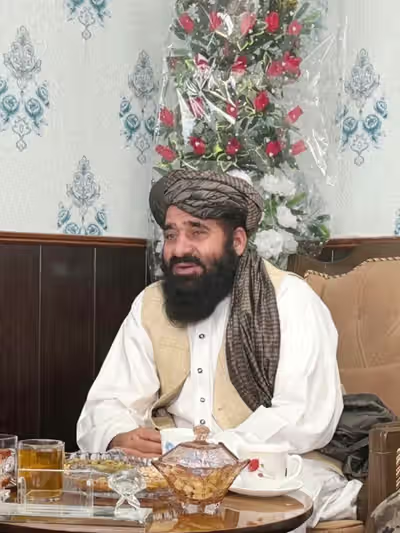
The Taliban Defence Ministry said it carried out airstrikes on several military targets in Pakistan, including sites in the capital, Islamabad.
In a statement, the ministry said the strikes were launched shortly before midday on Friday, at about 11 a.m. local time, targeting what it described as key Pakistani military facilities.
It said the targets included a military camp near the Faizabad area of Islamabad, a military installation in Nowshera, a base in Jamrud and a military centre in Abbottabad.
The ministry said the operation had been successfully conducted against important Pakistani military bases and facilities. It did not provide details on the type of aircraft or weaponry used.
Pakistan’s government had not issued an official response to the claim at the time of publication.
Shehbaz Sharif said Pakistan’s armed forces are capable of defeating any aggressive plan against the country.
He said the defence forces, under the leadership of Asim Munir, are carrying out their duties with national spirit and commitment.
According to Radio Pakistan, the prime minister said the armed forces are equipped with professional capabilities, high-quality training and an effective defence strategy, and are fully prepared to confront any internal or external challenge.
Sharif stressed that Pakistan’s territorial integrity would not be compromised under any circumstances and that the armed forces would respond decisively to any act of aggression.
He added that the entire nation stands alongside Pakistan’s armed forces.
Documents obtained by Afghanistan International show that the Taliban have appointed a Pakistani national as head of information technology at Afghanistan’s consulate in Bonn.
The individual, identified as Safiullah, was introduced to the Taliban’s Foreign Ministry with a proposed monthly salary of 2,500 euros, according to the documents.
Sources at the Afghan consulate in Bonn said the man had previously worked at Afghanistan’s embassy in Berlin, which operates under Taliban administration.
Some sources expressed concern about a third-country national having access to confidential consular documents and information, warning of the potential risk of sensitive data being disclosed.
Several former Afghan diplomats said that while it may be common in some cases to employ nationals of the host country at diplomatic missions, appointing a citizen of a third country would be contrary to established principles.
Afghanistan International also received additional documents related to the individual, including his German residence card.
The Taliban have not explained why a Pakistani national was appointed to the position.
The Afghan consulate in Bonn, which was handed over to the Taliban in October, has since resumed operations. The mission was transferred to Taliban representatives following the collective resignation of its diplomats and staff in late September.
Ministry of Foreign Affairs of Pakistan said it is monitoring what it described as threatening statements by the Taliban.
Spokesperson Tahir Andrabi told a news conference on Thursday that Islamabad was aware of threats emanating from Afghanistan and that Pakistani institutions were prepared to ensure security.
Andrabi said Pakistan had carried out strikes on militant sanctuaries in Afghanistan based on verified intelligence. He added that Islamabad’s objective was to end what he described as the freedom of militants to operate from Afghan territory, while maintaining that Pakistan did not wish to harm relations with the Afghan people.
Pakistan’s air force struck areas in Nangarhar and Paktika provinces on 22 February. Taliban officials said 18 civilians were killed in the strikes, while the United Nations Assistance Mission in Afghanistan confirmed 13 civilian deaths in Nangarhar.
Andrabi said the operation had been conducted with utmost caution to avoid civilian casualties.
Following the strikes, Taliban spokesperson Zabihullah Mujahid accused Pakistan of targeting civilians and said the group would respond at an appropriate time.
Some lower-level Taliban officials also issued threats. Abdul Hadi Himmat, head of the Taliban’s military court in the north-east zone, said that if authorised by the leadership, Taliban forces would be in the Pakistani cities of Peshawar and Quetta within two nights. Speaking at a graduation ceremony for Taliban defence forces in Kunduz Province, he said defending the people and taking revenge was a religious obligation.
Andrabi described the Taliban officials’ remarks as misleading and said Afghanistan must prevent its territory from being used by militants against other countries. He stressed that Pakistan would act against militants in Afghanistan in line with its right to self-defence.
Amit Halevi, a member of Israel’s Knesset, said the Taliban should not be granted international legitimacy and called for support for the group’s opponents.
In an interview with Afghanistan International, Halevi also urged India to halt what he described as its support for the Taliban.
He said Israel has influence in Washington and other capitals and that this influence should be used to strip the Taliban of international legitimacy and to support the emergence of opposition forces.
Halevi said the first step should be to completely revoke the Taliban’s legitimacy, after which opposition forces should be encouraged, similar to international backing for opponents of the government in Iran, so that people can stand up for their rights and future.
He added that achieving these goals would require taking all practical steps, including potential military measures, to bring about fundamental change.
Asked about India’s policy towards the Taliban, Halevi said New Delhi should reassess its strategy, arguing that India could eventually face security threats.
His remarks come as India has recently stepped up diplomatic engagement with the Taliban authorities. New Delhi has sought to maintain its political and economic presence in Afghanistan amid regional developments, security concerns and economic interests.
Commenting on Pakistan’s reported role in a proposed peace initiative linked to US President Donald Trump, Halevi said Israel’s policy is guided by the substance of positions rather than appearances, and that any reconsideration would depend on changes in Pakistan’s core principles.