Trade Transit With Iran Continues At Islam Qala Border, Says Taliban

Taliban officials in Herat say trade transit between Afghanistan and Iran continues despite the war in Iran, with up to 1,300 cargo trucks crossing the Islam Qala border each day.

Taliban officials in Herat say trade transit between Afghanistan and Iran continues despite the war in Iran, with up to 1,300 cargo trucks crossing the Islam Qala border each day.
Iran earlier suspended exports of food and agricultural products until further notice.
Hazrat Zaeem Agha, the Taliban commissioner at the Islam Qala crossing, told the Taliban-run Bakhtar News Agency that about 600 cargo trucks currently enter Iran through the crossing each day.
He said roughly 700 cargo trucks arrive daily from Iran, adding that commercial goods continue to move without disruption.
Mohammad Yousuf Saeedi, spokesperson for the Taliban governor in Herat, warned that traders who raise prices under the pretext of road closures in Iran would face legal action.
However, several Herat residents told Afghanistan International that the ongoing conflict between the Taliban and Pakistan, along with the war involving Iran, Israel and the United States, has led to rising food prices in the city.
Officials at the Herat Chamber of Commerce and Investment said that if the war in Iran continues, they will seek to expand Afghanistan’s trade relations with other countries to prevent possible food shortages.
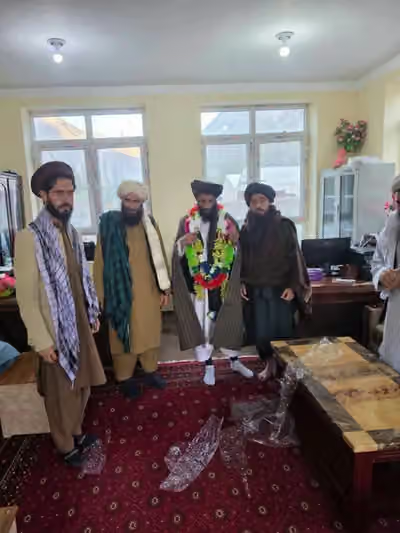
Taliban Foreign Minister Amir Khan Muttaqi said Pakistan’s recent strikes were an unjust violation of Afghanistan’s sovereignty during a meeting with foreign diplomats in Kabul.
Muttaqi said the Taliban administration was facing what he described as an imposed war and had acted cautiously in defensive operations.
Zia Ahmad Takal, head of public relations at the Taliban foreign ministry, posted a video on X on Monday showing Muttaqi attending a joint iftar with ambassadors and foreign diplomats based in Kabul, along with representatives of the United Nations, the European Union and several international organisations.
Muttaqi said the Taliban administration remained committed to resolving issues through understanding, dialogue and mutual respect but considered defending Afghan territory against any aggression a legitimate right.
He said Pakistan had carried out bombardments in areas including the provinces of Nangarhar, Paktia, Paktika, Kandahar, Khost, Kunar, Laghman, Parwan, Nuristan and Kabul.
Muttaqi said Pakistan had cited Tehreek-e-Taliban Pakistan to justify the strikes but argued that the group had existed in Pakistan for years and had its own causes and background.
He also said Pakistani generals were choosing confrontation and force rather than seeking solutions through dialogue and warned their actions risked undermining regional security.
Military clashes between Taliban forces and Pakistan entered their 12th day on Monday, March 9, following what the Taliban described as retaliatory cross-border attacks.
Pakistani officials have rejected any negotiations or ceasefire agreement.
The UN Security Council will meet on Afghanistan on Monday, March 9, with a senior UN official set to brief members on the situation in the country.
Georgette Gagnon, deputy special representative of the UN secretary-general in Afghanistan, is expected to present a report on developments in the country.
The meeting is scheduled for 11:30 pm Afghanistan time and 3 pm in New York. The United Nations Security Council last held a session on Afghanistan on Dec. 10.
The discussion comes amid growing international concern over human rights restrictions, humanitarian challenges, terrorism risks and border clashes between the Taliban and Pakistan.
In previous meetings, many council members raised concerns about Taliban policies and the situation of women and human rights in Afghanistan.
The Taliban have dismissed UN meetings held without their representatives as ineffective and have called on countries to engage directly with the group’s administration.
The Taliban have publicly flogged more than 2,000 people, including 291 women, on various charges since 2024, according to findings by Afghanistan International.
The group has not subjected any of its own members to public corporal punishment.
Despite international criticism, the Taliban have continued to carry out public floggings since returning to power. Official figures show 567 people were flogged in 2024, including 78 women; 1,110 in 2025, including 170 women; and 332 in the first two months of 2026 alone, including 34 women. United Nations reports have corroborated the data.
UN experts say the rate of corporal punishment doubled between 2024 and 2025, and early figures for 2026 suggest the trend is likely to continue upward.
The Taliban typically carry out floggings before transferring those convicted to prison. The punishments, usually 39 lashes, are administered publicly by Taliban officials. According to UN experts, most men are punished for theft, drug dealing, drug use and gambling, whilst women, girls and LGBT+ individuals are flogged primarily on charges of extramarital relations and leaving home without permission.
Afghanistan International's investigation found that no Taliban members have been subjected to public punishment, suggesting a system in which the group's own personnel are effectively exempt.
Eyewitnesses say children are regularly present when the floggings are carried out. A resident of Khost province, who witnessed an execution at a local stadium, said: " Many people came. Many were happy that a criminal was being punished. Children were there too." He described it as one of the most distressing experiences of his life, having watched a person killed before his eyes.
Some families have raised alarm over the deliberate inclusion of the public in these events, saying exposure to such scenes causes lasting fear and trauma in children.
Since retaking power, the Taliban have carried out 12 executions.
A group of women protested in Kabul on Saturday against Taliban restrictions on women’s rights, chanting slogans including “bread, work, freedom”.
Members of the Afghanistan Women’s Freedom Lantern Movement gathered on a street in the capital ahead of International Women’s Day to protest restrictions imposed by the Taliban and to call for the protection of their fundamental rights.
In a statement, the movement said this year’s International Women’s Day comes as the crisis of women’s rights in Afghanistan has entered a deeper and more systematic phase.
It said sweeping restrictions on girls’ education, bans on women’s employment and the suppression of protests have placed millions of women under unprecedented pressure.
The statement added that Afghan women are now fighting not only for their basic rights but also to preserve their identity, dignity and presence in society.
The protesters urged the international community to prioritise practical, targeted and sustained support for Afghan women.
The movement also said political engagement with Afghanistan’s current rulers should not take place without consideration of women’s fundamental rights.
The protesters called for international accountability mechanisms to address widespread violations of women’s rights.
In recent years, the Taliban have harshly suppressed women’s street protests. Several female protesters have been detained, and reports of torture have emerged.
Despite widespread restrictions and repression, women occasionally take to the streets to protest Taliban policies and strict regulations targeting them.
International Women’s Day is observed on Sunday, March 8. Since returning to power, the Taliban have rolled back many of women’s rights in Afghanistan, gradually excluding them from public life.
Women have been stripped of basic rights, including the right to work, education and participation in political and social life. They are also barred from working in many institutions, including international organisations.
The United Nations says it is preparing to support Afghans who may return from Iran in the coming months amid rising regional tensions.
Georgette Gagnon, acting head of the UN Assistance Mission in Afghanistan, said the UN refugee agency and the International Organization for Migration are preparing assistance at Afghanistan’s border crossings.
Gagnon said the return of more than 4 million Afghan migrants from neighbouring countries has created a highly challenging situation.
She also referred to the closure of the Afghanistan-Pakistan border since October, saying it has had humanitarian and economic consequences for communities on both sides.
Gagnon urged all sides to reduce tensions, pursue dialogue and protect civilians.
She also pointed to the situation of Afghan women and girls under Taliban rule, saying the United Nations continues efforts to lift restrictions imposed on them.
She warned the restrictions could have serious economic, political and social consequences for Afghanistan and remain a major obstacle to the country’s gradual reintegration into the international system and the fulfilment of its international obligations.