4 Civilians Killed In Pakistani Strikes In Kabul, Says UN

UNAMA says at least four civilians were killed and 14 others, including women and children, injured in overnight attacks in Kabul’s Pul-e-Charkhi area.

UNAMA says at least four civilians were killed and 14 others, including women and children, injured in overnight attacks in Kabul’s Pul-e-Charkhi area.
The United Nations Assistance Mission in Afghanistan (UNAMA) confirmed the casualties and urged both sides to immediately halt the fighting to prevent further civilian harm.
In a statement, the UN said civilians, particularly women and children, were paying the price for the clashes between the Taliban and Pakistan.
UNAMA added that since 26 February, at least 75 civilians have been killed and 193 others injured in Afghanistan during the fighting between the Taliban and Pakistan.
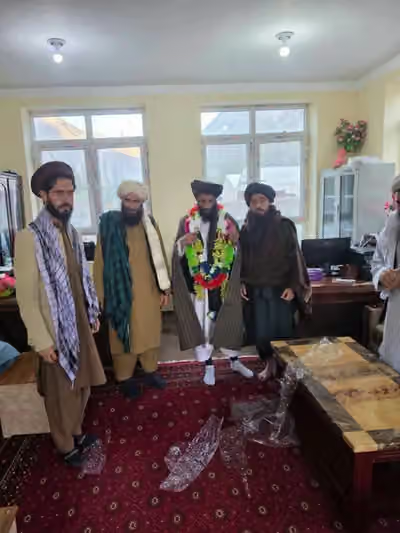
The Taliban say the United States’ decision to place Afghanistan on its list of hostage-taking countries is an excuse to justify possible future actions against the group.
Zabihullah Mujahid, the Taliban’s spokesperson, said in an interview that the issue of American detainees in Afghanistan was neither complex nor serious. He said they would be released either through judicial processes or through dialogue between the two sides.
The Taliban spokesperson stressed that only two US citizens were being held by the group and rejected claims that Mahmood Shah Habibi was in Taliban custody.
The United States has said that three of its citizens, including Afghan-American Mahmood Shah Habibi, are being detained by the Taliban.
The US State Department recently placed Taliban-controlled Afghanistan on its list of wrongful detention countries. The US secretary of state said the Taliban use American citizens as a political tool.
Speaking to TOLOnews on Thursday, Mujahid rejected the allegation and said the Taliban had not used the detention of American citizens for political purposes.
“We have not carried out unlawful detentions. American citizens have been detained for violating Afghanistan’s laws,” he said.
Mujahid also said pressure and threats were not a solution to the issue.
He again stressed that the matter was neither serious nor unsolvable but said Washington’s decision to place Afghanistan on the wrongful detention list and to highlight the issue of detainees was “an excuse for certain future scenarios”.
Mujahid did not specify what he meant by these scenarios. However, some observers believe the United States may act against the Taliban.
Adam Boehler, the US president’s envoy for hostage affairs, warned that if the Taliban did not release the detained Americans, they could face the fate of Iran, which he said is under heavy US air strikes.
Mujahid also said US policy towards the Taliban resembled the wartime approach, and that this was evident not only in the detainee issue but also in sanctions, blacklists and what he described as “the use of Pakistani generals to destabilise the region”.
No collapse of the Islamic Republic
In another part of the interview, the Taliban spokesperson referred to regional developments and said that “the Iranian regime will not collapse”.
He said Iran had faced many similar experiences in the past and possessed a strong military.
Mujahid stressed that the Taliban would not intervene in the conflict between the United States and Israel and Iran, but said the group was concerned about the continuation of the fighting. “We are affected by this war. War is not the solution, and it has no winner,” he said.
At the height of tensions with Iran, the United States has increased pressure on the Taliban. President Donald Trump, the US secretaries of state and defence, the US ambassador to the United Nations and American senators have repeatedly spoken about the withdrawal from Afghanistan and what they describe as the abandonment of Bagram air base.
The US ambassador to the United Nations said yesterday that if the Bagram base had remained in US hands, it could have been used to launch attacks on Iran.
The Taliban Ministry of Defence said it launched attacks early Friday on Pakistani military facilities in Khyber Pakhtunkhwa in response to new Pakistani strikes.
Enayatullah Khwarazmi, the ministry’s spokesperson, posted a video of a drone flight on X and said the Kohat military fort had been targeted.
He claimed that Taliban air force strikes destroyed military facilities, the command center, warehouses and troop accommodation at the fort, causing heavy casualties and significant material damage.
Pakistani officials have not yet commented on the Taliban’s claim.
Earlier, Taliban spokesperson Zabihullah Mujahid said the Pakistani army had again bombed areas in Kabul, Kandahar, Paktia and Paktika.
Sources told Afghanistan International that the European Parliament and the Belgian Senate are set to host several political and armed groups opposed to the Taliban on March 16 and 17.
According to the sources, the meetings would mark the first public engagement by European institutions with Taliban opponents to discuss the crisis in Afghanistan.
The sources said previous international meetings had largely focused on humanitarian aid, women’s rights and refugee issues. This time, however, the discussions are expected to shift toward political opposition and armed resistance against the Taliban.
In recent years, the European Union has emphasised engagement with the Taliban while avoiding official and public contact with opposition groups.
Belgium has previously hosted meetings on Afghanistan.
The European External Action Service held a senior officials’ meeting in Brussels on June 2025, to discuss Afghanistan’s political and humanitarian situation and the country’s basic needs.
The European Parliament also held public sessions in 2022 on Afghan women’s rights and hosted an event titled “Afghan Women’s Days”.
The European Union pursues what it describes as a policy of “limited and pragmatic engagement” with the Taliban. However, it does not recognise the group or grant it political legitimacy.
European officials have said such engagement is aimed primarily at addressing the situation in Afghanistan, delivering aid to the population and addressing security concerns.
At the same time, the European Union has repeatedly called for the formation of an inclusive political system, respect for human rights, counterterrorism efforts and protection of the rights of women and girls in Afghanistan.
European institutions have also repeatedly condemned Taliban restrictions on women and girls and called for those measures to be lifted.
The UN Special Trust Fund for Afghanistan (UNSTFA) says it has supported nearly four million Afghan women and girls during more than four years of Taliban rule, backing projects aimed at empowering women across the country.
In a statement on Thursday, March 12, UNSTFA said it had supported women with initiatives designed to bring change to their communities since the Taliban takeover. The fund said it values women’s participation in sustainable development.
Anwar-ul-Haq Ahady, a member of the Afghanistan Special Fund in Switzerland, told Afghanistan International in October that the fund had generated more than $500 million in returns so far. He said the funds’ assets, which previously stood at $3.5 billion, had risen to about $4.02 billion.
The fund had earlier said it assisted about one million people in Afghanistan in 2025, half of them women.
The United States transferred $3.5 billion of Afghanistan’s central bank assets to a trust fund in Switzerland to help support the Afghan economy.
India has rejected Pakistan’s claim that New Delhi played a role in escalating clashes between the Taliban and Pakistan, calling the allegation baseless.
Indian foreign ministry spokesman Randhir Jaiswal said at a press briefing on Thursday, March 12, that Pakistan’s record of supporting terrorism undermines its credibility.
He added that such accusations were unfounded and said it had become a habit for Pakistan to blame India for its own mistakes.
Jaiswal said Pakistan’s narrative does not change the facts and that attempts to portray itself as a victim would not deceive anyone.
Pakistan and the Taliban launched attacks against each other in February. The exchanges have caused casualties among Taliban and Pakistani forces as well as civilians.
Pakistan’s defence minister Khawaja Asif has accused the Taliban of harboring militants.
India had earlier condemned the attacks and expressed support for the Taliban.
Pakistan’s military has repeatedly accused New Delhi of backing militants operating in Afghanistan.