• العربية
  • پښتو
  • فارسی
Brand
  • Afghanistan
  • Sport
  • Markets
  • Afghanistan
  • Sport
  • Markets
  • Theme
  • Language
    • العربية
    • پښتو
    • فارسی
  • Afghanistan
  • Sport
  • Markets
All rights reserved for Volant Media UK Limited
volant media logo

Former Afghan Officer, Tribal Elder Killed In Separate Attacks

Jul 18, 2026, 16:40 GMT+1

Local sources told Afghanistan International that a former intelligence officer was killed in Daikundi and a tribal elder was murdered in Ghazni’s Qarabagh district in separate incidents.

According to the sources, Mohammad Ali Tofan, a former security forces member, was killed by unidentified gunmen on Thursday evening.

The body of Qadir Ali Rafat, a tribal elder in Ghazni, was also found after he had been missing for 24 hours. Sources said his body showed signs of torture and injuries.

Local residents said Tofan had no personal dispute with anyone. After the fall of the former government, he remained in Afghanistan, trusting Taliban’s declaration of a general amnesty.

According to available information, Taliban intelligence detained him about two years ago on suspicion of cooperating with the National Resistance Front.

He spent time in Pul-e-Charkhi prison in Kabul and Bagram prison in Parwan. He was released about five months ago, returned to Shahristan district in Daikundi and worked in farming and agriculture.

He had six children, the eldest of whom is a 27-year-old son.

In a separate incident, local sources in Ghazni said Rafat, a tribal elder from Qarabagh district, left his home by motorcycle on Thursday morning, July 16, heading towards the Aliabad Tamaki market and then disappeared.

According to the sources, local residents found his body after searching for him for 24 hours.

The attackers reportedly tortured him before killing him.

The motives and perpetrators behind the two killings remain unknown. The Taliban have not commented on the two incidents.

Most Viewed

ISIS-K Wants Afghanistan As Base For Regional Expansion, Says Russian FM
1

ISIS-K Wants Afghanistan As Base For Regional Expansion, Says Russian FM

2

Sun, Simurgh & Lapis Mountains Shape Sepahiyan-e Mihan Emblem

3

Taliban Police Academy Remains Closed Four Months After Winter Break

4

Former Afghan Officer, Tribal Elder Killed In Separate Attacks

•
•
•

More Stories

Taliban Police Academy Remains Closed Four Months After Winter Break

Jul 18, 2026, 14:56 GMT+1
100%

Students at the Taliban-run Police Academy in Kabul say classes have not resumed nearly four months after the winter break, with no explanation given for the delay.

They say some students have lost hope in their career prospects and have chosen to migrate.

Akram, a pseudonym for a second-year student at the academy, told Afghanistan International that students began their winter holiday in late December 2025. When they returned on March 6, 2026, they were told the academy would remain closed “until further notice”.

He said no one was willing to explain why the academy was closed.

Mansour, another student, said classes were expected to begin on March 6, but students were denied entry when they returned.

He said some of his classmates had travelled through illegal routes to Iran and Turkiye in recent months because of uncertainty over their education and employment prospects.

Mansour added that Police Academy students received about 1,500 afghanis a month during their studies and had hoped to secure jobs after graduation. However, that hope has now faded for some of them.

Another student, who asked to be identified by the pseudonym Wayand, cited budget shortages and difficulties in meeting students’ needs as possible reasons for the suspension of classes.

However, a Taliban Interior Ministry official told Afghanistan International that the academy had not “officially closed” and that no decision had been made to end its activities.

The official, who is close to Taliban Interior Minister Sirajuddin Haqqani, confirmed the delay in reopening the academy and said classes had not started because of “certain reasons”, without providing further details.

Students have expressed concern that the prolonged suspension could harm professional police training.

The Police Academy is one of the main institutions responsible for training police officers.

During the former Afghan government, its curriculum included law, criminal investigations, crime prevention, management and policing skills.

The Taliban Interior Ministry last announced the graduation of about 900 young officers from the academy in the winter of 2025–26. Sirajuddin Haqqani attended the ceremony.

After the collapse of the former Afghan government in August 2021, the Police Academy, like many of the country’s security institutions, underwent major changes.

The Taliban have used the academy’s facilities to train their security forces, but its structure and curriculum have changed compared with the previous system.

In one of the latest changes, Taliban leader Hibatullah Akhundzada replaced the word “police” with “shurta”, an Arabic term for police.

Sun, Simurgh & Lapis Mountains Shape Sepahiyan-e Mihan Emblem

Jul 18, 2026, 12:14 GMT+1
100%

As reactions continue to the newly formed Sepahiyan-e Mihan Front’s attack in Badakhshan, the group’s logo has become a subject of debate on social media.

Some users say the symbols featured in the emblem reflect Afghanistan’s history, culture and geography, particularly those of Badakhshan, rather than an ideological identity.

The logo includes symbolic elements such as the Simurgh, the sun, the Hindu Kush mountains, lapis lazuli, a sword and a star. Social media users have described these images as references to the country’s historical and mythological identity.

The Hindu Kush mountains are seen as a symbol of the group’s geographical roots, while the sword and star may represent its military and defensive character.

Abdullah Khodadad, a former Afghan diplomat, wrote on X that some of the symbols used in the Patriotic Soldiers emblem include the golden star of Bactria, the sun of Khorasan and lapis lazuli.

He added that the emblem also features the Simurgh, the wise and high-flying bird of Khorasan mythology, as well as the Hindu Kush mountains and a dagger.

Karim Kohyar, a social media user, wrote that the symbols neither suggest ideological affiliation nor links to foreign powers, but instead are rooted in the history, culture, geography and identity of Afghanistan.

According to him, the imagery connects viewers with the country’s historical past, land and collective memory.

Discussion over the group’s visual identity comes as Friday morning’s attack by Patriotic Soldiers forces on Yaftali Sufla district remains under scrutiny.

Local sources and the Taliban have confirmed that the district administration building fell out of Taliban control for several hours, although the two sides have given differing accounts of the scale and outcome of the incident.

Sepahiyan-e Mihan says its fighters temporarily seized the district headquarters, took weapons, military equipment and government vehicles, and then withdrew.

The Taliban, however, said the attackers retreated after the assault and that a search operation was continuing to identify them.

Following the incident, the Taliban launched extensive house-to-house searches in Yaftali Sufla. Local sources said several residents, including civilians and some local Taliban members, were detained during the operation.

The Taliban also confirmed arrests in connection with the attack but did not provide details about the identities of those detained.

Meanwhile, Taliban army chief Fasihuddin Fitrat travelled to Badakhshan and took charge of operations against the front.

He claimed the Taliban had known about the planned attack in advance and had prevented the assailants from achieving their objectives.

Sepahiyan-e Mihan, however, said none of its members had been detained and that videos released by the Taliban did not show fighters affiliated with the group.

Yaftali Sufla is located near Faizabad, the capital of Badakhshan. Its temporary seizure by a newly formed armed front has become one of the province’s most significant recent security developments and remains the subject of political and military analysis.

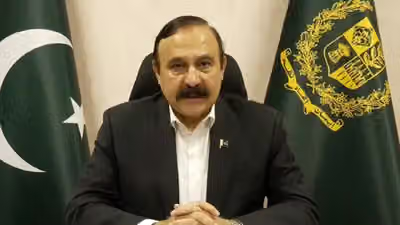
ISIS-K Wants Afghanistan As Base For Regional Expansion, Says Russian FM

Jul 18, 2026, 10:25 GMT+1
100%

Russian Foreign Minister Sergei Lavrov has warned that Islamic State Khorasan is the main threat to Central Asia, saying it seeks to use Afghanistan as a base for expansion and the creation of a caliphate.

In a message to a meeting on strengthening efforts to prevent terrorists from obtaining weapons in Central Asia, Lavrov stressed the cross-border nature of terrorist threats.

He said combating terrorism required unconditional unity and the rejection of double standards. He sharply criticised Western countries, saying international counterterrorism cooperation had become hostage to the destructive policies of certain Western states.

Lavrov also highlighted Moscow’s regional security efforts and reaffirmed Russia’s commitment to stability in Central Asia.

He said foreign ministers of the Collective Security Treaty Organization had approved a draft counterterrorism strategy through 2030 at a recent meeting in Kazan. The document is expected to be submitted to member-state leaders for final approval this autumn.

Lavrov added that Russia was among the 10 largest financial contributors to the UN Office of Counter-Terrorism and had provided $7 million to the office and its technical assistance programmes in Central Asia and Africa.

Taliban Response

Taliban spokesman Zabihullah Mujahid rejected Lavrov’s remarks about the presence and growing activity of Islamic State in Afghanistan.

Mujahid claimed the Taliban had contained the group’s activities and that it no longer had a physical presence in Afghanistan.

Speaking on Friday, 17 July to Taliban-controlled national television, he said Islamic State movements had been suppressed and that concerns among regional countries were unfounded.

He said the Taliban had full control over Afghanistan and assured neighbouring countries that no threat would emerge from Afghan territory.

The remarks come despite continuing Russian concerns about security threats from Afghanistan, even after Moscow recognised the Taliban and expanded diplomatic and economic relations with the group.

Russian officials have repeatedly warned about the possible movement of extremist groups and weapons from Afghanistan into Central Asian countries.

Russian President Vladimir Putin previously said Moscow could not remain indifferent to the security of Central Asian states because of threats originating from Afghan territory.

Alexander Bortnikov, head of Russia’s Federal Security Service, has also warned of increased activity by ISIS-K and its affiliates in Afghanistan.

Russian Defence Minister Andrei Belousov has said more than 20 radical groups with over 15,000 fighters are present in Afghanistan and could infiltrate neighbouring countries.

Al-Qaeda Remains In Afghanistan & Maintains Taliban Ties, Says UN Official

Jul 18, 2026, 09:03 GMT+1
100%

Alexandre Zouev, acting head of the UN Office of Counter-Terrorism, says al-Qaeda remains present in Afghanistan and maintains ties with Taliban officials.

In an interview with the Russian news agency TASS, the UN official said that although al-Qaeda had reduced its activities, it was still operating in Afghanistan and had complex relations with Taliban authorities.

He added that Afghanistan had traditionally been home to numerous extremist groups for decades.

Zouev’s assessment comes amid warnings from Russian Foreign Minister Sergei Lavrov.

Lavrov described Islamic State Khorasan as the main threat to Central Asia and said the group aimed to use Afghan territory as a base for establishing a caliphate.

Speaking at a meeting on preventing terrorists from obtaining weapons in Central Asia, he stressed the cross-border nature of the threats, an issue also highlighted by Zouev.

Despite expanding relations with the Taliban, Russia continues to raise security concerns that broadly align with Zouev’s assessment.

Russian President Vladimir Putin recently said Moscow was not indifferent to threats emerging from Afghanistan.

Amid concerns over security threats from Afghan territory, Asif Durrani, Pakistan’s former special representative for Afghanistan, said the Taliban administration would not be recognised or allowed to normalise relations with the international community as long as Afghan soil was used against neighbouring countries.

The former Pakistani envoy said the presence of armed groups, including the Pakistani Taliban, Islamic State Khorasan, the East Turkestan Islamic Movement, the Islamic Movement of Uzbekistan and the Balochistan Liberation Army, remained one of the main reasons for Afghanistan’s continued international isolation.

Taliban Deploys Army Chief To Lead Operation Against New Armed Group

Jul 17, 2026, 17:14 GMT+1
100%

Following an unprecedented attack in Badakhshan, the Taliban sent army chief Fasihuddin Fitrat to Yaftal to lead operations against the newly formed opposition group.

Fitrat travelled from Kabul to Yaftal district in Badakhshan and is leading operations against the armed attackers. He claimed that the assault had been foiled and that the attackers had failed to achieve their objectives.

The Taliban army chief said on Friday that the group had learned early that morning of a plan by armed attackers to target Yaftali Sufla district.

He said the Taliban had received information that the “enemy” planned to create unrest in Yaftal. Fitrat added that he had travelled from Kabul to Badakhshan after receiving the information and ordered Taliban forces to respond.

According to him, the Taliban prevented the attackers from reaching their objectives and disrupted their plan.

Fitrat described the attackers as corrupt and rioters and claimed that most of them had been detained. He told the media that the remaining individuals were being pursued.

However, he provided no evidence to support the claim.

Fitrat also insisted that the security situation in Badakhshan remained under Taliban control and said the group would confront any action by armed opponents.

The newly formed Sepahiyan-e Mihan (Patriotic Soldiers Front) claimed responsibility for Friday morning’s attack on Yaftali Sufla district and said its forces had controlled the district administration building for several hours.

Local sources confirmed that the district headquarters had temporarily fallen out of Taliban control.

Sources told Afghanistan International that the Taliban sent reinforcements from Faizabad to Yaftal after the attack and launched extensive house-to-house searches.

According to the sources, several local residents and some local Taliban members were detained during the operation.

Yaftali Sufla is located near Faizabad, the capital of Badakhshan province. The temporary seizure of its district centre by armed opponents poses a serious challenge to Taliban claims of having complete control over security in the province.

In recent years, most attacks by anti-Taliban groups in Badakhshan were concentrated in mountainous and border districts, particularly the Darwaz region.

However, the latest attack on Yaftali Sufla shows that opposition activity has expanded to the outskirts of the provincial capital, potentially indicating a shift in the pattern of armed operations in Badakhshan.