• العربية
  • پښتو
  • فارسی
Brand
  • Afghanistan
  • Sport
  • Markets
  • Afghanistan
  • Sport
  • Markets
  • Theme
  • Language
    • العربية
    • پښتو
    • فارسی
  • Afghanistan
  • Sport
  • Markets
All rights reserved for Volant Media UK Limited
volant media logo

Taliban Minister Requests Academic & Medical Support From Türkiye

Jul 29, 2026, 12:30 GMT+1

Neda Mohammad Nadeem, the Taliban’s higher education minister, has asked Türkiye to send university lecturers and specialist doctors to Afghanistan to provide teaching and practical training.

He made the request on Tuesday during a meeting with Sadin Ayyildiz, Türkiye’s ambassador to Kabul.

According to a statement from the Taliban’s Ministry of Higher Education, Nadeem also asked Türkiye to renovate two old buildings at Aliabad Teaching Hospital, which is affiliated with Kabul University of Medical Sciences, and help equip Afghanistan’s teaching hospitals.

The ministry said the Turkish ambassador expressed his country’s readiness to expand academic cooperation with Afghanistan. He said Turkish universities could establish academic ties with Afghan universities and sign cooperation agreements.

The statement did not say whether Türkiye had agreed to send lecturers and specialist doctors.

The request comes as Afghanistan’s universities and health institutions have faced shortages of lecturers, specialist doctors and academic staff since the Taliban returned to power.

Over the past five years, many university lecturers, doctors and specialists have left Afghanistan because of economic hardship, employment restrictions, political pressure and security concerns. Some lecturers have also been dismissed from universities or lost their jobs.

Critics say the Taliban has appointed people without academic experience, as well as clerics close to the group, to management and teaching positions at several universities. They argue that this policy, combined with the departure of qualified lecturers, has weakened the quality of education and research.

The Taliban has also banned girls and women from attending universities since late 2022. Besides depriving women of higher education, the ban has halted the work of female lecturers and the training of female doctors and specialists, worsening the shortage of qualified health workers.

Most Viewed

Taliban Warns Suicide Fighters Are Prepared To Defend Its Rule Amid Badakhshan Clashes
1

Taliban Warns Suicide Fighters Are Prepared To Defend Its Rule Amid Badakhshan Clashes

2

Head Of Taliban Information & Culture Killed In Badakhshan

3

Opposition Lacks Will & Ability To Fight, Says Taliban Culture Minister

4

Taliban Assaults Failed In Zebak of Badakhshan, Says AFF

5

Taliban Shuts Down Over 30 Ismaili Places Of Worship In Badakhshan

•
•
•

More Stories

Two Taliban Members Killed In Armed Attack In Sar-e-Pul, Say Sources

Jul 29, 2026, 11:17 GMT+1
100%

Local sources in Sar-e-Pul say two Taliban members, including an intelligence employee and a soldier from the group’s 209 Army Corps, were killed in an armed attack in the provincial capital.

The Taliban confirmed the shooting and the death of one person but did not identify the victim or acknowledge his affiliation with the group.

Information received by Afghanistan International indicates that the attack took place on Tuesday morning, 28 July, in the Mal Bazaar area of Sar-e-Pul city.

According to local sources, gunmen targeted a group of five Taliban members, killing two and wounding three others.

No individual or group has claimed responsibility for the attack.

Meanwhile, the Taliban governor’s office in Sar-e-Pul said its forces had detained two people in connection with the shooting.

In a statement, the Taliban confirmed that one person had been killed but did not disclose his identity. The group also claimed that the attackers were identified and arrested after fleeing the scene and said the motive was a “personal dispute”.

The Taliban’s Interior Ministry also confirmed the incident and said its forces had detained two suspects in connection with the killing.

The attack came a day after Zabihullah Amiri, the Taliban’s director of information and culture in Badakhshan, was killed by two motorcycle-borne gunmen while travelling to work.

Afghanistan Floods Trigger Widespread Humanitarian Crisis, Says WHO

Jul 29, 2026, 09:52 GMT+1
100%

The World Health Organisation says flash floods between 20 and 25 July caused widespread humanitarian damage across Afghanistan, severely affecting homes, public facilities and livelihoods.

According to the report, the floods affected the eastern provinces of Nuristan, Nangarhar and Laghman; the south-eastern provinces of Paktika, Paktia, Khost and Ghazni; and the central provinces of Kabul, Kapisa, Panjshir, Parwan, Logar and Maidan Wardak.

The most severe damage was reported in the eastern region, particularly in Parun, the capital of Nuristan province.

WHO figures show that at least 23 people were killed, five remained missing and 125 others were injured in the floods in Parun.

The organisation’s assessment found that the floods caused serious damage to homes, public facilities and sources of income in the area, increasing the urgent need for humanitarian assistance.

The report added that hundreds of families in Kabul and neighbouring provinces were affected, with significant damage to residential homes and community assets.

WHO said the floods caused widespread destruction in Mohammad Agha district of Logar, Ghorband district of Parwan and parts of Kabul.

Its assessment found that damage to roads and infrastructure had disrupted access to essential services, particularly healthcare.

According to the UN assessment, floods in the south-eastern region also caused deaths and destroyed homes and agricultural land.

UN figures show that at least 26 houses were destroyed and two people were killed in Paktika, while two children died in Paktia.

Extensive damage to farmland, roads and water-supply systems was also reported in Khost and Ghazni provinces.

WHO warned that the consequences of the floods extended beyond the immediate destruction and could have long-term effects on food security and family livelihoods, particularly among communities dependent on agriculture.

The report also said damage to drinking-water infrastructure had increased the risk of diseases caused by contaminated water.

WHO said it had activated its emergency coordination system in response to the crisis and, together with other aid agencies, had begun rapid needs assessments and the distribution of emergency supplies.

The organisation also expressed concern about severe shortages of healthcare resources in some areas, particularly Parun.

It said the limited capacity of health facilities, shortages of medicines, damage to treatment centres and difficulty reaching mountainous areas had created serious challenges for relief operations.

The report stressed the urgent need to strengthen health services, provide safe drinking water, establish temporary shelters for displaced families and increase disease surveillance.

The UN agency warned that continued rainfall could further worsen the humanitarian situation in the coming days.

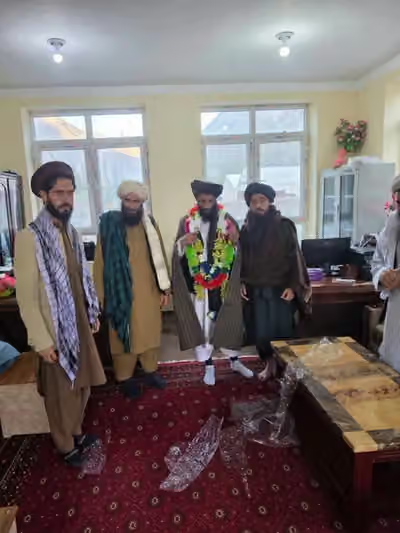
Taliban Launches Recruitment Drive Along Pakistan Border

Jul 29, 2026, 08:56 GMT+1
100%

Amid rising tensions and border clashes with Pakistan, the Taliban has begun recruiting soldiers in Kunar’s border districts. A spokesman said the programme is under way in six districts bordering Pakistan.

Wahidullah Mohammadi, spokesman for the Taliban’s 201 Khalid bin Walid Army Corps, said the registration and recruitment of 160 people had so far been completed in Nari, Dangam, Shultan and Marawara districts.

He said their documents had been sent to the Taliban’s central recruitment command for final processing.

Mohammadi said the programme was being carried out under the supervision of Dinar Khan Sediq Omar, the Taliban’s recruitment official in Kunar, and Firoz Khan Siraj, deputy for ethnic and tribal affairs at the First Border Brigade of the 201 Khalid bin Walid Army Corps.

The Taliban has provided no details about the total number of recruits required, the recruitment criteria or their possible assignments.

Taliban and Pakistani forces have clashed repeatedly in border areas in recent months.

The Taliban has not said whether the newly recruited soldiers will be deployed to reinforce its positions along the border.

Taliban Detained Nearly 400 In Three Months, Says UN

Jul 28, 2026, 17:07 GMT+1
100%

UNAMA says Taliban’s morality police arbitrarily detained 389 people in Afghanistan between 1 April and 30 June, while 65 others faced mistreatment by the ministry’s ombudsmen.

According to the UNAMA report, released on Tuesday, 28 July, Taliban officers detained Afghan citizens mainly for failing to follow the group’s dress code, trimming beards in a Western style, and playing or listening to music.

The report also referred to the detention of at least 30 women in Herat for failing to observe the Taliban’s required dress code.

The United Nations also said the killing of former Afghan security forces continued. It documented the killing of eight former Afghan soldiers over the past three months and recorded 29 cases of arbitrary arrest and detention between 1 April and 30 June this year.

The Taliban also carried out corporal punishments against dozens of citizens across Afghanistan during the same period. According to UNAMA, the Taliban administration publicly flogged at least 137 people, including 112 men and 25 women.

Taliban Restrictions On Journalists & Media Continue, Says UN

Jul 28, 2026, 15:13 GMT+1
100%

UNAMA says the Taliban continued restricting media freedom through journalist detentions, media suspensions and broadcasting limits, documenting measures against Radio Bamyan, Lawang Radio and Rah-e-Farda TV.

UNAMA’s quarterly report was released on Tuesday, 28 July.

In its section on media freedom, the report said the Taliban halted educational programmes broadcast by Lmar Radio in Khost province on 11 April, citing what it called a failure to comply with the approved curriculum.

According to the report, the Taliban’s General Directorate of Intelligence ordered Radio Bamyan to suspend operations on 17 May over allegations that it lacked a valid broadcasting licence. The station resumed operations six days later.

UNAMA also noted that Rah-e-Farda Television resumed broadcasting on 21 June after changes were made to its leadership.

The report said at least seven radio stations in Kunduz and Ghazni provinces were unable to continue operating because they could not meet financial obligations and other requirements for obtaining the necessary licences.

It also documented attempts by Taliban officials to seize mobile phones, cameras, computers and documents from a media office in Kabul, as well as the detention of three journalists in separate incidents.

According to UNAMA, two of the journalists were released after several days, while another was freed after being summoned and questioned.

UNAMA also reported restrictions on the use of smartphones by government employees.

Following the order, some local departments confiscated and destroyed employees’ personal phones and stopped posting information on social media platforms such as Facebook.