• العربية
  • پښتو
  • فارسی
Brand
  • Afghanistan
  • Sport
  • Analysis
  • Markets
  • Afghanistan
  • Sport
  • Analysis
  • Markets
  • Theme
  • Language
    • العربية
    • پښتو
    • فارسی
  • Afghanistan
  • Sport
  • Analysis
  • Markets
All rights reserved for Volant Media UK Limited
volant media logo

Taliban Seeks Kyrgyzstan’s Support At UN Security Council

Sep 15, 2026, 12:01 GMT+1

Taliban Foreign Minister Amir Khan Muttaqi spoke by phone with Kyrgyz Foreign Minister Jeenbek Kulubaev and asked Bishkek to support the Taliban at the UN Security Council. Kyrgyzstan will serve on the council in 2027–28.

The Taliban Foreign Ministry said on Tuesday, 15 September, that Muttaqi discussed expanding political, economic and trade relations with his Kyrgyz counterpart, as well as strengthening cooperation between the two countries.

The statement said the Taliban foreign minister expressed readiness to implement existing understandings and establish new areas of cooperation between the two sides.

The Taliban Foreign Ministry said Muttaqi described Kyrgyzstan’s election to the UN Security Council as an important achievement and stressed the importance of mutual cooperation and support between Afghanistan and Kyrgyzstan within this framework.

Kyrgyzstan’s Foreign Ministry also said the two ministers discussed trade, economic and investment cooperation.

Kyrgyzstan does not formally recognise the Taliban administration, but in 2024 it removed the group from its list of terrorist organisations. It maintains political and economic relations with the Taliban, and Kyrgyz delegations have visited Afghanistan.

Most Viewed

Taliban Denies Al-Qaeda Presence In Afghanistan
1

Taliban Denies Al-Qaeda Presence In Afghanistan

2

Muslim & Western Countries Want Girls’ Schools Reopened, Says Taliban FM

3

Former Senior Taliban Official ‘Detained’ In Kandahar, Say Sources

4

Taliban Detains At Least Eight Women In Northern Kabul, Say Sources

5

Former Taliban Official ‘Released’ A Day After Detention In Kandahar

•
•
•

More Stories

CSTO Holds Drills To Counter Militant Infiltration From Afghanistan

Sep 15, 2026, 08:56 GMT+1
100%

The Russia-led Collective Security Treaty Organisation has launched military exercises in south-eastern Kazakhstan, focusing on countering the possible infiltration of militant groups from Afghanistan into Central Asian countries.

According to The Times of Central Asia, the CSTO exercises began on 12 September and will continue until 19 September in the Koktal area of Kazakhstan’s Zhetysu region.

The organisation’s rapid reaction forces are training in mountainous and desert terrain to counter the infiltration of armed groups into border areas.

The exercises come as Russia and Tajikistan have again raised concerns about the activities of armed groups in Afghanistan.

Russian Defence Minister Andrei Belousov said on 8 September that Moscow was paying particular attention to strengthening security along the Tajikistan-Afghanistan border.

Following several attacks from Afghan territory late last year, Tajikistan called on other CSTO members to provide additional assistance to protect its border. Five Chinese citizens and two Tajik border guards were killed in attacks in late 2025.

In this context, CSTO Secretary-General Taalatbek Masadykov said on 28 August that the first shipment of equipment and weapons to strengthen the border would be sent to Tajikistan this autumn.

The Collective Security Treaty Organisation is a military and security alliance comprising Russia, Belarus, Kazakhstan, Kyrgyzstan, Tajikistan and Armenia. Tajikistan is the only CSTO member that shares a border with Afghanistan.

Despite growing engagement between Central Asian countries and the Taliban since the group returned to power in August 2021, the presence of armed groups in Afghanistan, particularly ISIS-Khorasan, remains a shared security concern for CSTO members.

According to UN estimates, around 15,000 to 20,000 fighters linked to roughly 20 armed groups are present in Afghanistan. Russia has estimated their number at up to 23,000.

The Times of Central Asia wrote that the Taliban was regarded as a serious threat to Central Asian countries in the late 1990s, but the current CSTO exercises are not directed against the group.

Russia has recognised the Taliban government, while even Tajikistan has gradually established channels of communication with the group.

CSTO members are now more focused on groups such as IS-Khorasan. The group claimed responsibility for the 22 March 2024 attack on Crocus City Hall near Moscow, which killed more than 140 people.

The infiltration of armed groups, drug trafficking and insecurity along Afghanistan’s borders remain among the CSTO’s main security concerns.

Muslim & Western Countries Want Girls’ Schools Reopened, Says Taliban FM

Sep 14, 2026, 13:43 GMT+1
100%

Taliban Foreign Minister Amir Khan Muttaqi says both the Muslim world and Western countries have urged the Taliban administration to reopen schools for girls, acknowledging that their continued closure is a problem.

Asked in an interview with senior BBC international correspondent Lyse Doucet whether the message from the international community was reaching Taliban leaders, Muttaqi said it was, and that all countries had called on the Taliban to allow Afghan girls to return to school.

However, he added that Afghanistan should not be viewed solely through a Western lens.

Muttaqi also acknowledged during the interview that the closure of girls’ schools remains a problem.

At the same time, the Taliban foreign minister said that the Western perspective should not be the standard by which Afghanistan is judged, stressing that not everything has been banned for women.

Five years after the Taliban returned to power in Afghanistan, the country’s human rights crisis has become increasingly structural and systematic.

While Taliban officials describe the closure of schools above sixth grade and universities to girls as temporary and until further notice, human rights activists and international organisations have described the policy as “gender apartheid” and the deliberate exclusion of more than half of society.

Taliban claims versus the human rights situation

In his interview with Lyse Doucet, Muttaqi claimed that around three million girls were still studying at primary schools and religious seminaries, while tens of thousands of women continued to work in healthcare, education and small businesses.

Citing these figures, he sought to argue that the international community was overlooking realities inside Afghanistan.

However, reports by the UN Human Rights Council and the UN special rapporteur on Afghanistan present a different picture.

Denial of education

More than 2.5 million girls have been deprived of their basic right to secondary and higher education.

Afghanistan remains the only country in the world where girls are barred from education beyond primary school.

Restrictions on employment and financial independence

The dismantling of independent institutions, restrictions on women working for the United Nations and non-governmental organisations, and the closure of businesses such as women’s beauty salons have severely damaged women’s financial independence.

International figures indicate that women’s formal employment has fallen below 10%.

Restrictions on freedom of movement

Successive orders imposing mandatory dress rules and banning travel without a male mahram have severely restricted women’s access to public spaces.

Systematic human rights violations and lack of accountability

Human rights concerns in Afghanistan under Taliban rule extend beyond restrictions on women.

Multiple reports by human rights organisations have documented arbitrary arrests, torture, retaliatory killings of former government security personnel, and severe repression of protesters and journalists.

Civil society activists say the central issue is not only the restrictions themselves, but also the absence of a transparent legal and judicial framework through which victims can seek justice.

Courts operate according to strict interpretations without meaningful accountability, while oversight bodies such as the Afghanistan Independent Human Rights Commission have been completely dissolved.

Women who have protested in the streets of Kabul and other cities have faced harsh responses, ranging from night-time arrests and forced confessions to psychological pressure on their families.

Critics say this approach shows that even the fundamental right to peaceful assembly and protest has effectively been denied.

Diplomatic deadlock and international response

The international community and the United Nations have repeatedly said that recognition of the Taliban government is directly linked to improvements in human rights and an end to the repression of women.

The Taliban, however, describes women’s rights as an internal matter connected to traditional and religious values.

UN experts argue that this justification is being used to disregard Afghanistan’s international obligations under human rights treaties.

The human rights crisis in Afghanistan has also deepened the country’s humanitarian and economic problems.

By excluding women from education and economic life, sustainable development has been severely undermined, while a new generation of girls is growing up without a clear prospect for the future.

What Taliban officials describe as a temporary suspension is viewed by human rights observers as a deliberate policy aimed at confining women to their homes and removing them from public life.

They warn that this approach poses profound challenges to Afghanistan’s international legitimacy and its social future.

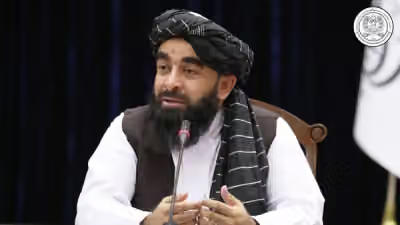
Former Senior Taliban Official ‘Detained’ In Kandahar, Say Sources

Sep 14, 2026, 10:26 GMT+1
100%

Informed sources told Afghanistan International on Sunday evening that Taliban Interior Ministry and intelligence forces had detained Mutasim Agha Jan, a former senior member of the group, after surrounding his religious school in Kandahar city.

According to the sources, Agha Jan was taken to Kandahar police headquarters following his arrest.

Sources said the school was surrounded after several people described as guests entered the premises. Their identities remain unclear, and it is not known whether they were Afghan citizens or foreign nationals.

Mutasim Agha Jan is a well-known former senior Taliban figure whose relations with the group’s leadership have been strained for years. After the Taliban returned to power, he came back to Afghanistan from Istanbul with the guarantee of Taliban defense minister, Yaqoob Mujahid.

This is not the first time the Taliban has detained Agha Jan. In 2022, Taliban intelligence forces raided his home in Kabul and confiscated some of his personal property.

The Taliban also detained Mutasim Agha Jan on 16 April this year before later releasing him.

The Taliban has not yet commented on the reason for the latest detention of its former senior member.

Who is Mutasim Agha Jan?

Mutasim Agha Jan was a long-standing and influential Taliban figure. During the Taliban’s first period in power, from 1996 to 2001, he served as the group’s finance minister and was considered close to its former leader, Mullah Mohammad Omar.

His name was added to the United Nations sanctions list in 2001.

After the fall of the Taliban government, Agha Jan remained within the group’s leadership structure and for a period headed the Taliban’s political committee.

Reports indicate that he remained an important political figure within the Taliban until around 2009, but gradually developed differences with parts of the leadership over the group’s strategy, particularly the issue of negotiations with the Afghan government.

Agha Jan was among former Taliban officials who openly supported a political settlement to end the war.

He called for the formation of an inclusive political system in Afghanistan and, in the years after 2010, took part in several initiatives and meetings related to peace negotiations.

These positions were opposed by sections of the Taliban, and the group’s leadership at times stressed that Agha Jan and his associates did not officially represent the Taliban in negotiations.

Mutasim Agha Jan was seriously wounded in an armed attack in Karachi, Pakistan, in 2010.

He later left Pakistan and lived for periods in Turkiye and Arab countries, while continuing efforts to promote talks with the Afghan government.

His support for negotiations and growing distance from the Taliban leadership’s official position eventually made him a distinct and somewhat marginal figure among the group’s former senior leaders.

Taliban Denies Al-Qaeda Presence In Afghanistan

Sep 14, 2026, 09:32 GMT+1
100%

Taliban spokesperson Zabihullah Mujahid on Sunday denied the presence of al-Qaeda in Afghanistan, rejecting a Washington Post report that cited Western security officials and a UN body as saying the group is active again in the country.

Mujahid described the report as propaganda against the Taliban and said there was no evidence proving the presence of foreign groups in Afghanistan.

He told domestic media that such claims were being made by what he described as biased and intelligence-linked circles seeking to fuel tensions and create scenarios of regional insecurity.

Mujahid has previously rejected UN Security Council reports about the presence of al-Qaeda in Afghanistan.

At the same time, Hamdullah Fitrat, the Taliban’s deputy spokesperson, also responded to the Washington Post report by denying to Taliban-affiliated media that foreign groups, including al-Qaeda, were present in Afghanistan.

He said groups that had operated in connection with past wars no longer needed to remain in Afghanistan because circumstances had changed. He also described claims about their activities as propaganda.

In a report published on 12 September, the Washington Post said al-Qaeda and its affiliates had established at least eight training centres in Afghanistan since the Taliban returned to power.

The report said Islamist groups, including ISIS-Khorasan, had also opened new training facilities and that armed groups were present in at least 14 provinces across Afghanistan.

According to the newspaper, the new al-Qaeda centres provide training in the use of weapons, explosives and guerrilla warfare tactics, while there are also signs of instruction in encryption, artificial intelligence, drones and other emerging technologies.

A member of the UN monitoring team also estimated that al-Qaeda had around 100 core members in Afghanistan.

A UN Security Council report also said cooperation between al-Qaeda, the Taliban and Tehreek-e-Taliban Pakistan had increased, and that training camps run by the groups in Afghanistan were focused on training local fighters and TTP members.

The report also said al-Qaeda continued to operate covertly in Afghanistan and that commanders from the network were travelling into the country.

According to the Security Council report, al-Qaeda members in Kunar province had been involved in training TTP members in suicide bombing techniques, while the network also served as an adviser and trainer for allied armed groups.

The Taliban has consistently rejected UN reports about al-Qaeda’s presence and activities in Afghanistan. However, Security Council reports in recent years have said ties between the Taliban and al-Qaeda remain intact, that the network operates training centres in the country and that it cooperates with regional armed groups.

Attacks From Afghanistan Have Killed 4,700 People, Says Pakistan Envoy

Sep 12, 2026, 15:19 GMT+1
100%

Pakistan’s UN representative has expressed deep concern over what he called growing terrorist activity from Afghan territory, saying more than 4,700 Pakistanis have been killed in such attacks over the past three years.

Asim Iftikhar Ahmad, Pakistan’s representative to the United Nations, told a Security Council meeting on Friday, 11 September, marking the 25th anniversary of the September 11 attacks that Tehreek-e-Taliban Pakistan, the Balochistan Liberation Army and its Majeed Brigade continued to operate from safe havens in Afghanistan with significant foreign support.

He said the groups had carried out some of the most brutal terrorist attacks against Pakistan.

Pakistan’s representative also criticised the absence of restrictive measures and UN Security Council sanctions against the Balochistan Liberation Army, saying the group was operating freely.

According to Ahmad, Pakistan’s efforts to have the Balochistan Liberation Army added to the Security Council sanctions list have so far been unsuccessful.

He stressed that other groups, including the East Turkestan Islamic Movement and ISIS, must also be effectively contained.

The Pakistani representative described the terrorist threat in Afghanistan, alongside threats in Africa and the Middle East, as a serious concern in the global fight against terrorism.

In recent years, Pakistan has repeatedly accused the Taliban administration of allowing Tehreek-e-Taliban Pakistan to operate from Afghan territory and has urged Kabul to act against the group.

Islamabad also considers the Balochistan Liberation Army one of its main security threats and alleges that its members also operate from Afghanistan against Pakistan.

The Taliban administration has rejected the accusations, saying it does not allow any group to use Afghan territory against other countries.

The Taliban has also repeatedly said that insecurity in Pakistan is the country’s internal matter and that Islamabad should address its security problems inside Pakistan.

Security tensions between Pakistan and the Taliban administration have increased in recent months.

Pakistan has justified military strikes and operations along the Afghan border as action against armed groups based in Afghanistan, while the Taliban has described the attacks as violations of Afghanistan’s sovereignty.